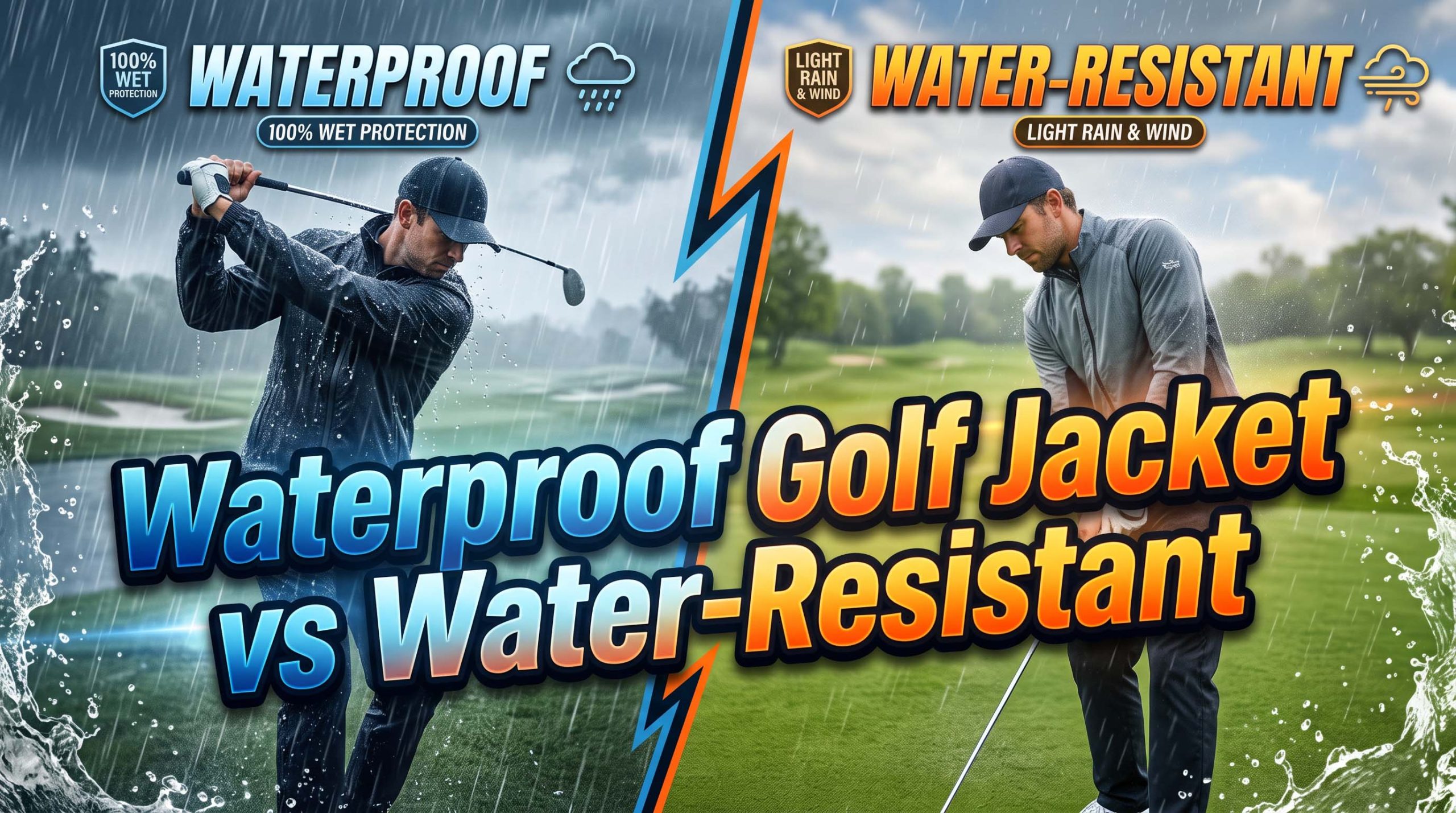
A waterproof golf jacket and a water-resistant one are not two grades of the same thing. A water-resistant jacket relies on a surface finish that makes light rain bead and roll off for a while. A waterproof golf jacket adds a barrier layer (a membrane or coating) plus sealed seams, so water cannot get through the fabric or the stitch holes. If the label says "resistant" and you expect steady October rain, plan on being damp by the turn. If you mostly dodge showers, resistant may be all you need.
That is the whole answer. The rest of this page is about reading a label well enough to know which one you are holding, because the wording on hangtags is loose and the difference only shows up when it is raining.
What "water-resistant" actually promises
Almost every golf jacket sold today has a water-repellent finish on the outside, usually called DWR (durable water repellent). It is the reason fresh fabric makes rain bead into little balls. That finish is real and useful, but it is a surface treatment, not a wall. Sunice, a golf outerwear maker, puts it plainly in its own explainer on this exact question (read 2026-09-25): DWR "is not the same thing as waterproof construction."
A water-resistant jacket is typically a tightly woven shell with that finish and not much else. It handles a drizzle, a passing shower, and a wet towel on your shoulder. What it does not have is anything to stop water once the finish is overwhelmed, and it usually has ordinary stitched seams, which are rows of small holes.
Resistant is not a bad buy. It is lighter, it packs smaller, and it breathes better, which matters on a humid afternoon. It is just the wrong buy if you expect to stand in rain for four hours.
What a waterproof golf jacket has to include
Three things separate a genuinely waterproof golf jacket from a resistant one, and you can check all three before you pay.
1. A barrier layer. A membrane laminated to the fabric, or a coating on its inner face. This is the part that actually stops water. Makers name it on the tag or the product page. If no membrane or coating is named anywhere, assume there isn't one.
2. Sealed or taped seams. Every stitch is a hole. On a waterproof jacket, tape is bonded over the inside of the seams so the holes are closed. Turn the jacket inside out: taped seams show a flat strip running along every seam line. Sunice's explainer says true waterproof performance needs "sealed or taped seams" and protected zippers, not just good fabric. If only some seams are taped, or the listing says "critically taped," the jacket is sealed in the main spots and not everywhere.
3. Protected openings. Water finds the zipper, the cuffs and the collar. Look for a storm flap over the main zip or a coated zipper, adjustable cuffs, and a collar that closes high.
A jacket that meets all three is waterproof by construction. A jacket that meets only the first is water-resistant with a better fabric.
The number on the tag: what "10,000 mm" measures
Many waterproof jackets list a rating in millimeters. That number comes from a hydrostatic pressure test, often called "hydrohead." The American textile standard for it, AATCC TM127 (read 2026-09-25), "measures the resistance of a fabric to the penetration of water under hydrostatic pressure." In plain terms, a sample of fabric is clamped under a column of water, the pressure rises steadily, and the test stops when water shows through the other side in three places. A higher number means the fabric held out against more pressure.
Here is the catch that most buying guides skip. That test is run on a flat swatch of fabric, not on a finished jacket. The AATCC page itself notes that results "may differ" from its separate tests for rain and water spray. So the millimeter rating tells you about the fabric and says nothing about the seams, the zipper, or how the jacket has aged. A high-rated fabric sewn into a jacket with untaped seams will still leak at the seams.
For scale, Sunice's own page (read 2026-09-25) lists its Zephal Elite line at 15,000 mm and its Zephal Elite Max at up to 30,000 mm. Those are the maker's figures for its own fabric, not an independent test, and a rating from one brand is not always measured the same way as another brand's. Use the number to compare jackets within one maker's range, and use the seams and the construction to judge the jacket as a whole.
Label words, decoded
This is the table to have open on your phone in the shop.
| Label wording | What it usually means | Check before buying |
|---|---|---|
| Water-repellent / DWR | Surface finish only | Expect it to wet out in steady rain |
| Water-resistant | Finish, maybe a tighter weave, no sealed seams | Fine for showers, not a full wet round |
| Waterproof fabric | Barrier layer in the fabric | Are the seams taped? Often not |
| Critically taped / critically sealed | Main seams taped, others not | Shoulders and hood usually covered, check the rest |
| Fully taped / fully seam-sealed | Barrier layer plus every seam sealed | This is the waterproof jacket |
| Waterproof with a written guarantee | The maker stands behind the claim | Read what voids it (see below) |
When a listing mixes these words, go by the weakest claim that is stated clearly. "Waterproof, breathable, water-resistant zips" is a waterproof jacket with ordinary zips.
Why a good waterproof jacket can still feel wet inside
Plenty of golfers return a waterproof jacket that never leaked. There are two usual causes, and neither is a leak.
The outside has "wetted out." When the DWR finish wears off, the outer fabric soaks up water instead of shedding it. The membrane is still stopping the rain, but the jacket feels cold and clammy. GORE-TEX says this directly in its own care FAQ (read 2026-09-25): a saturated outer fabric can make a garment "feel damp and clammy, even if it's not leaking."
Your own sweat. Walking 18 holes and swinging produces moisture. A membrane lets some of it escape, but on a warm, wet day it cannot move all of it, so it condenses on the inside. That feels identical to a leak. Opening vents and the front zip between shots helps more than buying a pricier fabric.
Before you decide a jacket leaks, check where the wet patch is. Damp everywhere, especially the back and underarms, points to sweat. A wet line along a seam or a wet cuff points to a real entry point.
The golf-specific way to ruin a waterproof jacket: the club logo
This one does not show up in general rain-gear guides, and it matters on golf courses more than anywhere else. Pro shops and clubs love to embroider a logo on the chest of a rain jacket. Embroidery is hundreds of needle holes punched through the membrane.
The GORE-TEX FAQ (read 2026-09-25) states that "any form of alteration to your GORE-TEX garment can compromise the waterproofness of your product," and that logo embroidery needs seam sealing done at an authorized facility. Its guarantee (the black diamond "GUARANTEED TO KEEP YOU DRY" hangtag) covers only products that carry that tag, for the original owner of a new purchase. If you are buying a jacket for a club team or a member-guest, ask whether the embroidery is sealed behind, or buy the logo on a cap instead.
The same logic applies to any waterproof jacket, whatever the membrane brand: a hole you add yourself is a hole the maker did not seal, and most waterproof warranties exclude damage and alterations. Read the warranty terms on the maker's own site before you add anything.
Caring for it so "waterproof" lasts more than one season
Most waterproof jackets that "stop working" have a tired finish, not a failed membrane, and that is fixable. The GORE-TEX FAQ gives a routine that matches what most makers print on their care labels:
- Wash in warm water, 105°F (40°C), with a small amount of liquid detergent.
- Skip powder detergent, fabric softener and bleach.
- Tumble dry for 20 minutes afterward to reactivate the water-repellent finish.
- If water still does not bead, apply a spray-on or wash-in DWR product.
Gore also notes that its Shakedry garments should not be tumble dried, which is the reason to read your own jacket's label rather than assuming. Dirt, sunscreen and body oils break down the finish faster, so a jacket stuffed wet into a bag pocket all summer will need this sooner. Storing it clean and dry over winter matters for the same reason it does for clubs, which we cover in putting golf away for winter.
Which one to buy, by how you actually play
Skip the marketing and match the jacket to your weather.
- You play fair-weather golf and cancel when rain is forecast. A water-resistant windshirt or pullover covers the surprise shower and keeps wind off. Don't pay for sealed seams you won't use.
- You play a fixed tee time or a league night, rain or not. Buy a fully seam-sealed waterproof golf jacket. Add a waterproof pant only if you often walk in steady rain.
- You play into late fall. Waterproof shell, sized to go over a thin mid layer, with cuffs that don't catch the grip at the top of the swing.
- You are on a tight budget. A plain, fully taped waterproof shell from last season beats a newer water-resistant jacket with a better logo. The same "pay for the part that works" logic runs through how to buy golf clubs without wasting money.
Whatever you buy, take a full practice swing in the store with the jacket zipped. Waterproof fabrics are stiffer than resistant ones, and a shell that binds across the shoulders is one you will take off on the second hole.
Rain rarely comes alone. If your round involves fog or low light too, your gear has other limits worth knowing, and how a golf rangefinder behaves in rain, fog and low light covers the device side of a wet day.
What nobody selling the jacket will tell you
No jacket stays waterproof forever without care, and no jacket is fully comfortable in warm rain. The millimeter number is a fabric test, not a promise about the finished garment. And the single most reliable sign of a waterproof golf jacket is not the price or the brand; it is a taped seam you can see with your own eyes when you turn it inside out.
FAQ
Is a water-resistant golf jacket enough for rain?
For short showers, usually yes. For steady rain across a full round, no. Water-resistant jackets rely on a surface finish and ordinary seams, so water eventually gets through once the finish is overwhelmed.
What waterproof rating should a golf jacket have?
There is no single number that guarantees you stay dry, because the millimeter rating is a fabric test that ignores seams and zippers. Compare ratings within one maker's range, and make sure the jacket is fully seam-sealed before trusting any number.
Why does my waterproof golf jacket feel wet inside?
Usually the outer water-repellent finish has worn off, so the outside fabric soaks up water and feels clammy, or your own sweat is condensing on the inside. Washing and reactivating the finish, and venting while you walk, fixes most cases.
Can I get a logo embroidered on a waterproof jacket?
You can, but embroidery punches holes through the waterproof layer. GORE-TEX says alterations can compromise waterproofness and that logo embroidery needs sealing at an authorized facility. Ask how the embroidery is sealed before you order.
How do I restore the water beading on my rain jacket?
Wash it as the care label directs, then tumble dry if the label allows, since heat reactivates many DWR finishes. If water still soaks in rather than beading, apply a spray-on or wash-in DWR treatment.