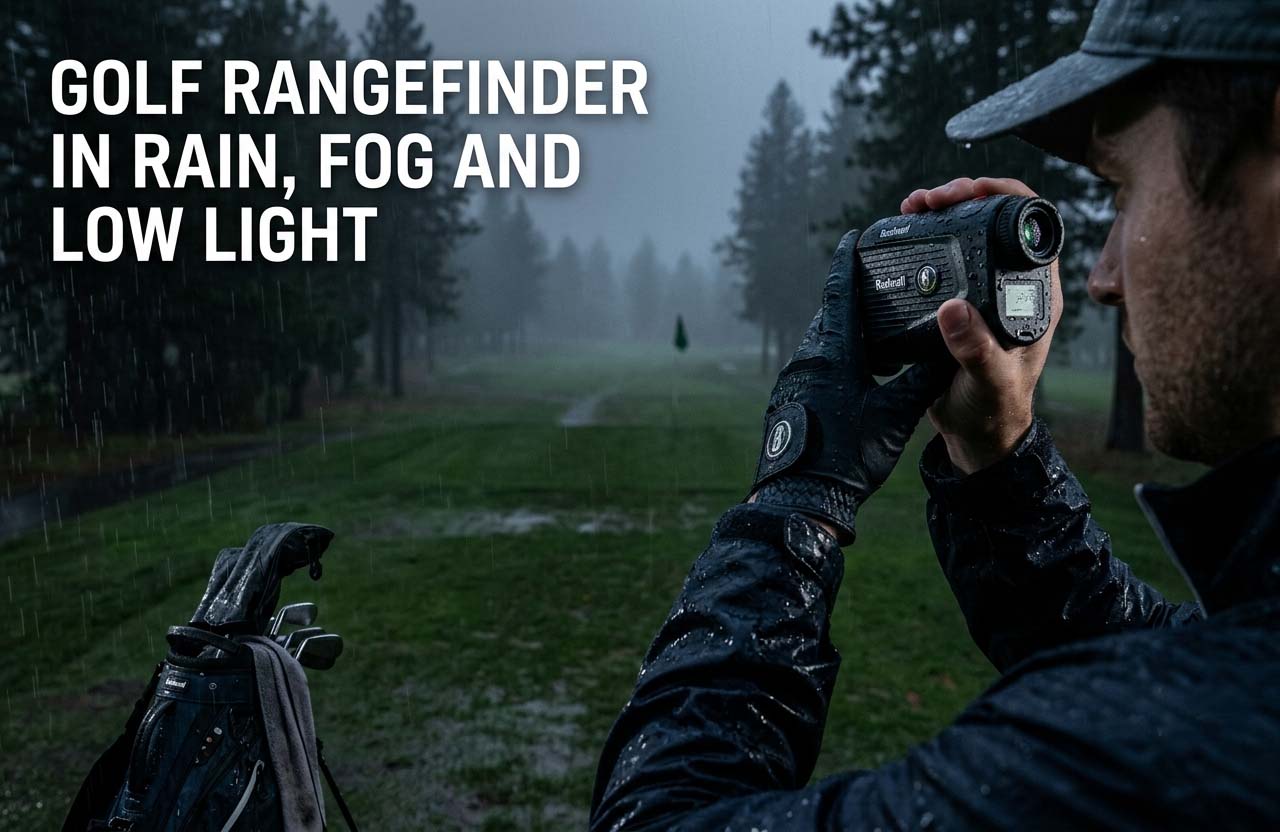
A laser rangefinder measures distance by firing a beam of light at a target and timing how long it takes to bounce back. Weather does not break that mechanism, it interferes with it: fog and rain scatter or absorb the beam before a clean signal returns, and low light is a separate problem that affects how well you can see and aim at the target in the first place. The practical result is the same either way, a slow lock, no reading, or a number you do not trust, but the fix is different depending on which of the three is actually happening.
Why fog scatters the beam
Fog is water and ice crystals suspended in the air, and when a laser beam passes through it, some of that light bounces off the droplets instead of continuing to the target. The device is not receiving a clean echo back from the flag; it is receiving a weaker, more dispersed signal, some of which returned early from the fog itself rather than from what you aimed at. Leupold's own troubleshooting guidance for its laser rangefinders states plainly that "lighting, fog, and rain all may reduce the effective max range of your rangefinder." Light haze usually costs you little. Genuinely dense fog can prevent a lock entirely, and no golf rangefinder, regardless of price, is immune to that once visibility itself drops low enough.
Why rain does something related but distinct
Rain introduces the same basic problem, scattering, but through falling droplets rather than suspended mist, and it adds a second failure mode: the beam can bounce off a raindrop that happens to be in its path and return a distance shorter than the actual target. A rangefinder that suddenly reports a number far shorter than the yardage you expect in the rain is a plausible sign of exactly this, not necessarily a broken unit. Heavy, sustained rain reduces effective range the same way dense fog does; light rain is usually a minor nuisance rather than a functional block.
Low light is a different problem from weather
Low light, at dusk or under heavy overcast, does not scatter the laser beam the way fog and rain do. What it affects is your ability to see the target clearly enough through the eyepiece to aim precisely at it, and in some conditions, bright light from beyond the target can also reduce the effective range or shorten the displayed reading. This is worth separating from the weather problem above because the fix is different: a weather problem is about the beam's path, a low-light problem is about your aim. Devices with better optics and larger objective lenses generally perform better in dim conditions, since more available light reaches your eye, but this is a lens-quality question, not a laser-strength one.
What an IPX rating actually promises, and what it doesn't
"Water resistant" on a spec sheet usually points to an IPX rating under the IEC 60529 standard, and the number matters more than the word. IPX4 means the device is protected against splashing water from any direction under a defined 10-minute test; it covers rain and incidental splash, not sustained exposure. IPX6 means the device withstood powerful water jets, a meaningfully higher bar than splash resistance. IPX7 means the device can survive being fully submerged in up to one meter of water for 30 minutes. These ratings are not cumulative or automatically inclusive of each other, a device rated IPX7 was tested for submersion, not necessarily for the powerful-jet conditions IPX6 tests for, even though in practice a submersion-rated device usually tolerates less demanding exposure too. None of this describes how well the device performs optically in fog or rain; a highly water-resistant rangefinder can still struggle to get a lock in dense fog, because water resistance and beam performance in poor visibility are two separate engineering questions answered by two different specs.
What actually helps in the moment
A few habits reduce, though do not eliminate, weather-related misreads. Wipe the objective lens and the laser aperture dry before ranging; a wet or fogged lens surface adds its own scatter on top of whatever the air is already doing. Take two or three readings instead of trusting a single number, since a false short reading from a stray raindrop or a weak return from mist tends not to repeat consistently across attempts. Aim at the most reflective part of the target available, a metal flagstick pole rather than the flag fabric itself, since a stronger natural return signal has more margin to survive scatter along the way. None of these fully restore performance in genuinely bad conditions, they just improve your odds within whatever margin the weather leaves you.
When it isn't the weather at all
A rangefinder that consistently reads background objects instead of the flag, in clear conditions, is very likely a target-lock problem rather than a weather problem, and that is a distinct issue with its own causes and fixes. See /golf-rangefinder-not-locking-on-flag/ if the device is missing the flag on clear days too, not just in poor weather.
FAQ
Does rain damage a golf rangefinder?
Rain itself typically does not damage a rangefinder built to a reasonable IPX rating, though the manufacturer's specific rating determines what level of exposure is actually covered. What rain does reliably do is interfere with the laser's return signal, which is a performance issue during use rather than a damage issue afterward.
Will fog make my rangefinder give a wrong number, or just no number?
Both are possible. Light fog may return a number that is slightly less reliable due to beam scatter; dense fog is more likely to prevent a lock entirely, since not enough of a clean signal makes it back to the sensor.
Is a higher water-resistance rating the same as better performance in fog?
No. Water resistance describes how well the device's housing tolerates moisture exposure; it says nothing about how the laser performs when passing through fog or rain in the air. A device can be well sealed against water and still struggle with a lock in dense fog, because those are different specifications answering different questions.
Do budget rangefinders perform worse in bad weather than premium ones?
Optics quality and laser strength both affect performance in reduced visibility, and these tend to improve with build quality generally, but the relationship is not strictly tied to price. See /cheap-golf-rangefinder-worth-it/ for a fuller look at what a budget device actually gives up.
Should I stop trying to get a reading in a genuine downpour?
If repeated attempts are not returning a consistent number, that is the device telling you the conditions have exceeded what it can reliably measure. Estimating from a known reference point, or simply accepting a rough distance for that shot, is a reasonable fallback rather than continuing to force readings that are not converging.
For the fuller framework on what specs to weigh before buying, including water-resistance ratings, see /golf-rangefinder-buying-guide/. For how accuracy claims are measured under stated test conditions more broadly, see /golf-rangefinder-accuracy-explained/. For how cold and wet weather affects battery performance in the same season, see /golf-rangefinder-battery-life/.