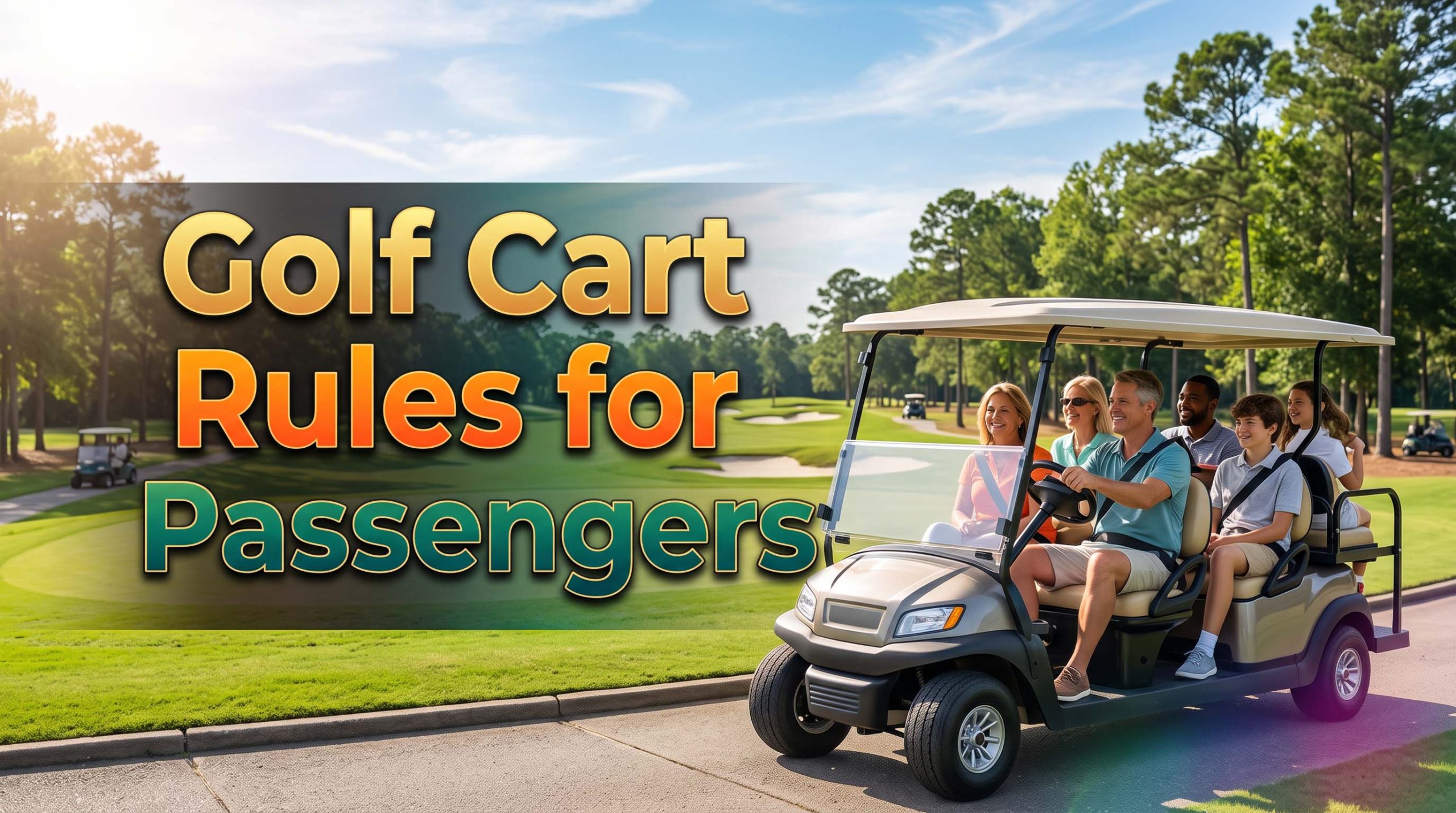
Golf cart rules for passengers and children do not come from one national law. They come from three layers. The manufacturer sets the first: E-Z-GO's owner's manual for its Valor golf car says every passenger must be at least 59 inches (150 cm) tall and able to sit with their back against the seat and both feet on the floor. The course sets the second through its own cart policy. State and local law sets the third, mainly for carts on public roads, and it differs sharply from place to place. Injury researchers have gone further, recommending that children under 6 not ride in golf carts at all.
So the honest answer to "Can my kid ride along?" is: check the cart's manual, ask the course, and check your state and town rules if the cart will touch a public road. This page explains what each layer says and why children are the riders most likely to be hurt.
Golf Cart Rules for Passengers: Children and the Three Layers
It helps to separate the three sources, because people often assume one of them covers everything.
| Layer | Who sets it | What it usually covers |
|---|---|---|
| Manufacturer | The cart maker's owner's manual and dash labels | Passenger height, seating capacity, where passengers may sit, holding on, driver licensing |
| Course or community | The golf course, resort or residential community | Who may drive, minimum driver age, where carts may go, rental rules |
| State and local law | Your state and often your town or county | Use on public roads, driver license requirements, equipment, sometimes passenger rules |
A rule from one layer does not cancel another. If the manual says a passenger must be 59 inches tall and the course is silent on the subject, the manual's rule still describes how the vehicle was designed to be used.
Layer One: What the Manufacturer Says
The most specific passenger rules we found are in the cart maker's own documents. E-Z-GO's owner's manual for its Valor golf car (model year 2024 onward, read September 27, 2026) says:
- Passenger size. "All passengers must be at least 59 in. (150 cm) tall. Passengers must be able to sit with their back against the seat and both feet on the floor."
- Seat count. The dash label says "NEVER carry more than 2 occupants on each bench seat," and the manual describes the forward seat as "one person on each side of the seat."
- Where passengers ride. "Do not allow a passenger to ride anywhere on the vehicle except the passenger seat(s)." On models with a rear load deck: "Never allow a passenger to ride on the load deck."
- Rear-facing seats. Passengers "must stay in the seat and hold both the hand rail and rear grab handle while the vehicle is in motion," and the front seat should be filled before anyone sits on the rear-facing seat. The manual adds: "Never leave small children alone on the seat."
- Holding on. "Do not start moving until all occupants are PROPERLY SEATED and HOLDING ON. KEEP entire body INSIDE VEHICLE while moving."
- Children and the vehicle. The label reads "This vehicle is NOT A TOY" and says "NEVER leave children unattended or allow children to play on the vehicle."
- Drivers. "Drivers must possess a valid drivers license in accordance with local state law," and "anyone who is be below the height of 59 in. (150 cm) is not permitted to operate the vehicle." The manual also tells owners to remove the key to prevent use "by someone below the age of 16, or someone without a driver's license and proper training."
- New drivers. "Do not carry a passenger until you have a minimum of two hours driving experience on this vehicle."
That is one manufacturer's manual for one model. Other makers and other models may word things differently, so check the manual or the dash label on the cart you are actually using. What the Valor manual makes clear is that the seat is designed around a passenger who can sit back with feet planted. A small child cannot do that.
Lap riding and child seats
The seating rule counts people, not adults. A child on a lap is a third occupant on a two-person bench. The Valor manual we read does not describe installing a child safety seat, and we found no instruction in it for doing so. Do not assume a car seat can be secured in a golf cart just because it fits on the bench.
Layer Two: The Course's Own Rules
Courses, resorts and golf communities write their own cart policies, and those vary. Common items include a minimum driver age, a requirement that the driver hold a license, limits on the number of riders, and where carts may go. These are operating rules set by the facility, separate from the Local Rules that change how the game itself is played. The Rules of Golf are about playing the game, not about who rides in a cart, which you can confirm by reading the text itself; our guide to where to read the official Rules of Golf points to the R&A and USGA versions.
Because course policies vary, the only reliable way to know a course's passenger rules is to ask the pro shop or read the rental agreement. If a course allows something the manufacturer's manual prohibits, the manual still tells you what the vehicle was designed for.
Layer Three: State and Local Law
This is the layer that differs most. The first thing to understand is where federal vehicle rules draw their line.
Federal regulation defines a Low Speed Vehicle as a four-wheeled motor vehicle whose top speed is more than 20 mph and not more than 25 mph, with a gross vehicle weight rating under 3,000 pounds. The federal standard for those vehicles, 49 CFR 571.500 (read September 27, 2026), requires equipment including headlamps, turn signals, mirrors, a windshield and "a Type 1 or Type 2 seat belt assembly" at each designated seating position. A cart slower than 20 mph falls outside that definition. E-Z-GO's manual states that its Valor "does not meet FMVSS (Federal Motor Vehicle Safety Standards) for public street, road, or highway use."
The same manual explains what happens when an owner changes that: a golf car modified to run at or above 20 mph on public roads becomes a Low Speed Vehicle under federal law and must be equipped to that standard. An ordinary golf cart may not have seat belts at all; E-Z-GO's label says to wear them "if so equipped."
Beyond that federal line, state and local law decides things like whether carts may use public roads, who may drive them, and sometimes rules about passengers. Those rules are not uniform across US states, and towns and counties often add their own. We are not going to summarize 50 states in one paragraph and risk getting yours wrong. If the cart will be on a public road, a neighborhood street or a community path, check your state motor vehicle agency and your local ordinance before assuming a child may ride or drive.
Why Children Are the Riders Most at Risk
The research on this is consistent, and it is mostly about falling or being thrown out.
- Nationwide Children's Hospital, 2008. The hospital's news release on the study (read September 27, 2026) says "more than 30 percent of golf cart-related injuries involved children under the age of 16," and that "the most common cause of injury for all ages was falling or jumping from the cart." It reports that children had higher rates of head and neck injuries and hospitalizations from those falls.
- Children's Hospital of Philadelphia. CHOP researchers analyzed national emergency department surveillance data for riders 22 and younger from 2010 to 2023. The hospital's release (read September 27, 2026) says "nearly 50% of injuries resulted from falls or ejections from golf carts, primarily affecting the head, face, and neck."
- Galveston trauma center, 2024. A study by DeJesus and colleagues of golf cart injuries at the University of Texas Medical Branch from 2012 to 2022 found that 105 of the 235 patients were children, that only 10 percent of the children were restrained, and that ejection was associated with more severe injury.
What the researchers recommend
The 2008 Nationwide study's authors recommended that "children under the age of 6 years not be transported in golf carts" and that drivers be at least 16. They also recommended "wearing seat belts when they are available," along with better passenger restraints and four-wheel brakes. These are researchers' recommendations, not a law, but they line up with the manufacturer's passenger height rule: both point away from putting small children in a golf cart seat.
A Practical Checklist Before a Child Rides
This is general guidance drawn from the sources above, not legal advice for your state.
- Check the cart's manual or dash label for passenger height, seat count and where passengers may sit.
- Can the child sit back with both feet on the floor? If not, the cart was not designed for them as a passenger.
- One person per seat position. No laps, no standing, nobody on the back.
- Seat belt if the cart has one. Hands on the handrail or grab handle either way.
- Front seat before rear-facing seat, and rear passengers hold both handles.
- A licensed, experienced adult drives. The manual we read requires a valid license, whatever else a course allows.
- Slow down before turns. The Galveston study found hard cornering increased the odds of ejection.
- Check course and local rules if you are renting, visiting, or leaving the course on a road.
If a Child Is Hurt
A child who falls from a cart and hits their head, loses consciousness, vomits, is unusually drowsy or confused, or has neck pain needs emergency care. Call 911 or go to the nearest emergency department, and do not move a child with a possible neck injury unless they are in further danger. A pediatrician or emergency clinician is the right person to decide what happens next.
FAQ
What are the golf cart rules for passengers and children?
There is no single national rule. The cart's manufacturer sets passenger rules (E-Z-GO's Valor manual requires passengers to be at least 59 inches tall), the course sets its own policy, and state and local law governs carts on public roads.
Can a toddler ride on a lap in a golf cart?
Not according to the manual we read. The seating rule is two occupants per bench, and passengers must sit with their back against the seat and feet on the floor. Researchers from Nationwide Children's Hospital recommended that children under 6 not ride in golf carts at all.
Do golf carts need seat belts for kids?
An ordinary golf cart may have none. Low Speed Vehicles, which are faster and covered by federal rules, must have seat belts at each designated seating position under 49 CFR 571.500. If a cart has belts, use them.
How old do you have to be to drive a golf cart?
It depends on the course and your state. E-Z-GO's manual says drivers must hold a valid driver's license under local state law and tells owners to keep the key away from anyone under 16.
Can I put a car seat in a golf cart?
The Valor manual we read does not describe installing a child seat. Do not assume a car seat can be secured on a golf cart bench.