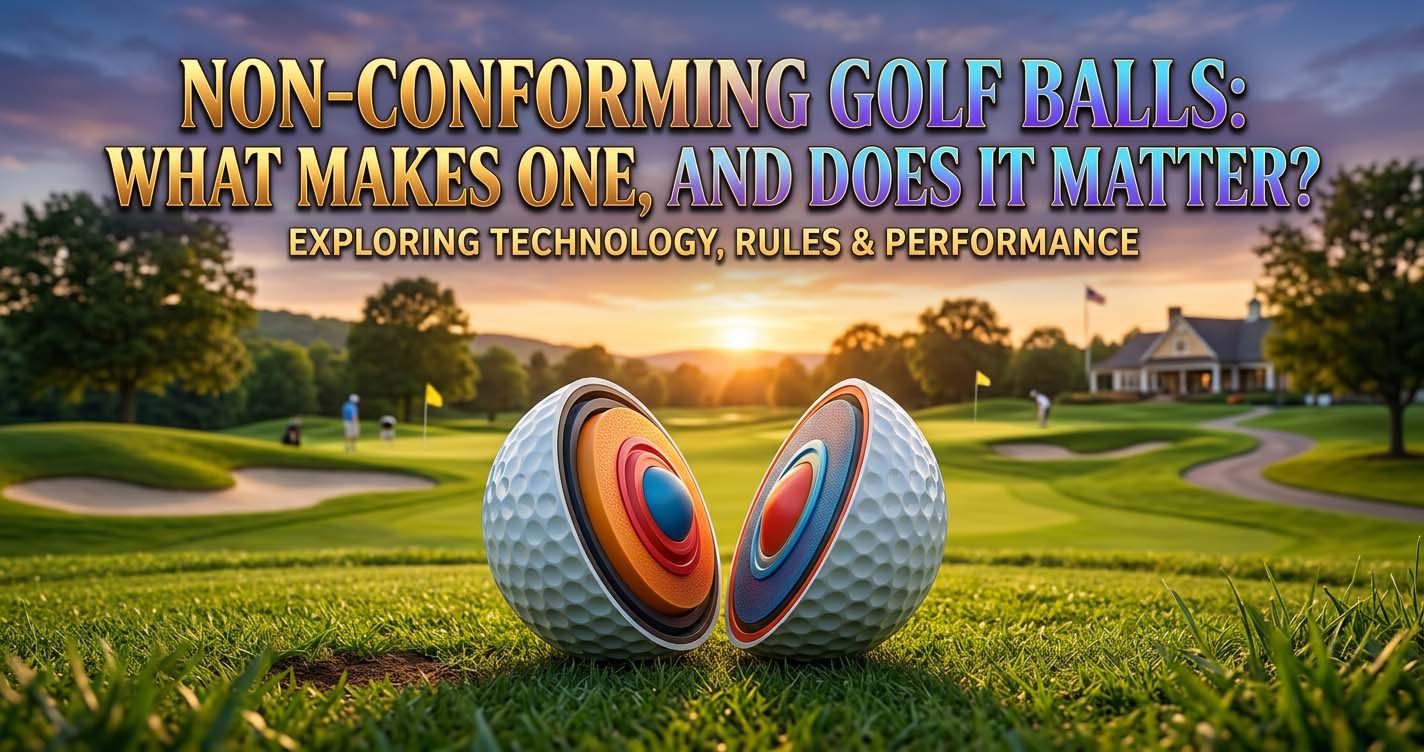
For most casual and club golfers, occasionally, and it's worth knowing the difference between a ball that's genuinely non-conforming and marketing copy borrowing the word "illegal" for attention. Under the Equipment Rules jointly published by the USGA and The R&A (2023 Rules of Golf, current at the time of writing), a golf ball must meet physical requirements covering minimum size, maximum weight, spherical symmetry, initial velocity, and the Overall Distance Standard. A ball that fails any one of these is non-conforming under Rule 4.2a, and making a stroke with one during a round played under the Rules of Golf carries disqualification. Separately, a ball simply missing from the official Conforming Ball List only matters in competitions that specifically adopt Model Local Rule G-3; everywhere else, a ball just has to meet the physical requirements, listed or not.
The physical requirements, and why they're stated as limits, not targets
Per the USGA/R&A Equipment Rules, a conforming ball must not weigh more than 1.620 ounces (45.92 grams), must not measure less than 1.680 inches (42.67 mm) in diameter, must not exceed an initial velocity limit of 250 feet per second under the governing bodies' test conditions, and must not be designed or intentionally modified to fly other than as a spherically symmetrical ball would. These are all published, testable specifications, not general guidance. A manufacturer submitting a new ball model for evaluation has to demonstrate it meets every one of them.
What "deliberately altered" covers, separately from manufacturing specs
Rule 4.2a also addresses balls altered after manufacture: scuffed, heated, or treated with a substance beyond ordinary cleaning, specifically to change how they perform. This is a distinct issue from a ball that was manufactured outside spec. It's about a player changing a conforming ball's characteristics mid-round, and it carries the same disqualification penalty as playing a ball that was never conforming to begin with.
The Conforming Ball List, and the Model Local Rule that gives it teeth
The USGA and R&A jointly maintain a Conforming Ball List of models that have been submitted and evaluated, republished on the first Wednesday of every month. A ball being on the list confirms it conforms. A ball missing from the list doesn't automatically mean it's non-conforming. It could simply never have been formally submitted, which is common for balls not marketed toward serious competitive golfers, or it could have expired off the list after roughly 12 months without resubmission. In both of those cases, the ball can still meet the actual physical requirements and be permissible for recreational play. It only becomes disqualifying in a specific competition if that competition has adopted Model Local Rule G-3, which restricts play to balls currently on the list. Outside that condition, an unlisted ball just needs to meet the physical spec on its own merits.
Why distance-ball marketing claiming "illegal" is a red flag, not a spec sheet
Some recreational golf balls are marketed with claims that they're "not USGA conforming" or "illegal for tournament play," framed as a selling point for extra distance or reduced curve. Read that framing skeptically. A ball's actual conformance status is determined by whether it meets the physical requirements above, evaluated by the USGA and R&A, not by what a marketing page asserts about itself. Manufacturer distance and performance claims for these products are routinely presented without independent, checkable testing behind them, and this site does not repeat those figures as fact. If you're specifically shopping for a distance-focused non-conforming ball for casual, non-competitive play, treat the marketing copy as advertising, not as a verified performance number.
Construction and technology don't determine conformance by themselves
A common point of confusion is assuming that a ball's construction, such as a two-piece surlyn ball versus a multi-layer urethane-cover tour ball, has anything to do with whether it conforms. It doesn't, directly. Conformance is about the physical performance limits described above, not the number of layers, the cover material, or the compression rating printed on the box. A budget two-piece ball built to the same size, weight, symmetry and velocity limits as a premium tour ball is just as conforming; it simply performs differently around the green and off the tee because of its construction, not because of any rules status. The one construction-related exception is spherical symmetry: a ball deliberately built or modified with an asymmetrical dimple pattern designed to self-correct hooks and slices, rather than fly like a normal spherically symmetrical ball, fails that specific requirement regardless of how conventional the rest of its construction looks.
Carrying vs playing, the same distinction that runs through the equipment rules
Owning or carrying a non-conforming ball isn't itself penalized under the Rules of Golf; the penalty attaches to making a stroke with one during a round played under the Rules. A golfer who keeps a sleeve of a distance-focused, non-conforming ball for casual weekend rounds with friends, separate from the conforming balls used for anything posted or competitive, isn't in breach of anything in that casual context.
When this actually matters for a casual or club golfer
For an ordinary weekend round with no stated agreement to play under the Rules of Golf, ball conformance has no enforcement mechanism at all. It's a group-agreement matter, the same as every other equipment rule at that level. It becomes practically relevant in two situations: a club competition or handicap-posting round, where the ball you're using should conform to the physical requirements (and, if the competition has adopted Model Local Rule G-3, should also be on the current list), or if you're simply buying a new ball model and want confidence it's a genuine tournament-legal ball rather than a distance-marketed novelty.
FAQ
What actually makes a golf ball non-conforming?
Failing any one of the physical requirements: minimum size, maximum weight, spherical symmetry, initial velocity limit, or the Overall Distance Standard, all set out in the USGA/R&A Equipment Rules. Deliberately altering a ball's performance mid-round, such as by scuffing or applying a substance, also makes it non-conforming under Rule 4.2a.
Does a ball missing from the Conforming Ball List automatically mean it's illegal?
No. It may simply never have been formally submitted, or it may have expired off the list after about 12 months. It's only disqualifying in a specific competition that has adopted Model Local Rule G-3; otherwise the ball just needs to meet the physical requirements on its own.
Are "illegal distance ball" marketing claims trustworthy?
Treat them as advertising, not as verified specs. Actual conformance is determined against the published physical requirements by the USGA and R&A, not by a manufacturer's own framing of its product.
Does a cheaper two-piece ball fail conformance compared to a premium tour ball?
No. Construction, cover material and compression have nothing to do with conformance status on their own. Both types of ball just have to meet the same size, weight, symmetry and initial velocity limits.
Can I be penalized for just having a non-conforming ball in my bag?
No. The penalty under Rule 4.2a attaches to making a stroke with a non-conforming ball during a round played under the Rules of Golf, not to owning or carrying one.
For the broader equipment rules that actually affect an amateur golfer, see /golf-equipment-rules-for-amateurs/. For how the equivalent conforming-list question works for clubs, see /usga-conforming-golf-club-list/.