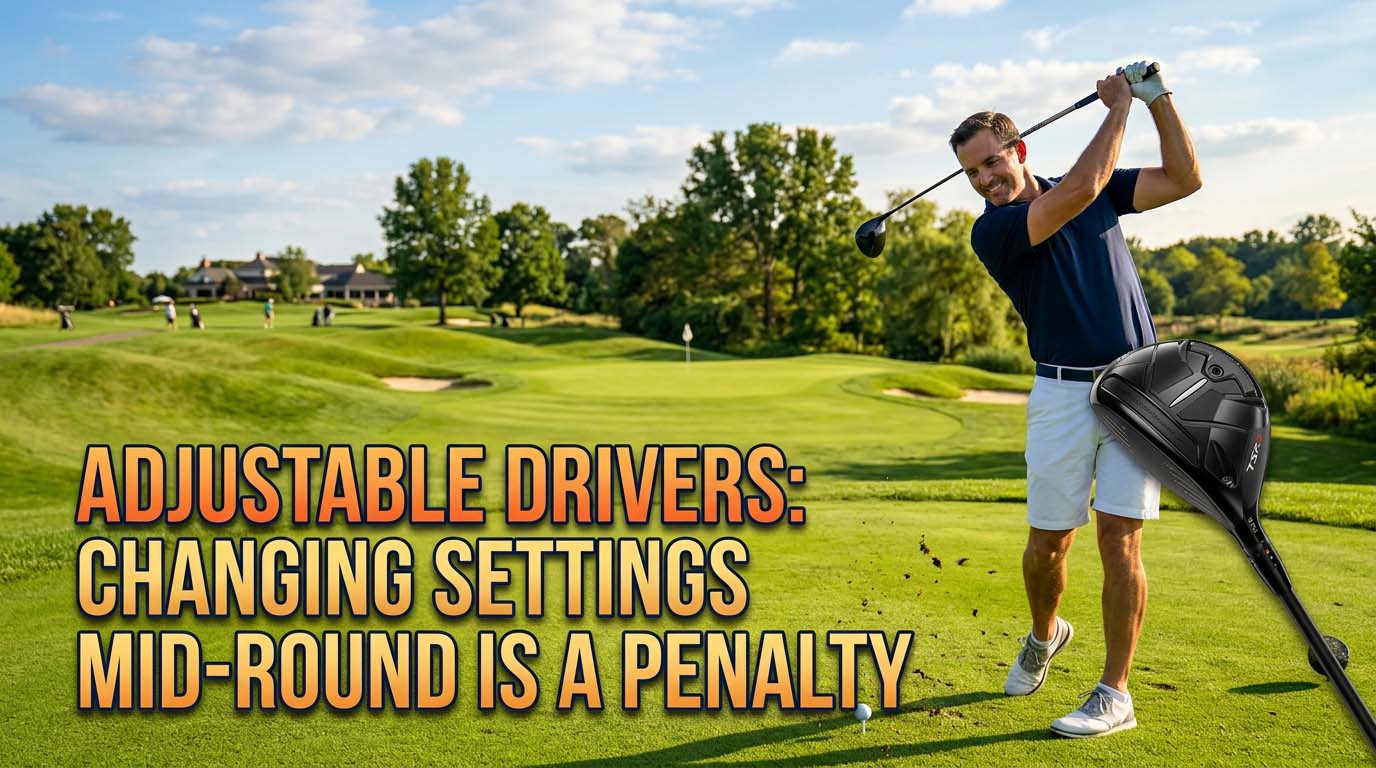
No, you may not adjust your driver's loft, lie, or weight settings during a round played under the Rules of Golf, and doing so before making a stroke with it carries disqualification. Rule 4.1a(3) of the 2023 Rules of Golf (jointly published by the USGA and The R&A) states that a player must not make a stroke with a club whose playing characteristics have been deliberately changed during the round, whether by using an adjustable feature, physically altering the club, or applying anything to the clubhead to affect performance. There are two narrow exceptions, both covered below, and neither one means "twist it back whenever you want."
What Rule 4.1a(3) actually prohibits
The rule targets deliberate mid-round changes to a club's playing characteristics, made in one of two ways: using an adjustable feature on the club, such as the hosel wrench on an adjustable driver or a sliding or swappable weight, or physically changing the club some other way, including applying a substance to the clubhead (other than simply cleaning it) to affect how it performs. This covers the obvious case, twisting an adjustable hosel to change loft or add draw bias between holes, and the less obvious one, adding lead tape to a clubhead mid-round to shift its weighting.
The two exceptions
The rule carves out two specific situations where a changed club can still be used without penalty:
- Restoring an adjustable club to its original setting. If a club's characteristics were changed, even accidentally, or by someone else, the player may restore it to its original position before making a stroke with it. Putting a setting back where it started isn't a new deliberate change.
- Removing a non-permissible external attachment. If something was added to the club that shouldn't have been there, taking it off before the next stroke is allowed.
What the rule does not carve out is any version of "I'll just switch it back after this hole" or "I only changed it once." A deliberate change followed by a stroke, in either direction, is what triggers the penalty; there's no allowance for temporarily adjusting a driver to hit one specific shot and then reverting it.
Repair is treated differently from adjustment
Rule 4.1a(3) specifically excludes changes made while lawfully repairing damage to a club under Rule 4.1a(2). A genuinely damaged club being restored to its prior condition is a repair, not a deliberate characteristic change, and the two situations are governed differently. The distinction that matters is intent and cause: fixing something that broke is not the same act as choosing to reconfigure a working club for a different shot.
The penalty, and why it's more severe than most equipment breaches
Most equipment-rule breaches in the Rules of Golf carry the general penalty: loss of hole in match play, two strokes in stroke play, capped for the round. Rule 4.1a(3) is different. Making a stroke with a club whose playing characteristics were deliberately changed mid-round carries disqualification, full stop, with no stroke-count alternative. This puts it in the same severity tier as making a stroke with a genuinely non-conforming club under Rule 4.1a. The governing bodies treat mid-round equipment manipulation as a serious integrity issue, not a minor procedural slip, because it changes the playing tool itself rather than how it's used.
What is actually fine
Between rounds of a multi-day event, adjusting a driver's settings is permitted. The restriction is specifically about changes made during a round, not changes made before teeing off on a new one. A player who sets their driver to a 10-degree loft with a slight draw bias for the day is not obligated to keep that exact configuration for every future round; they can reconfigure it before the next round begins. Carrying a second, differently configured driver as one of the 14 clubs, rather than adjusting one club mid-round, is also fine. That's simply having two different clubs, not changing one club's characteristics during play.
Why this rule exists
The playing-characteristics restriction exists to keep equipment fixed for the duration of a round, the same underlying principle behind the 14-club limit and the conforming-equipment requirement: a golfer plays the round with the tools they started it with, rather than reconfiguring gear hole to hole to respond to conditions in a way the Rules don't intend to permit. Distance-measuring devices are allowed to give raw information; equipment itself isn't meant to be re-tuned shot by shot.
What this means practically before you tee off
If you own an adjustable driver, the practical takeaway is simple: set it before the round, based on what you know about the course and conditions that day, and leave it alone until the round ends. If something happens mid-round that makes you want a different loft or weight setting, the rule doesn't offer a path to that during the round played under the Rules of Golf. The fix is a second club in the bag, or waiting for the next round.
FAQ
Can I switch my adjustable driver's loft between the front nine and back nine?
No, not if it's a single round played under the Rules of Golf. The prohibition applies for the duration of the round, not just within a hole.
What if I accidentally bump the adjustable hosel and it changes?
Restoring it to its original position before making a stroke is one of the rule's two explicit exceptions, and doing so isn't itself a penalty. The issue arises from making a stroke with the club in its changed state, or from a change made and left in place.
Is this different for a casual round with no committee?
The rule only has force to the extent the round is played under the Rules of Golf. A fully casual round with no such agreement isn't governed by it, the same distinction that applies throughout the equipment rules. See /golf-equipment-rules-for-amateurs/ for how that plays out generally.
Can I adjust my driver between two rounds on the same day at a multi-round event?
Yes. The restriction applies during a round, not between separate rounds. Reconfiguring before a new round begins is permitted.
What's the penalty if I get caught?
Disqualification, for making a stroke with a club whose playing characteristics were deliberately changed during the round. There's no lesser stroke-penalty alternative under Rule 4.1a(3).
For the broader set of equipment rules that actually affect amateur golfers, see /golf-equipment-rules-for-amateurs/. For what makes a driver non-conforming beyond mid-round adjustment, see /non-conforming-golf-driver/ and /driver-ct-test-conforming/.