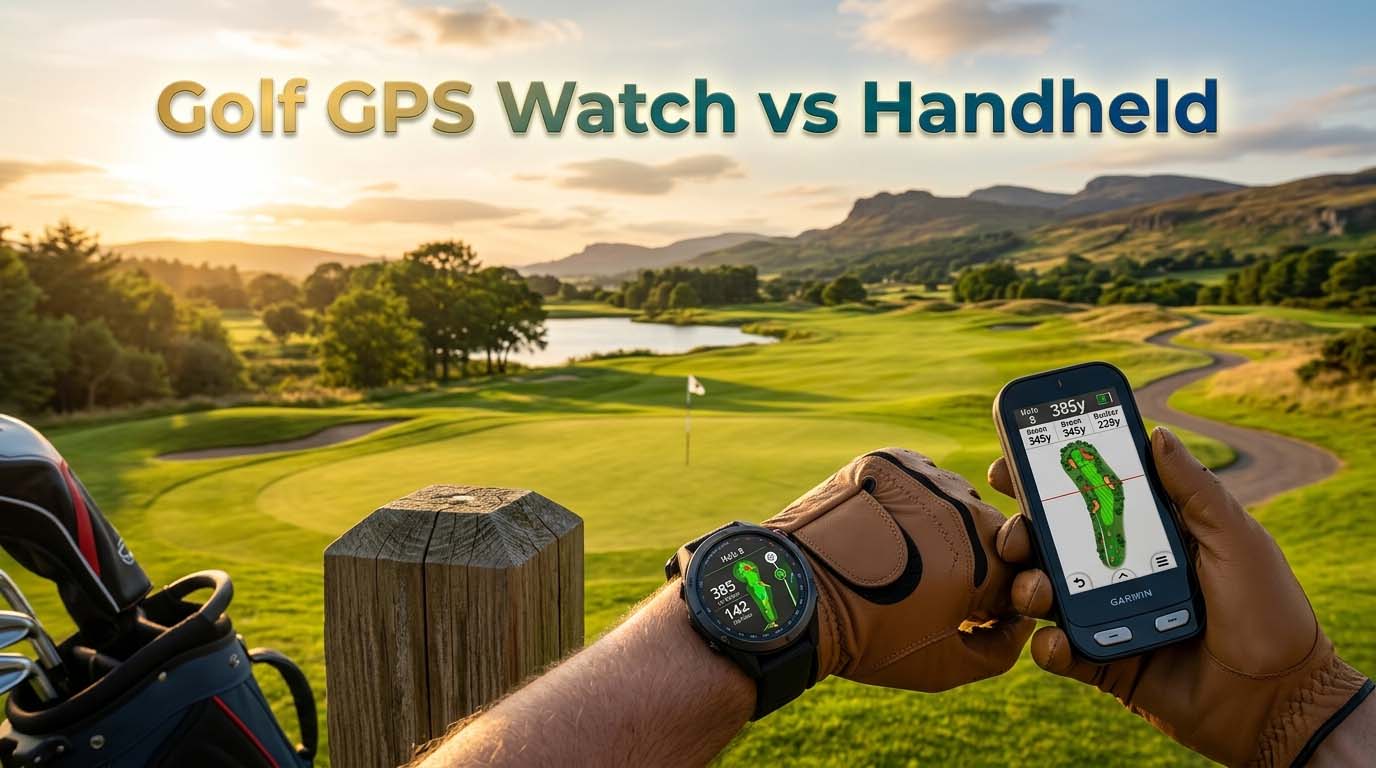
A golf GPS watch and a golf GPS handheld both work from the same underlying course-mapping data, front, middle and back yardages, hazard distances, layup points, and neither one is a strictly better version of the other. The real difference is form factor, and form factor changes screen size, battery life, and which features are practical to fit into the device. This is a narrower question than laser vs GPS vs phone, covered separately at /golf-rangefinder-vs-gps/; here the assumption is you already want a GPS device and are choosing which shape it comes in.
Screen size and what it costs you
A wrist-based device has a small screen by necessity, since it has to stay wearable. That is enough room for numbers, front/middle/back yardages and maybe a simple hole layout, but not much more. A handheld device has a genuinely larger screen, which makes a real difference on holes with hazards you actually need to read rather than just glance at a number for, dogleg shapes, water carries, bunker clusters relative to the pin. If you play courses where you regularly want to look at the shape of the hole rather than just a distance, the handheld's screen size is doing real work a watch cannot match.
Battery life across a round, and across a season
Wrist-based GPS devices are built to be worn all day, which usually means smaller batteries optimized for standby efficiency between rounds rather than continuous active display use. Handheld devices are typically built with the opposite priority, larger batteries meant to run actively for a full round or several rounds before a recharge, since the whole device exists to be looked at repeatedly rather than glanced at occasionally. If you play back-to-back rounds over a weekend, or you tend to forget to charge things, the handheld's larger battery margin is a practical, not cosmetic, advantage.
Features that lean toward each form factor
A watch's always-on-wrist form factor lends itself to features you want without stopping: shot tracking, live scorekeeping, step and activity tracking outside of golf. A handheld's larger screen and more deliberate "pick it up, look at it, put it away" use pattern lends itself to features that reward more screen space and detail: fuller hazard mapping, green shape and pin-position detail on the models that offer it, and a layout that is easier to study for a moment before you commit to a shot. Neither list is exclusive to one form factor across every model on the market, but it describes the general design pull of each shape.
Price tier, as a general pattern
Handheld GPS devices, as a category, tend to sit at a lower price point than GPS watches with comparable course-mapping features, largely because a watch also has to solve wearability, strap durability, and often a touchscreen or button interface built for a much smaller surface. This is a general pattern across the category rather than a rule that holds for every specific model, and it is not a reason to buy either type on its own; it is one input alongside screen size, battery life, and features.
Sunlight readability and durability
Screen visibility in direct sunlight matters more on a golf course than in almost any other outdoor use case, since you are checking the device repeatedly across four-plus hours in open sun. Watch displays, being smaller, generally pack the same readability technology into less physical space, which can make glare and washout more noticeable than on a larger handheld screen, though this varies by specific model and display type rather than being a fixed rule of the category. On durability, a watch lives on your wrist through the whole round, including in your golf swing's general vicinity and through incidental knocks against a bag or cart, while a handheld spends most of the round in a pocket or bag pouch and is only out during active use. Neither exposure pattern is inherently worse, but they are different risk profiles worth being aware of before choosing where you are comfortable spending on a device.
Charging habits, since they differ by form factor
A watch, if you also wear it day to day, tends to get topped up in the small windows between wears the way any smartwatch does, and running it down mid-round because it was not fully charged before you left the house is a realistic risk for a device with a smaller battery. A handheld, by contrast, is a single-purpose device that only leaves its charger when you are about to play, so the habit of charging it is simpler to build precisely because it has one job. Neither pattern is objectively easier to manage, but they call for different personal habits, and it is worth being honest about which one you will actually keep up with.
A decision framework by how you actually play
If you value having the device always on your wrist without a separate item to carry, glance-and-go convenience over screen detail, and you are likely to use features like shot tracking between shots, a GPS watch fits that pattern.
If you play courses with hazards and layouts worth actually studying, you want the largest practical screen for that, or you play enough rounds in a row that battery margin matters, a handheld fits that pattern instead.
If you are undecided, it is worth thinking about how you actually check a GPS device mid-round: a fast glance for a single number, or a longer look to plan a shot. That single habit is a reasonable tiebreaker between the two form factors.
FAQ
Is a GPS watch or a handheld more accurate?
Both work from the same underlying satellite and course-mapping data, so the core distance accuracy is not the primary difference between them. Screen size, battery life, and feature set are the meaningful differences, not raw accuracy.
Can a GPS watch do everything a handheld does?
Not within the same screen space. A watch can carry similar underlying data, but the smaller display genuinely limits how much detail, like full hazard maps or green shape, is practical to show at once.
Do I need either one if I already have a laser rangefinder?
Not necessarily. A laser rangefinder answers a different question, the precise distance to one target you aim at, while a GPS device answers a whole-hole question without needing a line of sight. See /golf-rangefinder-vs-gps/ for that comparison in full.
Are budget GPS devices, watch or handheld, worth it?
The same budget-tier trade-offs that apply to rangefinders generally, build quality, feature depth, screen quality, apply to GPS devices too. See /cheap-golf-rangefinder-worth-it/ for that framework.
Which is better for a beginner?
Neither form factor is inherently more beginner-friendly; both display the same kind of course information. A watch may suit a beginner who wants the least amount of extra gear to manage, while a handheld may suit one who wants to actually study the hole before deciding on a shot.
For the fuller framework on what to check before buying any device in this category, see /golf-rangefinder-buying-guide/.