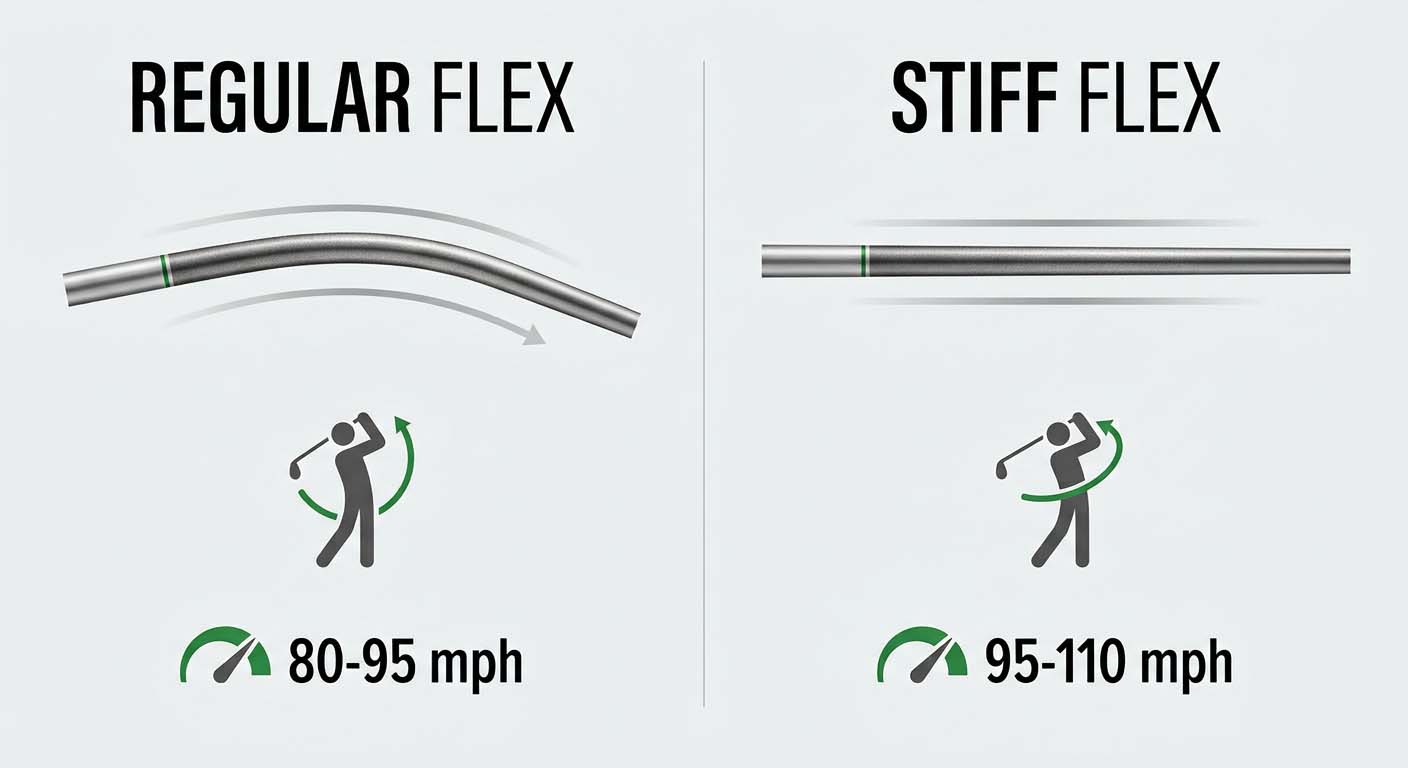
You found your swing speed, looked it up, and landed exactly on a boundary. One chart says regular, another says stiff, and a third uses a scale that does not map onto either.
The instinct is to find a tiebreaker. There is a better answer, and it starts with what being "between them" actually means.
Being between two flexes is not a close call
A flex chart is a company's own map of its own product range, divided into bands by that company. There is no industry standard for shaft flex, so the boundary you landed on is one manufacturer's internal line, and a different manufacturer drew theirs somewhere else.
So you are not on a knife edge between two correct answers. You are at the point where a coarse instrument has run out of resolution.
That reframing is the useful part, because it means the tiebreaker is not going to come from a better chart. It comes from the specifications that are actually defined.
What decides it instead
Four things, roughly in order of how directly a golfer tends to notice them.
| What decides it | Why it carries more information than the label |
|---|---|
| Weight | Published in grams by every manufacturer, means the same thing everywhere, and is frequently the spec a golfer feels most immediately |
| Where the shaft is stiff | Two shafts with the same overall stiffness can be built with opposite profiles and behave differently through impact |
| How you load it | Two golfers at the same clubhead speed can be genuinely different fits, which is why a one-input chart cannot resolve the case |
| The head it is attached to | The same shaft model can feel different in two different heads |
Weight
Shaft weight is published in grams by every manufacturer and means the same thing everywhere. It is the least ambiguous spec on a shaft and, in a great deal of fitting practice, the one a golfer feels most immediately.
A lighter shaft in a stiffer flex and a heavier shaft in a softer flex are two genuinely different clubs, and the weight difference is frequently the more noticeable of the two changes. If you are agonizing over a letter while ignoring the grams, you are optimizing the vaguer of the two specs.
Where the shaft is stiff
Stiffness is not uniform along a shaft. Two shafts with the same overall stiffness can be built with a softer tip and firmer butt, or the reverse, and they will behave differently through impact.
This is what people are describing when they say two shafts of the same flex feel nothing alike. It is also why a fitter with a bend profile in front of them is working with better information than a chart provides.
How you load it
Swing speed is one input and it is not the only one. How abruptly you apply force through the downswing, and where in the swing your peak effort arrives, change what a shaft does. Two golfers at the same clubhead speed can be genuinely different fits.
This is the reason the chart cannot resolve your case. It has one input, and the question has several.
The head it is attached to
A shaft is fitted to a club, not in isolation. The head's weight and how it is built changes the assembled club's behavior, which is why the same shaft model can feel different in two different heads.
The two situations people describe, and what is actually going on
"Stiff feels harsh and regular feels loose." Two things worth separating. Harshness is often a weight and vibration-damping question rather than a stiffness one, and "loose" is often a tip-section question. Both point at variables that are not the letter you are trying to choose.
"I've always played stiff." This is a sentence about a previous purchase, made by a previous version of you, from a manufacturer whose range may no longer exist in the same form. It is worth noticing that it carries less information than it feels like it carries.
What a fitting actually resolves, and what it does not
A fitting is the intended answer to this question, and it is worth being precise about what it does.
What it gives you: a measurement of what happens when you hit shots with different assemblies, made with an instrument rather than a chart. That is a genuinely different kind of evidence.
What it depends on: the fitter's range of options, the day you had, and how many shots you hit. A fitting is a measurement of your swing that day, and a golfer whose swing is actively changing is a moving target.
What it costs, and whether it is refundable against a purchase, varies, and this site publishes no figure for it because there is not one. Fitters publish their own process pages and their own fees, and reading two of those before booking tells you more than any general article can.
And it is not a requirement. Plenty of people play well on stock shafts chosen from a chart. The reason a fitting helps is not that stock is bad; it is that stock is chosen for the middle of a range.
The honest options if you are not being fitted
Not recommendations. Just the choices that exist and what each one means.
Choose by weight first, then by flex. You are then optimizing the defined spec rather than the label.
Use the maker's own chart for the specific shaft, not a general one, and read what the maker says about that model rather than about flex in general.
Consider what happens with each error. A shaft that is too stiff for you tends to feel unresponsive; one that is too soft tends to feel uncontrolled. Neither is a disaster and both are recoverable, which is a genuinely reassuring thing to know at a decision point that feels bigger than it is.
Recognize that a used club removes the choice anyway. You get the shaft that is in it, and the model name is the information rather than the letter. Our guide to buying used golf clubs covers what is worth checking there, and it is not the flex.
What this article will not do
It will not print a swing-speed range and tell you which side of it you are on.
Every such range belongs to a company, describes that company's shafts, and disagrees with the next company's. A number here, with no publisher and no date behind it, would be a fabrication wearing a chart's clothes, and it is the exact thing that produced the confusion you arrived with.
If you want the number, it is on the shaft maker's own current page, for the specific model you are considering, and the date you read it is part of the answer. The same principle applies to every figure on a club, which is why our page on the golf club spec sheet, translated sends you to the maker's own sheet, and why our article on what a trade-in is really worth refuses to estimate a figure nobody publishes.
FAQ
What does it mean if I am between regular and stiff on a chart?
It means the chart has run out of resolution, not that you are on a knife edge between two correct answers. The boundary you landed on is one manufacturer's internal line, and a different manufacturer drew theirs somewhere else.
Should I just take the stiffer one to be safe?
There is no safe default. A shaft that is too stiff for you tends to feel unresponsive, and one that is too soft tends to feel uncontrolled. Neither error is a disaster and both are recoverable, which takes some of the weight off the decision.
What actually decides it if the chart cannot?
The defined specifications: the shaft's weight, where along its length it is stiff, how you load the shaft through the downswing, and the head it is attached to. Choosing by weight first, then flex, puts the decision on the spec that is actually comparable.
Do I need a fitting to settle it?
It is not a requirement, and plenty of people play well on stock shafts chosen from a chart. What a fitting adds is a measurement of what happens when you hit shots with different assemblies, which is a different kind of evidence from a chart lookup.
Does the fact that I have always played stiff answer the question?
No. That is a sentence about a previous purchase, made by a previous version of you, from a manufacturer whose range may no longer exist in the same form. It carries less information than it feels like it carries.