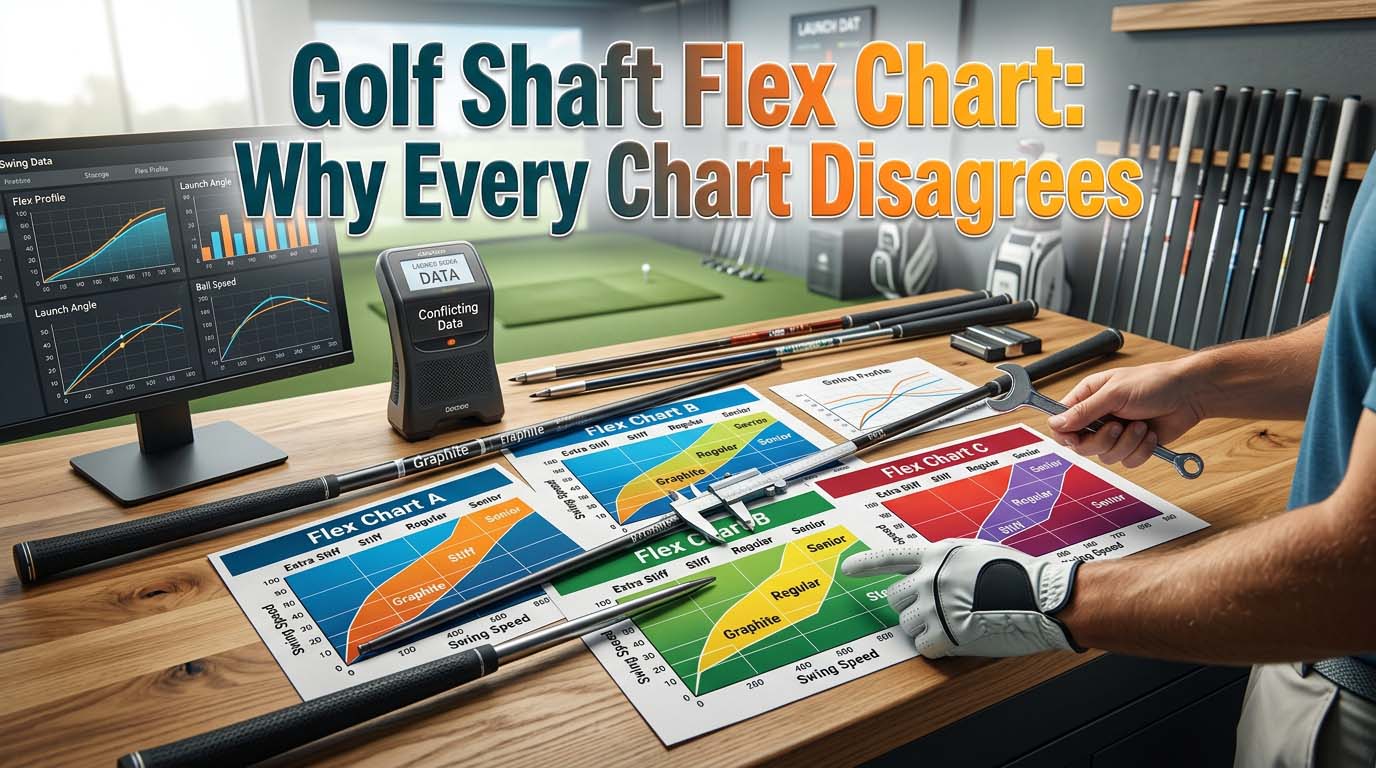
You looked up a swing-speed-to-flex chart, found one, then found a second one that put you in a different flex. Then a third that used a different measurement entirely.
The charts are not badly made. They disagree because there is no industry standard for shaft flex, and once you know that, the whole question changes shape.
What R, S and X actually are
They are the manufacturer's own labels for their own product line.
There is no governing body that defines what makes a shaft "stiff". There is no test a shaft has to pass to be sold as regular. Each company decides where its own boundaries sit, and it decides them relative to the rest of its own range.
The consequence is the thing golfers notice and cannot explain: two shafts both labeled S, from two companies, can feel and behave meaningfully differently. Neither company has done anything wrong. They were never claiming to describe the same thing.
The same is true within one company across model lines and across years. A label is a position on a ladder, and each maker builds its own ladder.
Why the charts still exist, and what they are for
A swing-speed-to-flex chart is a starting point, published by someone who has to give one. It is not a measurement of you.
Two things are worth knowing about them:
The input is usually driver clubhead speed, which is not the same as ball speed and not the same as your speed with an iron. People frequently look up a number they were given for one and apply it to the other.
The chart is only meaningful alongside the maker whose chart it is. A chart from a shaft company describes that company's shafts. Applied to a different brand's shaft it is a guess.
So the honest use of a chart is: find the chart published by the company that makes the shaft you are considering, and use it as the entry point for that specific product. A generic chart found on a search result is describing nothing in particular.
The specs that are actually measurable
If flex is a label, what is not?
Frequency. A shaft's stiffness can be measured by clamping the butt and measuring how fast the tip oscillates, expressed in cycles per minute. This is a real, repeatable measurement, and fitting shops that own a frequency analyzer use it precisely because it does not depend on anybody's label.
Two caveats that matter. Frequency depends on how the shaft is clamped and what weight is on the tip, so numbers from two different setups are not directly comparable. And it produces one number for a shaft that behaves differently along its length.
Bend profile. A shaft's stiffness is not uniform. A shaft can be relatively soft in the tip and stiff in the butt, or the reverse, and two shafts with the same overall frequency can have opposite profiles. This is what people are describing when they say two shafts of the same flex feel completely different, and it is more informative than the letter on the label.
Weight. Measured in grams, published by every maker, and entirely unambiguous. It is also, in many fitters' experience, the spec a golfer feels most directly. That is its own subject and this site covers it separately.
Torque. How much the shaft twists along its length under load, published in degrees by many makers. Also unambiguous as a number, though what it means for a given swing is contested.
The pattern: where a number is published and defined, it is comparable. Where a letter is printed, it is not.
What this means when you are shopping
Three practical consequences, and none of them is a recommendation about what to buy.
A used shaft labeled S tells you very little on its own. It tells you where that shaft sat in that maker's range, in that year. If you are buying used, the model name and the specific product are the information; the letter is not. Our guide to buying used golf clubs covers the wider version of that problem, where the model name is doing all the work and the label is doing none.
Matching your old flex to a new brand is not matching anything. "I play stiff" is a sentence about a previous purchase.
Being between two flexes on a chart is not a problem to be solved by picking a chart you agree with. It means the chart is at the edge of what it can tell you, which is a different situation and one this site covers in its own article.
Why no standard exists, briefly
It is worth knowing that this is not an oversight.
Shaft behavior is genuinely multi-dimensional: weight, overall stiffness, distribution of stiffness, torque, and how all of those interact with a particular swing and a particular head. Compressing that into one letter necessarily loses most of it. A standard would either be so coarse that it told you nothing, or so detailed that it would stop being a letter.
There have been attempts at common measurement approaches over the years, and none has become a universal label that manufacturers use in place of their own. The letter survives because it is easy to print, not because it is informative.
What to ask instead
If you want the actual specification of a shaft, the questions with defined answers are:
Which model and which weight? The model name plus the weight is the identifier that means something.
What is the published torque? Where a maker publishes it.
Where is it stiff? A maker's own description of the bend profile, or a fitter's measurement.
And, if you are being fitted: what was measured, and against what. A fitting that produces a recommendation from a measurement is a different thing from one that produces it from a chart.
What this article deliberately does not contain
No swing-speed ranges. No frequency figures. No chart.
That is not caution for its own sake. Publishing one chart, with no publisher and no date, is precisely the practice that produced the confusion you arrived here with. Every number in this category belongs to a specific company, describing a specific product line, at a specific time, and stripped of that it is decoration.
Where a number matters to you, it is on the shaft maker's own current page, and the date you read it is part of the answer. That is the same principle as reading a club's own specification sheet rather than a summary of it, which is what our page on the golf club spec sheet, translated is built around. And it is the same reason our article on whether last year's model is worth buying checks the maker's own lineup page rather than a comparison written by someone else.
FAQ
Why do golf shaft flex charts disagree with each other?
Because there is no industry standard for shaft flex. Each chart is one company's own map of its own product range, with boundaries that company decided, so two charts are describing two different ladders rather than one shared scale.
Are two shafts labeled stiff from different brands the same?
No. The label is a position in each maker's own range, and two shafts both labeled S can feel and behave meaningfully differently. Neither company is wrong; they were never claiming to describe the same thing.
How should I actually use a flex chart?
Find the chart published by the company that makes the shaft you are considering and treat it as a starting point for that specific product, not a measurement of you. A generic chart from a search result describes nothing in particular.
Which shaft specifications can I actually compare?
Weight, published in grams by every maker, torque, published in degrees by many, frequency where it is measured on the same setup, and the bend profile. Where a number is published and defined it is comparable; where a letter is printed it is not.
Does "I play stiff" carry over to a new brand?
No. It is a sentence about a previous purchase from a maker whose boundaries were their own, so matching your old flex to a new brand is not matching anything. The model name and the weight are the information that transfers.