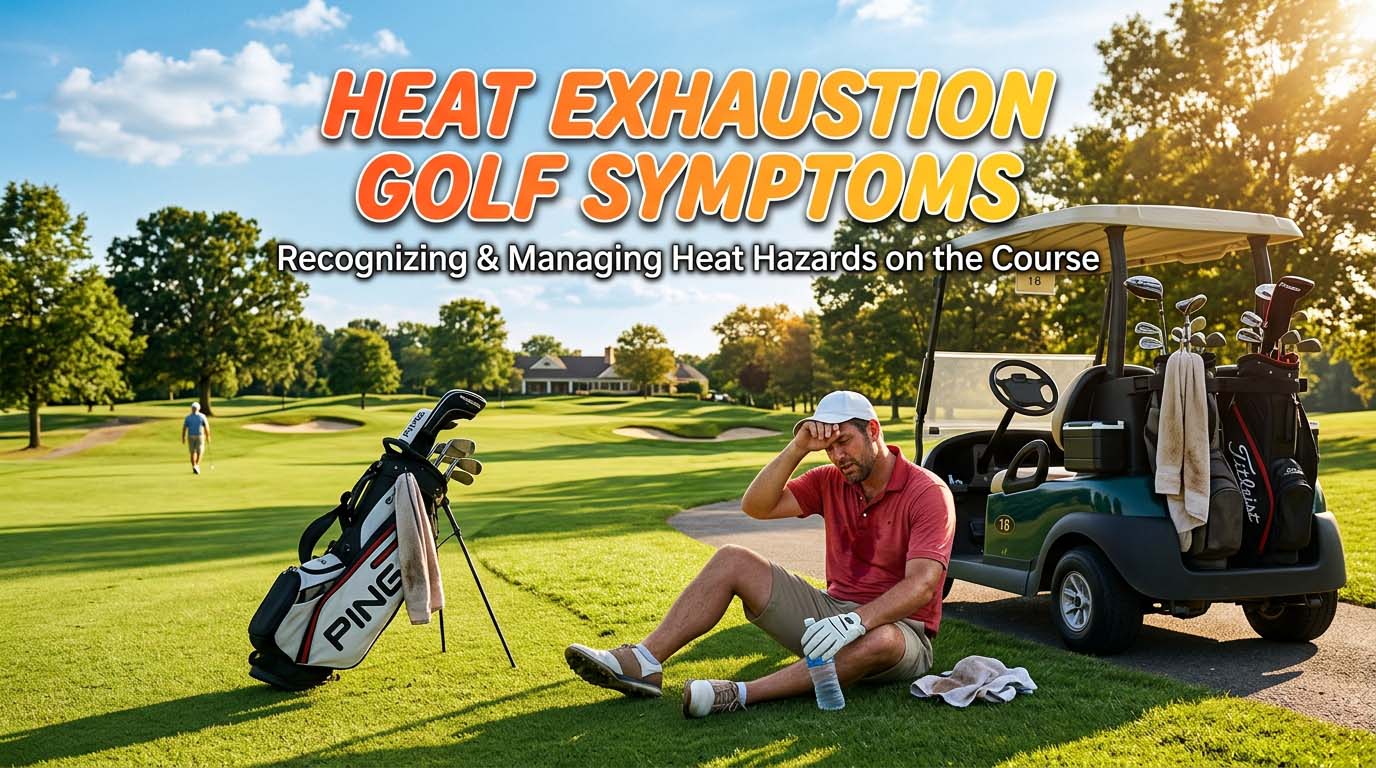
Heat exhaustion golf symptoms, as the National Weather Service lists them, are heavy sweating, weakness or tiredness, cool, pale and clammy skin, a fast and weak pulse, muscle cramps, dizziness, nausea or vomiting, headache, and fainting. The line that means 911 is heat stroke. The NWS lists confusion, slurred speech, hot red skin that may be dry or damp, a body temperature above 103°F, and loss of consciousness as heat stroke signs, and calls it "a severe medical emergency." The NWS also says to seek immediate medical attention if a person with heat exhaustion vomits, or if symptoms get worse or last longer than one hour.
This page is general information drawn from public health sources, not medical advice. When it is unclear which condition someone has, the safer reading is the more serious one, and a 911 dispatcher can help decide.
When to Call 911 on the Course: The Escalation Rule First
Before any explanation, here is what the sources say about urgency, because that is the decision a group faces on the 12th hole.
The NWS heat illness safety page (read September 27, 2026) separates the two conditions sharply:
- Heat stroke: "Call 911 or get the victim to a hospital immediately. Heat stroke is a severe medical emergency. Delay can be fatal."
- Heat exhaustion: "Seek immediate medical attention if the person vomits, symptoms worsen or last longer than 1 hour."
The CDC's National Institute for Occupational Safety and Health (NIOSH), on its heat-related illnesses page (read September 27, 2026), goes further for heat exhaustion in workers: its first aid line is to take the person "to a clinic or emergency room for medical evaluation and treatment," and to "call 911 if medical care is unavailable." For heat stroke, NIOSH says "Call 911 for emergency medical care."
On a golf course, where the nearest clinic is rarely close, that makes the practical threshold low. Any sign on the heat stroke list points to 911. Heat exhaustion that is not improving points to medical help, not another hole.
Heat Exhaustion Golf Symptoms, Sign by Sign
The NWS list for heat exhaustion reads: "Heavy sweating; weakness or tiredness; cool, pale, clammy skin; fast, weak pulse; muscle cramps; dizziness, nausea or vomiting; headache; fainting."
The NIOSH list overlaps and adds a few that are easy to miss because they do not feel physical: "Irritability," "Thirst," and "Elevated body temperature," alongside headache, nausea, dizziness, weakness and heavy sweating.
The CDC's Travelers' Health page on heat illnesses, read the same day, gives a shorter list: "excessive thirst, profuse sweating, headache, dizziness or confusion, nausea."
A few of these are worth reading in a golf context:
- Irritability. On a course, a short temper after a bad hole is normal. A short temper that arrives with a headache, heavy sweating and a hot afternoon may be something else. NIOSH lists irritability as a heat exhaustion symptom.
- Muscle cramps. Cramping calves on a hilly walking course are easy to blame on the hills. NIOSH lists cramps under both heat cramps and heat exhaustion.
- Dizziness when standing up. Golf involves a lot of crouching to read putts and standing back up. NIOSH lists "light-headedness from standing too long" and short fainting spells under a related condition called heat syncope.
Heat cramps and heat syncope: the smaller warnings
NIOSH treats two milder conditions separately. Heat cramps show up as "muscle cramps" and "pain or spasms in the abdomen, arms, or legs." Heat syncope shows up as "fainting (short duration)," "dizziness," and "light-headedness from standing too long." For heat cramps, NIOSH says to get medical help if a person "has cramps that do not subside within 1 hour."
Neither is a reason to panic. Both are a reason to pay attention, because they are signs the heat is winning.
Where Heat Exhaustion Ends and Heat Stroke Begins
The difference that matters most is the brain. The NWS list for heat stroke is: "Throbbing headache; confusion; slurred speech; nausea; dizziness; body temperature above 103°F; hot, red, dry or damp skin; rapid and strong pulse; fainting; loss of consciousness."
NIOSH lists "Confusion, altered mental status, slurred speech," "Loss of consciousness (coma)," "Hot, dry skin or profuse sweating," "Seizures," and "Very high body temperature." The CDC Travelers' Health page adds how quickly this can move, saying body temperature can rise "to 106°F or higher within 10-15 minutes."
Two details are commonly misunderstood:
- Sweating does not rule out heat stroke. Older advice says heat stroke means dry skin. Both the NWS ("dry or damp skin") and NIOSH ("hot, dry skin or profuse sweating") say a person with heat stroke can still be sweating.
- Nobody on a course has a thermometer. The 103°F figure is from the NWS list, but in practice the signs a playing partner can actually see are the mental ones: confusion, slurred speech, odd behavior, collapse.
Why Golfers Miss These Signs
Golf has a few features that make heat illness easier to overlook than in many sports. None of this is a claim that golf is unusually dangerous, only that the setting works against noticing.
The effort feels low. Golf does not feel like a hard workout, so players rarely think of themselves as exerting in the heat. Yet NIOSH's guidance is written for people doing ordinary physical work outdoors, and a walking round on a hot day is sustained activity in the sun for several hours.
The round has momentum. There is a group behind you, a match in progress and a card to finish. The NWS one hour threshold for heat exhaustion is easy to blow past when you are counting holes instead of minutes.
The person affected is the worst judge. Confusion is a heat stroke sign on both the NWS and NIOSH lists. Someone who is becoming confused is not well placed to notice it. That makes playing partners the real early warning system. If a partner's speech slurs, they seem disoriented, or they stop making sense, the NWS and NIOSH guidance points to 911, whatever the partner says about being fine.
Air conditioning is far away. The NWS first aid for heat exhaustion starts with moving the person "to a cooler environment, preferably a well air-conditioned room." On most courses the only air-conditioned rooms are in the clubhouse, and the far end of the back nine can be a long ride from it.
What the Sources List as First Aid
This is what the named sources list as first aid. It is not a substitute for a clinician or a 911 dispatcher, who may give different instructions for the person in front of them.
For heat exhaustion, the NWS lists: "Move person to a cooler environment, preferably a well air-conditioned room. Loosen clothing. Apply cool, wet cloths or have person sit in a cool bath. Offer sips of water." It pairs that with the escalation line: seek immediate medical attention if the person vomits, symptoms worsen or last longer than one hour.
For heat stroke, the NWS lists calling 911 or getting the person to a hospital immediately, moving them to a cooler environment, and reducing body temperature with cool cloths or a bath. It also says "Do NOT give fluids." That is the opposite of what most people reach for on a course, where a water bottle is the first thing in hand, so it is worth knowing in advance.
NIOSH adds for heat stroke that the person should be cooled quickly, "with a cold water or ice bath, if possible," while emergency care is on the way.
A golf cart can help here as transport. It can get a person out of the sun and back to the clubhouse, or to a point an ambulance can reach faster than on foot. It is not a cooling method on its own.
Planning a Hot Round So a Group Can Act Early
The sources above describe recognition and first aid. The golf-specific part is being in a position to act on them. These are planning points, not medical advice:
- Know where the cool rooms are. Before teeing off, it helps to know which buildings are air-conditioned, and whether the course has a halfway house or indoor space at the turn.
- Know how an ambulance reaches the back nine. Courses have service roads and gates. The pro shop can give you the street address and the access point to pass to a 911 dispatcher, which is much harder to work out in the moment.
- Agree on a check-in with your group. Because confusion is a heat stroke sign, an agreement that anyone in the group can call a stop is worth more than any gadget.
- Watch the clock, not the scorecard. The NWS one hour line for heat exhaustion is measured in time. Nine holes can take far longer than an hour.
Many players carry a phone or a watch for yardages, as covered in our comparison of a golf GPS watch vs a handheld unit. The same device is how a group reaches 911 and shares a location, so a charged phone in the bag is part of heat planning too.
Stopping Mid-Round and the Rules of Golf
Players sometimes hesitate to stop because they worry about a penalty. In a casual round there is no penalty to worry about. In a competition, the Rules of Golf anticipate this. National Club Golfer's rules explainer, read September 27, 2026, summarizes a clarification to Rule 5.6a (unreasonable delay) as recommending that Committees allow "up to 15 minutes" for a player with a sudden illness or injury to recover before failure to continue counts as unreasonable delay.
That allowance is about delay, not about whether it is wise to keep playing. The medical question comes first. Tournament notices and Local Rules can also set out how a Committee handles medical stoppages. For the wording of the rules themselves rather than a summary, see our guide on where to read the official Rules of Golf.
FAQ
What are the first signs of heat exhaustion on a golf course?
The NWS lists heavy sweating, weakness or tiredness, cool and clammy skin, a fast and weak pulse, muscle cramps, dizziness, nausea, headache and fainting. NIOSH also lists thirst and irritability.
How do you tell heat exhaustion from heat stroke?
Per the NWS and NIOSH, heat stroke signs include confusion, slurred speech, seizures, loss of consciousness and very high body temperature. The NWS calls heat stroke a severe medical emergency that needs 911.
Can someone have heat stroke and still be sweating?
Yes. The NWS describes heat stroke skin as "dry or damp," and NIOSH lists "hot, dry skin or profuse sweating," so sweating does not rule it out.
When does heat exhaustion need a doctor?
The NWS says to seek immediate medical attention if the person vomits, or if symptoms worsen or last longer than one hour. NIOSH advises medical evaluation for heat exhaustion in workers.
Is there a penalty for stopping a competitive round because of heat illness?
A clarification to Rule 5.6a, as summarized by National Club Golfer, recommends Committees normally allow up to 15 minutes for a sudden illness or injury before it counts as unreasonable delay. The medical question still comes before the card.