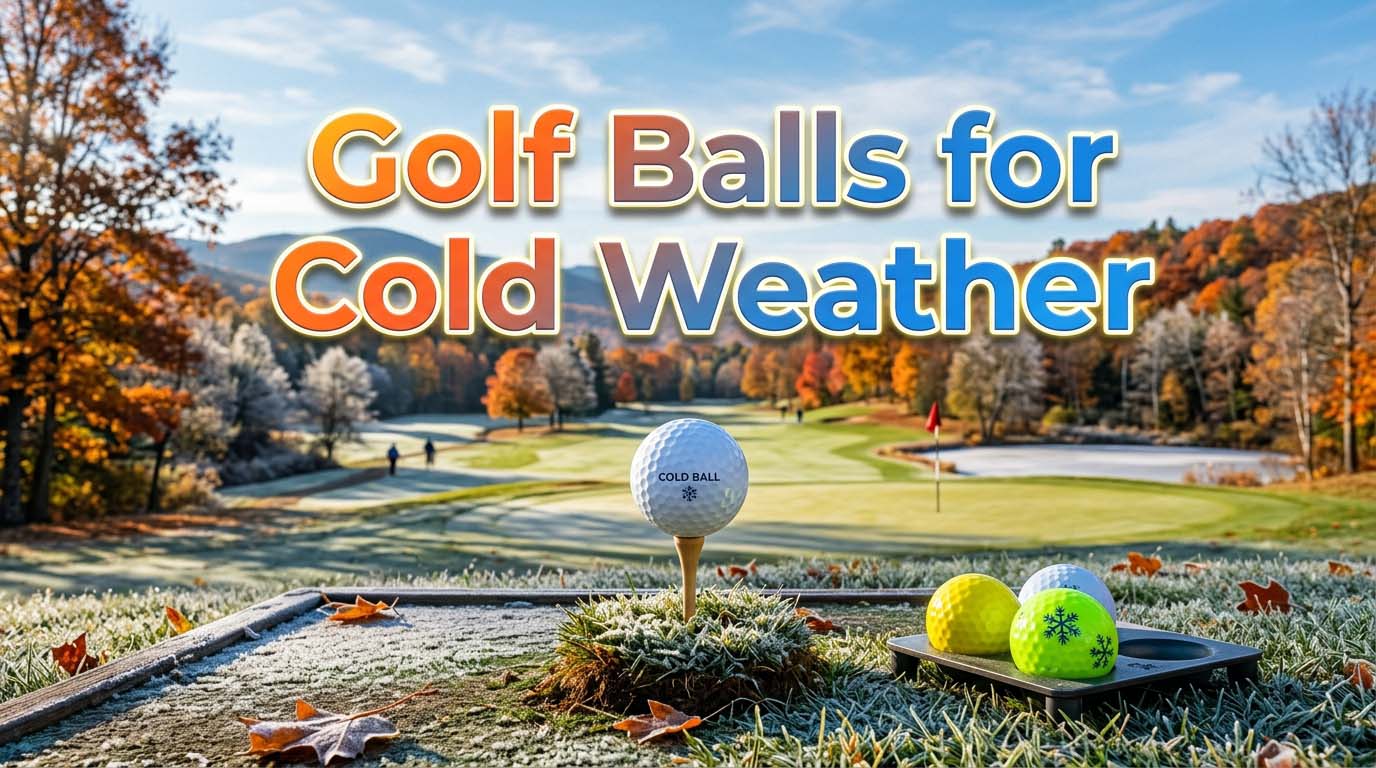
Short answer: golf balls for cold weather do not need to be a special model. Cold air is denser and a cold ball is stiffer off the clubface, so shots fly shorter once the temperature drops, full stop. But according to the manufacturer that actually builds and tests these balls, the biggest lever you control is not which ball you buy. It is keeping the one already in your bag warm between shots. Golf media runs a "best winter balls" roundup every October, pulled off compression numbers on a spec sheet nobody swung outdoors in the cold. I am not doing that version of this article.
What Cold Actually Does to a Golf Ball
Two separate things happen when the temperature drops, and it helps to keep them apart.
First, the air itself changes. Cold air is denser than warm air, and a denser medium resists the ball more as it flies, which shortens carry regardless of what the ball is made of. Second, the ball's own materials stiffen as they get colder, which changes how energy transfers from clubface to ball at impact. Titleist, which publishes its own testing on this rather than leaving it to golf-forum folklore, frames the combined effect as roughly a 1.5% distance loss for every 20°F the temperature drops, by Titleist's own account on its Learning Lab (read 2026-09-18). That is their estimate, not a law of physics you can apply to every ball, swing speed or course, and it is small enough that most golfers blame the wrong thing when a shot comes up short in December.
The Low-Compression Myth, According to the People Who Make the Balls
Here is where the marketing and the manufacturer's own position actually diverge. The common advice is to switch to a soft, low-compression ball once the weather turns, on the logic that a softer ball offsets the firmness cold brings. Titleist pushes back on its own product page: once you follow the more basic advice of keeping your ball at something close to room temperature, compression stops being the variable that matters, and switching models mid-season just means you are now playing an unfamiliar ball with unfamiliar spin and feel on top of the cold. A ball you know, at a normal temperature, beats a ball you don't know that happens to say "winter" on the box.
That is also the honest limitation of this whole topic: manufacturers test in controlled conditions, and your course's dense December air and slower swing after twenty minutes standing around are not identical to a lab. Treat the number as a direction, not a promise.
The One Fix That Actually Works: Keep the Ball Warm
If cold ball temperature, not ball model, is doing most of the damage, the fix follows directly. Carry two balls and rotate them: play one while the other sits in an interior jacket pocket, close to your body, so it stays near room temperature instead of near air temperature. Swap after each hole or two. It costs nothing, requires no new purchase, and directly targets the mechanism Titleist itself points to.
The flip side matters just as much. Do not leave a sleeve of balls in a cold trunk or garage overnight and expect them to perform normally on the first tee. If they have been sitting somewhere cold, let them warm back toward room temperature before you play them, the same way you would not expect a phone battery pulled from a freezing car to behave normally the instant you turn it on.
Storage Between Rounds Is the Bigger Lever
Where you keep your balls off the course matters more than which balls you own. If your bag lives in an unheated garage between rounds, the same swings in temperature and moisture that make a case for how an unheated garage actually affects golf clubs apply to a sleeve of balls stored the same way: it is the condensation and the swings doing the damage, not the cold number on the thermometer. A ball sitting through repeated freeze-and-warm cycles in a damp garage is a worse bet than one kept somewhere stable, whatever the compression rating on the box says.
If you are putting most of the bag away for the season rather than playing through it, that is a separate and bigger job than managing a few balls for a cold round, and it is covered properly in how to store golf clubs for winter: grips, shafts, and what actually needs doing before spring.
Visibility Beats Compression in Winter
The genuinely useful "winter ball" feature has nothing to do with compression. It is color. Brightly colored balls, yellow especially, are easier to spot against frost, bare dirt, and the leaf litter that collects on most courses once the trees drop for the season. Losing a perfectly good ball in a pile of wet leaves costs you more strokes and more money than any distance loss from cold air ever will. If you want one concession to the season, buy the same ball you already trust in a color you can actually see, rather than a different compression you do not need.
Are "Winter" Balls Even Legal to Play?
Marketing a ball as a "winter" model does not exempt it from anything. Every ball you play, whatever the season and whatever the box calls it, has to appear on the USGA List of Conforming Golf Balls (checked 2026-09-18) if you intend to post a score for handicap purposes or play in a USGA-governed competition. That list covers construction, dimple pattern and spin rating, and it is refreshed regularly rather than being a one-time approval. It is the same principle behind why an old set of grooves does not get a free pass just because it is old, covered in our piece on the groove rule and when it actually applies: a marketing name on the box changes nothing about whether the equipment is legal to use.
For a casual weekend round with your regular group, none of this stops you from playing whatever ball you like. It matters the moment a score is going to a handicap or a club competition.
Don't Overspend on a Dedicated Winter Dozen
If you are budgeting for the season, spend the money on staying warm and keeping your usual ball in play rather than a separate dozen with a seasonal label. The same reasoning that decides where golf club money actually gets wasted applies here: pay for consistency and enough balls to survive a wetter, leafier course, not for a compression number sold as a seasonal fix you do not need once you are keeping the ball warm anyway. A cheap ball warmer or simply a spare pocket costs far less than a full box of "winter" balls you will abandon again in April.
So, Golf Balls for Cold Weather: Yes or No?
No dedicated ball is required. Golf balls for cold weather perform close to normal once the ball itself is kept near room temperature, which is a habit, not a purchase. The two things worth actually changing for the season are visibility, because a ball you cannot find costs more than a ball that flies three yards shorter, and storage, because damp, swinging temperatures in a garage do more damage over a winter than any single cold round ever will.
FAQ
Do golf balls really travel shorter in cold weather?
Yes, by a small amount. Denser cold air and a stiffer, colder ball both reduce distance slightly. Titleist's own estimate is roughly 1.5% per 20°F drop, which is a small effect most golfers overestimate relative to how much a cold body and stiff swing cost them.
Should I switch to a low-compression ball for winter golf?
Not according to the manufacturer's own guidance. Once the ball is kept close to room temperature, compression stops being the variable driving performance, and switching models mid-season trades a small theoretical gain for an unfamiliar feel and spin.
Does the color of the ball matter in winter?
More than the compression does. Bright colors, especially yellow, are genuinely easier to spot against frost, bare turf, and fallen leaves, which prevents lost-ball strokes that cost more than any cold-air distance loss.
How should I store golf balls between cold rounds?
Keep them somewhere temperature-stable rather than in a cold car trunk or an unheated garage that swings widely between day and night. If a ball has been sitting somewhere cold, let it return to room temperature before you play it.
Are golf balls marketed as "winter balls" legal for competition?
Only if the specific ball is on the USGA (or R&A) List of Conforming Golf Balls, the same requirement that applies to every ball regardless of how it is marketed. Check the list rather than assuming a seasonal label means anything about legality.