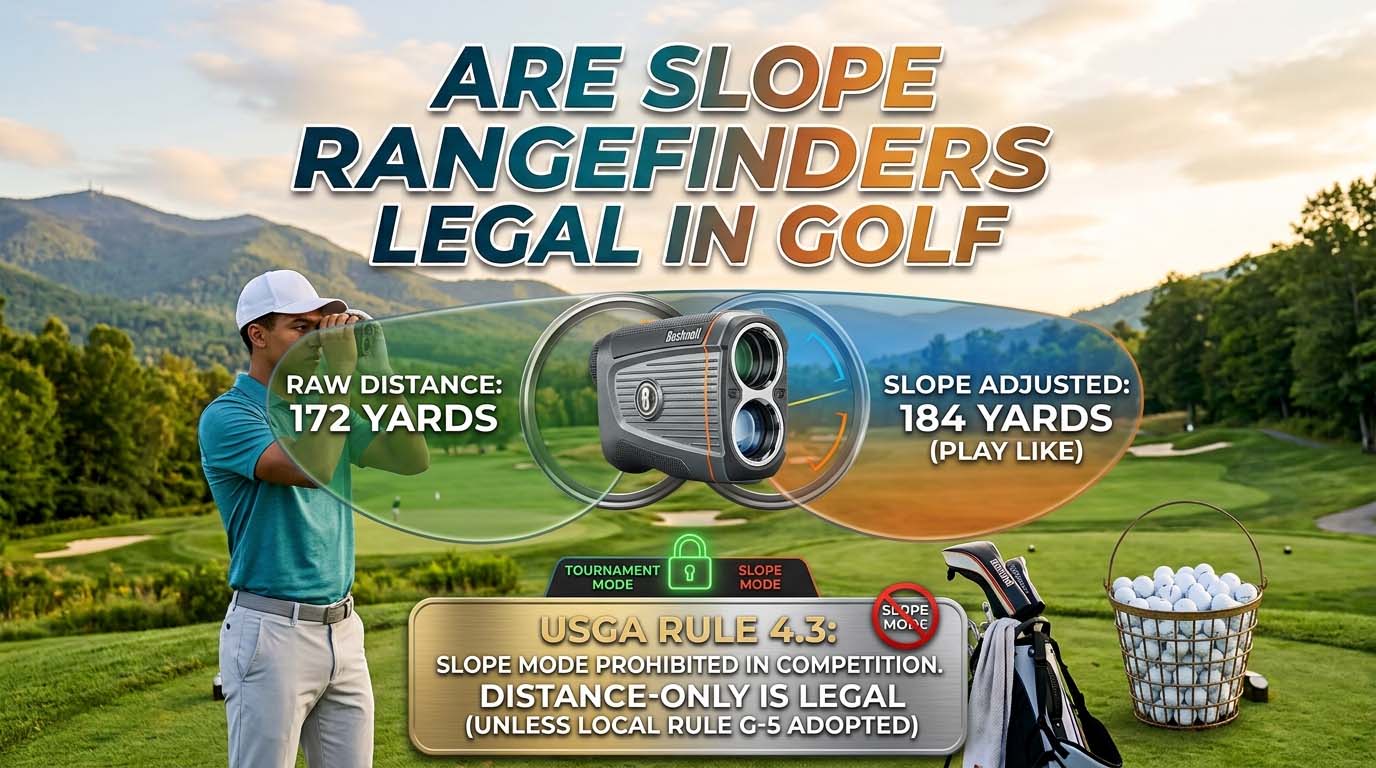
The honest answer is conditional, not a flat yes or no. Under the 2023 Rules of Golf (jointly published by the USGA and The R&A, checked 2026-08-10), Rule 4.3a restricts using a device to measure or account for elevation changes during a round played under the Rules of Golf. Separately, a committee has to adopt Model Local Rule G-5 to permit distance-measuring devices at all. A rangefinder with a slope feature is not automatically illegal to own or carry; using its slope function during a round where that isn't permitted is what breaches the rule. Two different questions get collapsed into one online, and untangling them is most of the confusion.
What Rule 4.3a actually restricts
Rule 4.3a covers use of equipment generally, and it draws a specific line around distance-measuring devices. A player is allowed to get distance or direction information from a device, such as a rangefinder or a compass. What the rule restricts is using that same device to measure elevation changes, or to gain other information, like wind speed, that would give the player more than a straight, unadjusted distance. A rangefinder that reports slope-adjusted "plays-like" yardage is providing exactly the kind of processed information Rule 4.3a is written to keep out of a round played strictly under the Rules of Golf.
Model Local Rule G-5: the other half of the question
Rule 4.3a on its own does not say distance-measuring devices are banned outright. Whether any rangefinder, slope-capable or not, is permitted in a given round depends on whether the committee running that round has adopted Model Local Rule G-5. Many club and casual competitions do adopt it, because most golfers now use one, but it is a Local Rule choice, not a default. This is why the honest answer to "is my rangefinder legal here" always starts with checking whether G-5 (or an equivalent local decision) is actually in effect for the specific round.
The switch-off distinction
Here is the part general blog posts most often get wrong: a rangefinder that includes a slope function is not disqualified from a round just because it has the feature built in. If the device can be switched to a mode that reports straight-line distance only, with the slope function off, using it in that mode during a round where DMDs are permitted under G-5 does not breach Rule 4.3a. The breach happens specifically when a player uses the device's elevation-adjusted output during the round. In practice, this means the same physical rangefinder can be legal in one round and a rule breach in another, depending entirely on how it's set and what the competition allows, not on what model it is.
What happens if slope is used when it isn't permitted
Under Rule 4.3a, the first breach carries the general penalty: loss of hole in match play, two penalty strokes in stroke play. A second breach of the same restriction during the same round results in disqualification. This structure (one warning-equivalent penalty, then disqualification) is the same asymmetry that shows up elsewhere in the equipment rules, and it means an accidental first use (forgetting to switch slope off) is recoverable if caught and corrected, while a repeated or deliberate use is not.
Casual rounds vs rounds played under the Rules of Golf
None of this restricts what a player does on a casual round that the group has not agreed to play under the Rules of Golf. A weekend foursome using a slope-enabled rangefinder for club selection, with no committee, no posted score for handicap purposes, and no stated agreement to play "by the rules," is not in breach of anything: there is no rules authority governing that round in the first place. The restriction becomes live the moment a round is played under the Rules of Golf: a club competition, most handicap-posting rounds, and anything run by an official committee.
How to find out what's actually in effect
The specific answer for any given round is whatever the competition's own terms or the club's Notice to Players says, not a general assumption pulled from an article, including this one. Most clubs that run any kind of competitive or handicap-relevant golf will state clearly whether distance-measuring devices are permitted and whether slope specifically is allowed. If nothing is posted and it matters, asking the pro shop or the competition committee directly settles it faster than searching further online. For what the pillar article covering the broader set of amateur-relevant equipment rules says about where local rules fit in, see /golf-equipment-rules-for-amateurs/.
FAQ
Can I own and carry a slope-enabled rangefinder even if slope isn't allowed in a competition?
Yes. Rule 4.3a restricts using the slope function during a round, not owning or carrying a device that has the capability. Switch the function off and the device functions as a standard distance-only rangefinder.
Is a rangefinder banned outright if my club hasn't adopted Model Local Rule G-5?
Then no distance-measuring device is permitted for that round under the Rules of Golf, regardless of whether slope is on or off. Check with the committee or pro shop for what's actually adopted at your club.
What actually changed my understanding of what "slope" measures, separate from the legality question?
That's a different article: see /what-is-slope-on-a-golf-rangefinder/ for what the slope feature does mechanically, as opposed to whether using it is permitted.
Does a slope penalty apply to a casual, non-competitive round?
No. The restriction only has force in a round played under the Rules of Golf. A casual round the group has not agreed to play "by the rules" isn't governed by Rule 4.3a at all.
What if I forget the slope function is on and use it once by accident?
The first breach carries the general penalty (loss of hole in match play, two strokes in stroke play), not disqualification. A second breach in the same round is what triggers disqualification, so catching and correcting it matters.
For the broader buying-decision context this fits into, see /golf-rangefinder-buying-guide/.