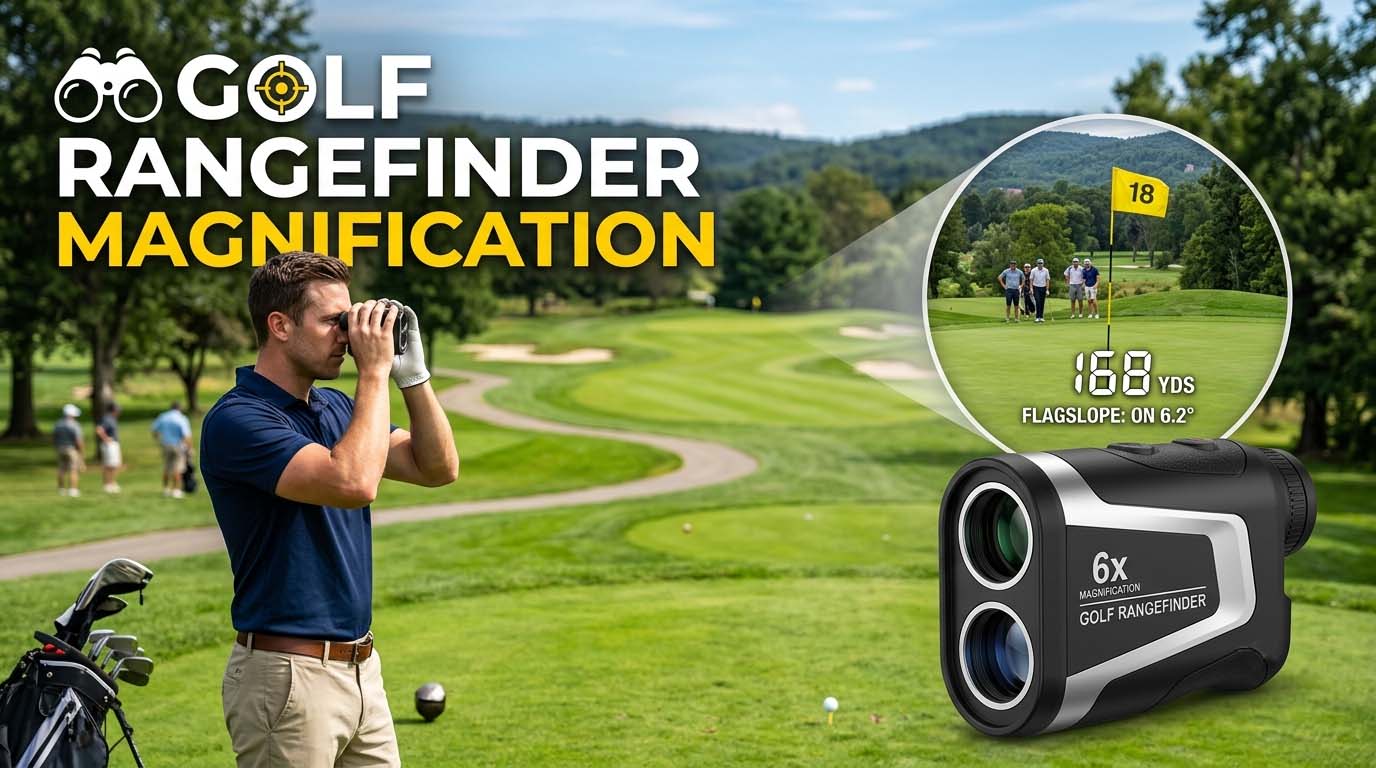
Six-times magnification is not a floor that budget models settle for or a ceiling that manufacturers have failed to push past. It is a deliberate balance point, and almost every laser rangefinder on the market, from entry-level to premium, ships with 6x or very close to it for the same reason: it is roughly where zoom stops helping and starts getting in the way.
What magnification actually is
Magnification on a rangefinder is an optical spec, not a measurement spec. A 6x rating means the target appears six times closer through the eyepiece than it does to the naked eye. That is the entire function of the number. It changes how large the flagstick looks when you raise the device to your eye. It does not change how the device measures distance, which is done separately by timing a laser pulse's round trip.
This distinction matters because listings sometimes present magnification alongside accuracy figures in a way that blurs the two together, as though a higher-zoom model is inherently a more precise one. See /golf-rangefinder-accuracy-explained/ for what actually governs a rangefinder's measurement accuracy; magnification plays no part in it.
Why 6x became the default
Optical zoom is a trade-off against field of view. The more a scope magnifies a target, the smaller the total area visible through the eyepiece becomes, and the harder it is to find and hold a small target like a flagstick in the first place, especially with a handheld device that is not mounted or braced. Manufacturer explainers from Mileseey Golf and GOGOGO SPORT both describe 6x as the point where you get enough zoom to clearly resolve a distant flag while keeping a wide enough field of view to actually locate it and hold it steady. Go meaningfully higher and that balance starts to tip.
The real cost of going higher
A 7x or 8x rangefinder is not a straightforward upgrade over a 6x one, and it is worth being specific about what changes.
Field of view narrows. A higher-zoom optic shows less total area at any given distance. On a golf course, where the target is a thin stick against a variable background (trees, bunkers, a grandstand), a narrower field of view can make the initial job of finding the flag through the eyepiece slightly harder, not easier.
Hand shake gets amplified. Any tremor in your grip is magnified along with the target. At 6x, a small shake is manageable. At 8x, the same shake becomes a visibly larger wobble in the eyepiece, which can make it harder to hold the crosshair steady on a thin target long enough to get a confident lock. This is particularly relevant if you are also relying on the flag-lock feature covered at /rangefinder-pin-lock-flag-lock-explained/, which needs a reasonably steady aim to do its job. If you are shopping magnification alongside a flag-lock feature, note that a steadier two-handed hold matters more, not less, as the number climbs. See /golf-rangefinder-not-locking-on-flag/ for the grip and aiming technique that offsets this.
Diminishing practical return. Beyond a certain point, additional zoom is resolving detail that the golfer does not need in order to identify a flagstick and get a locked reading. The visual gain becomes marginal while the steadiness cost keeps compounding.
Where higher magnification genuinely helps
This is not an argument that 6x is correct for everyone. A few situations make a case for going higher:
- Long, thin targets against heavy visual clutter: a flag set against dense tree lines or a backdrop with similar coloring can benefit from the extra optical detail a higher-zoom unit provides, assuming the hand-shake cost is managed (a steady stance, both hands, elbows in).
- Vision differences: some golfers simply see more comfortably at a higher zoom level, independent of any objective performance argument.
Neither of these is a claim that 7x or 8x measures more accurately. They are visual-comfort and target-acquisition arguments, and they are legitimate ones, but they are a different question from the one "magnification" answers on a spec sheet.
What magnification does not change
Worth stating directly, because spec sheets sometimes imply otherwise: the laser measurement itself, its round-trip timing and the resulting yardage figure, is entirely independent of the optical magnification used to view the target. A 6x device and an 8x device using the same underlying laser and sensor technology will return the same measurement for the same target; the difference is purely in how large and how steady that target appears to your eye while you aim.
A quick way to sanity-check magnification before you buy
If you get a chance to handle a rangefinder in person before buying, a simple check tells you more than the printed number does: raise the device to your eye, aim at a distant, thin object (a lamp post, a flagpole on a practice green, a fence post), and note how long it takes you to find and steady on it. A device that feels quick and stable to acquire a thin target at its stated magnification is telling you something the spec sheet alone cannot: how that particular unit's field of view and grip ergonomics work together in practice. This is a usability check, not a substitute for the manufacturer's own accuracy specification.
A practical way to read this spec on a listing
When comparing rangefinders, treat magnification as one input into how easy a device will be to use in the field, not as a proxy for measurement quality. Ask whether the listing separates magnification from accuracy in its own description, or whether it lists them together as though a higher number in one implies a better number in the other. A listing that keeps the two distinct is describing the spec accurately. One that blurs them is using an optical spec to imply a measurement claim it has not actually made.
FAQ
Is a higher magnification rangefinder always better?
No. Higher magnification narrows the field of view and amplifies hand shake, both of which can make it harder to acquire and hold a steady lock on a thin target. 6x is a deliberate balance point, not a compromise.
Does magnification affect how accurate the distance reading is?
No. Magnification is an optical spec governing how large the target appears. The distance measurement itself is produced by the laser's timing mechanism, which is unaffected by zoom level. See /golf-rangefinder-accuracy-explained/.
Why do almost all golf rangefinders use 6x instead of something higher?
Because 6x is close to the point where additional zoom stops adding practical benefit and starts costing field of view and steadiness. Manufacturers across the price range converge on it for this reason.
Should I pay more for a 7x or 8x model?
Only if you have a specific reason, such as heavy visual clutter behind typical targets or a personal vision preference, and you are prepared to hold the device more steadily to offset the added shake sensitivity. It is not a straightforward upgrade.
Does higher magnification help with flag-lock technology working better?
Not directly. Flag-lock relies on the device's target-prioritization algorithm, not on optical zoom. See /rangefinder-pin-lock-flag-lock-explained/ for how that feature actually works.
For the fuller framework on reading a rangefinder spec sheet without confusing marketing language for a measurable claim, see /golf-rangefinder-buying-guide/.