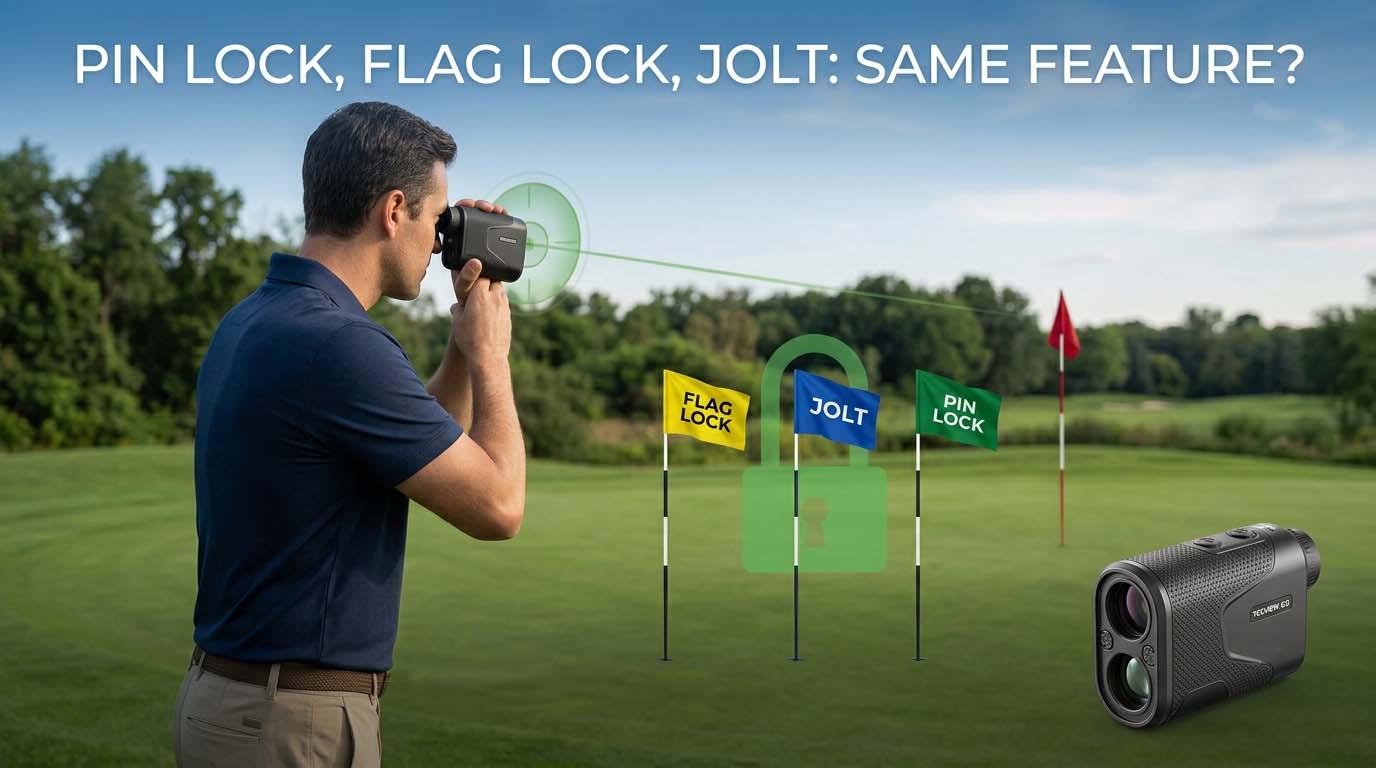
PinSeeker, Flag Lock, Pin Lock, Target Lock, and Jolt are brand-specific names for what is, functionally, one feature family: technology that helps a laser rangefinder correctly identify and hold onto a thin, distant target, usually the flagstick, instead of accidentally measuring a tree, a bunker edge, or a cart path behind it. The names differ by manufacturer. The underlying job the feature does is the same one across essentially every brand that offers it.
What this feature is actually solving
A laser rangefinder measures distance by timing a laser pulse's round trip to whatever it hits first along its aim path. Point it at an open target with nothing behind it, and this is straightforward. Point it at a flagstick standing in front of trees, a grandstand, or another part of the course, and the laser can potentially return a reading from something behind the flag instead of the flag itself, since more than one surface sits along roughly the same line of sight.
This is the real problem the feature exists to solve: helping the device recognize that a thin, close target (the flagstick) is the intended one, even when a larger, farther object sits directly behind it along the same line.
How it works, in plain terms
The device uses an algorithm that prioritizes a thin, vertical target profile over a larger background object along the same line of sight. When the device successfully identifies and locks onto that thin target, most models confirm the lock with a brief vibration, so the golfer knows the number on the display corresponds to the flag and not to whatever sits behind it.
This confirmation step is worth separating from the targeting step itself, because some marketing language blurs the two together. Bushnell, for example, uses "PinSeeker" for the overall targeting technology and "Jolt" specifically for the vibration confirmation that follows a successful lock. Other brands bundle both steps under a single name like "Flag Lock" or "Pin Lock." The vibration is not the targeting technology; it is confirmation that the targeting technology worked.
The brand-name table
Here is how the major naming conventions map onto the same underlying function, without ranking or recommending any specific brand or model.
| Brand-specific term | What it actually refers to |
|---|---|
| PinSeeker (Bushnell) | The targeting algorithm that identifies and prioritizes the flagstick over background objects |
| Jolt (Bushnell) | The vibration confirmation that follows a successful PinSeeker lock, not the targeting itself |
| Pin Lock (several brands) | Generally used as an umbrella term for both the targeting and the confirmation together |
| Flag Lock (several brands) | Functionally equivalent umbrella term to Pin Lock, used by different manufacturers |
| Target Lock (several brands) | Another umbrella term for the same targeting-plus-confirmation function |
The exact marketing name attached to a given rangefinder tells you very little about how that specific implementation performs. It tells you the manufacturer's chosen vocabulary, nothing more, and a listing that presents its version as fundamentally unique is describing branding, not a different technology.
What this feature does not do
It is worth being precise about the limits here, since some listings imply this feature does more than it actually does.
It does not add slope adjustment. Flag-locking technology and slope adjustment are separate features that are often bundled on the same device but are not the same thing; a rangefinder can have one without the other. See /what-is-slope-on-a-golf-rangefinder/ for what slope actually measures.
It does not increase the device's base measurement accuracy. The underlying laser measurement tolerance is unchanged by whether the device successfully identifies the flagstick over the background; what changes is the likelihood that the number on the display corresponds to the target you intended rather than something behind it. See /golf-rangefinder-accuracy-explained/ for what actually affects accuracy.
And it does not guarantee a lock every time. A flagstick that is very thin, poorly lit, or set against a background with similar reflectivity can still be difficult for any device to isolate confidently, regardless of brand.
Why this matters for comparing listings
When two rangefinder listings both advertise a flag-locking feature under different brand names, that similarity in vocabulary does not tell you the two devices perform identically, but the difference in vocabulary also does not tell you one is meaningfully more advanced than the other. Without an independent, verifiable test of both devices, a reader has no basis to conclude that one brand's naming implies better real-world performance than another's. Treat the presence of some version of this feature as a genuine spec worth having, and treat the specific brand name attached to it as marketing language rather than a performance claim.
A practical way to read this spec on a listing
When you see a flag-locking feature listed on a rangefinder, it is worth asking two separate questions rather than one. First: does the device have some version of this feature at all, since it is a genuinely useful spec on courses with cluttered backgrounds behind the green. Second: does the listing give you any independently verifiable detail beyond the brand name, such as how the confirmation is signaled (vibration versus a visual indicator) or how the manufacturer describes its background-rejection method. A listing that only repeats its brand name for the feature, without describing what it actually does, is telling you less than it appears to.
This is also a useful test for the broader habit of reading a rangefinder spec sheet covered elsewhere on this site: separate the part of a listing that is a checkable claim from the part that is simply vocabulary. A brand name for a feature family is vocabulary. Whether the feature is present at all, and how its confirmation step works, is closer to a checkable claim.
FAQ
Are PinSeeker, Flag Lock, and Pin Lock actually different technologies?
They describe the same underlying function, target prioritization and background rejection for a thin, distant object, under different brand-specific names. There is no public, independently verifiable basis for ranking one implementation above another purely from the name used.
What specifically is "Jolt"?
It is Bushnell's name for the vibration confirmation that follows a successful lock onto the flagstick. It is a confirmation signal, not the targeting mechanism itself, and other brands may achieve a similar confirmation through a visual indicator instead of vibration.
Does this feature work at any distance?
Its effectiveness generally depends on how thin and how well-lit the target is relative to its background, which is not solely a function of distance. A closer flagstick against a cluttered background can be harder to isolate than a farther one against open sky.
Do I need this feature if I mostly play courses with open, unobstructed greens?
It matters less on courses where the flagstick rarely has significant background clutter directly behind it. On courses with tree-lined greens or backdrops close to the pin, it becomes considerably more useful.
Does this feature replace the need for slope adjustment?
No, they solve different problems entirely. This feature is about correctly identifying the target; slope adjustment is about accounting for elevation change once the correct distance is measured. See /what-is-slope-on-a-golf-rangefinder/ for that separate feature.
For the fuller framework on separating genuinely comparable specs from marketing language across a whole rangefinder listing, see /golf-rangefinder-buying-guide/.