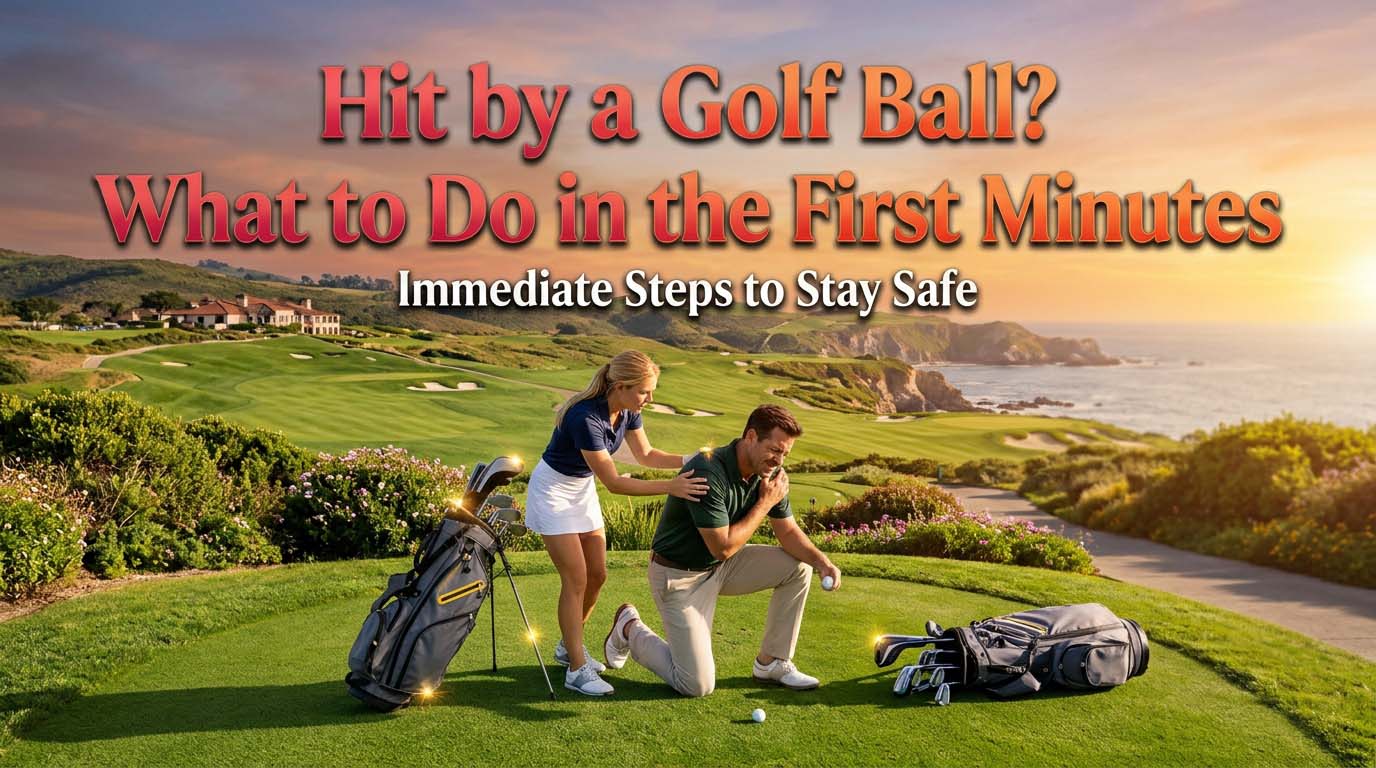
If you or someone in your group is hit by a golf ball, what to do first depends on where it struck. A blow to the head is treated as a possible head injury: the CDC says to call 911 or go to the nearest emergency department for danger signs such as seizures, repeated vomiting, slurred speech, a worsening headache, unusual behavior, one pupil larger than the other, or drowsiness. A blow near the eye goes to an ophthalmologist or emergency room, because the American Academy of Ophthalmology warns that "even a light blow" can cause a serious eye injury. Anything else is watched, reported to the course and taken to a doctor if it does not settle.
This is general safety information from public health and eye care sources, not medical advice. A clinician or 911 dispatcher who can assess the person always outranks this page.
Hit by Golf Ball, What to Do First: Head, Eye or Anywhere Else
Every source we read for this page points the same way: the head and the eyes are different from an arm or a leg. So the first question after a strike is not how much it hurts, it is where it landed.
| Where it hit | What the named source says |
|---|---|
| Head, face or neck | CDC: call 911 or go to the nearest emergency department if any danger sign appears |
| Eye, or around the eye | AAO: if a black eye, pain or visual disturbance occurs, "immediately contact your ophthalmologist or emergency room" |
| Arm, leg, body | No single source threshold; pain, swelling or trouble moving a limb that does not settle is a reason to see a doctor |
A struck golfer often wants to wave it off and keep playing. That instinct is the problem this page is written for.
A Blow to the Head: The CDC Danger Signs
The CDC's HEADS UP program, on its concussion signs and symptoms page (read September 27, 2026), introduces its list plainly: "Call 911 or go to your nearest emergency department if you notice any of the following danger signs following a bump, blow, or jolt to the head." The list is:
- "Convulsions or seizures (shaking or twitching)"
- "Not able to recognize people or places"
- "Repeated nausea or vomiting"
- "Unusual behavior, increased confusion, restlessness, or agitation"
- "Loss of consciousness with increasing drowsiness, inability to wake up, or inability to stay awake"
- "Slurred speech, weakness, numbness, or decreased coordination"
- "A headache that gets worse and does not go away"
- "One pupil larger than the other or double vision"
The same CDC page lists more common concussion symptoms that are not on the emergency list, including headaches, dizziness or balance problems, being bothered by light or noise, attention or concentration problems, feeling foggy or groggy, and irritability.
Why "I feel fine" is not the end of it
The CDC page says "concussion signs and symptoms may not show up right away" and "may take hours or days to appear or be noticed." That matters on a golf course, where a player can be struck on the 4th hole, feel shaken but upright, and finish the round before anything changes.
Two practical points follow from the CDC wording:
- Someone else should be watching. Several danger signs, such as confusion, unusual behavior and not recognizing people, are things the injured person may not notice in themselves. Playing partners are better placed to see them.
- The watching continues after the round. Because symptoms can appear hours or days later, the CDC danger list still applies at home that evening. The people the injured player lives with are worth telling about the strike, so they know what to look for.
A Blow Near the Eye
The eye gets its own section because the risk is easy to underrate. The American Academy of Ophthalmology's page on recognizing and treating eye injuries, read September 27, 2026, says "even a light blow can cause a significant eye injury, like a retinal detachment," and that "if a black eye, pain or visual disturbance occurs even after a light blow, immediately contact your ophthalmologist or emergency room."
On first aid for a blunt injury, the same AAO page describes gently applying "a small cold compress to reduce pain and swelling" and says, in capital letters, "DO NOT apply any pressure." It also advises against using food items as a compress because of contamination risk. That rules out the bag of frozen peas from the halfway house.
The CDC danger list above also includes "one pupil larger than the other or double vision," so a strike near the eye can raise both concerns at once. An emergency department can assess both.
Struck by a Club
Being hit by a swinging club is less common than being hit by a ball, and it tends to happen at close range: behind a player on the tee, or beside someone taking a practice swing. We found no separate public health guidance for club strikes, so the same escalation applies. A club to the head is a blow to the head under the CDC list. A club near the eye falls under the AAO warning. Anything else is judged the way any hard blow would be.
The prevention side is in the game's own guidance. The R&A's Spirit of the Game page (read September 27, 2026) says "a player should ensure that no one is standing close by or in a position to be hit by the club, the ball or any stones, pebbles, twigs or the like when they make a stroke or practice swing."
"Fore": What the Rules Expect of the Player Who Hit It
The same R&A page says: "If your ball is heading in a direction where there is a danger of it hitting someone, shout a warning immediately. The traditional word of warning is 'Fore!'." It also says players should "wait until the players in front are out of range," and "should always alert greenstaff nearby or ahead when they are about to make a stroke that might endanger them."
Those three lines describe most of the ways people get hit: a shot hit before the group ahead was clear, a shot toward maintenance staff, and a wayward ball with no shout.
What happens to the ball under the Rules
Players often ask whether a penalty applies when a ball hits someone. According to the R&A's Player's Rule Finder entry on a ball accidentally hitting a person, read September 27, 2026, "there is no penalty to any player" and the ball "will normally be played as it lies." Rule 11 covers the exceptions, such as a ball that comes to rest on a person. The Rules deal with the ball, not the injury, and nothing in them asks anyone to keep playing while a person is hurt. For the full rule text rather than a summary, see our guide on where to read the official Rules of Golf.
Clubs and tournaments can add their own expectations about warnings and safe play through a Code of Conduct, which is one reason it is worth reading a course's notices and Local Rules before a competition.
After the First Few Minutes: Reporting and Records
Once any medical question is handled, a few practical steps protect everyone involved. None of this is legal advice.
- Tell the course. The pro shop or starter should know. Courses often have an incident process and may know the fastest access route for an ambulance.
- Exchange names and contact details with the player who hit the shot, and with anyone who saw it.
- Write down what happened while it is fresh: the hole, the time, where each person was standing, and whether a warning was shouted.
- Take photos of the injury and, if relevant, the location.
- Keep medical records from any doctor or emergency visit.
Who is responsible for costs after a golf injury depends on the facts and on local law, and it varies between US states. If medical bills or a lasting injury are involved, a local attorney is the right person to ask, not a golf website.
Being Ready Before Anyone Gets Hit
The planning that makes the first minutes easier is simple:
- Know the course address and ambulance access point. A 911 dispatcher needs a location, and "the 14th hole" means nothing to them. The pro shop can give you the street address and the gate or service road.
- Carry a charged phone. Many golfers already carry one for yardages, as covered in our comparison of a golf GPS watch vs a handheld unit. The same phone is how a group calls for help and shares a location.
- Ask where the first aid kit and any AED are kept. Most players never ask until they need it.
FAQ
What should I do if I get hit in the head by a golf ball?
The CDC says to call 911 or go to the nearest emergency department if danger signs appear, such as seizures, repeated vomiting, slurred speech, a worsening headache, unusual behavior or unequal pupils. The CDC also notes symptoms can take hours or days to show, so a clinician's assessment is worth having even without them.
Is getting hit near the eye by a golf ball an emergency?
The American Academy of Ophthalmology says to immediately contact an ophthalmologist or emergency room if a black eye, pain or visual disturbance occurs, even after a light blow, and warns against applying any pressure to the eye.
Is there a penalty if my ball hits another person?
No. The R&A says there is no penalty to any player when a ball in motion accidentally hits a person, and the ball is normally played as it lies.
Do the Rules of Golf require shouting fore?
The R&A's Spirit of the Game guidance says to shout a warning immediately if a ball might hit someone, and that "Fore!" is the traditional word. Clubs can also set their own conduct expectations.
Should the person who was hit keep playing?
That is a medical question, not a golf one. Because the CDC notes head injury symptoms may appear hours or days later, a head strike is one for a clinician to assess rather than something to play through.