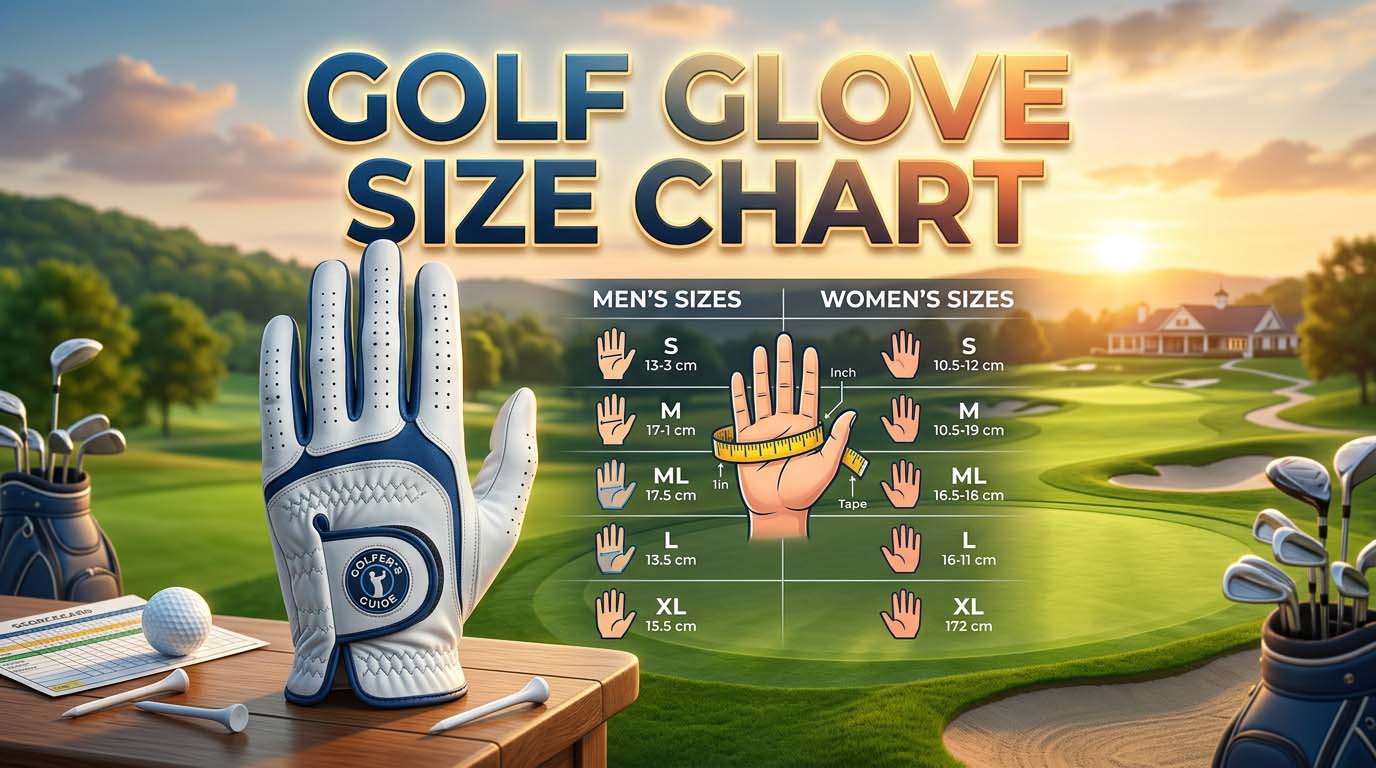
There is no single golf glove size chart. Each maker publishes its own, and the same hand can land in different sizes at different brands. Measure two things, your middle finger length and your hand circumference around the knuckles, then use the chart of the exact brand you are buying. If your fingers are short for the width of your palm, look at cadet sizing. And if your glove keeps wearing through in the same spot, treat that as information about fit, grip pressure or worn grips, not simply as a cheap glove.
Everything below comes from makers' own sizing pages, a glove brand's published guidance and the Equipment Rules, all read on September 24, 2026. We have not worn or tested any of these gloves.
Why No Golf Glove Size Chart Is Universal
Two makers can use the same measurement and still draw the size lines in different places.
Nike and Red Rooster Golf both ask for your middle finger length, measured from the crease between your middle and index fingers to the tip of your middle finger. Nike's golf glove size chart, read September 24, 2026, pairs that with hand circumference, measured by wrapping a tape snugly around your knuckles. Red Rooster's chart adds a second length, from the first wrist crease under the palm to the tip of the middle finger, and describes a circumference measurement around the widest part of the palm.
Now look at where each one puts a middle finger of 3.4 inches:
| Size | Nike men's middle finger (in) | Red Rooster men's middle finger (in) |
|---|---|---|
| Small | 2.7 to 3.21 | 2.75 to 3.2 |
| Medium | 3 to 3.31 | 3.2 to 3.5 |
| Medium/Large | 3 to 3.41 | 3.4 to 3.7 |
| Large | 3.13 to 3.5+ | 3.6 to 4 |
| X-Large | 3.21 to 3.5+ | 3.7 to 4.5 |
At Red Rooster, a 3.4-inch middle finger sits in Medium or Medium/Large. At Nike, it is outside the Medium range entirely and falls within Medium/Large, Large or X-Large, which is why Nike's chart also asks for your circumference to settle it. Neither brand is wrong. They are simply not the same scale, and a "Medium" is a brand's word, not a measurement.
Nike's ranges also overlap from one size to the next. Its men's Medium lists a hand circumference of 7.36 to 8.46 inches and its Medium/Large 7.6 to 8.68 inches. When ranges overlap, the combination of both measurements decides the size, not either one alone.
How to Measure Your Hand for Any Chart
Take all three measurements once and keep them. Then whichever chart you open, you have what it asks for.
- Measure the hand that wears the glove. For a right-handed golfer that is the left hand; for a left-handed golfer, the right.
- Middle finger length. From the crease between your middle and index fingers to the tip of your middle finger. Both charts above use this.
- Full hand length. From the first crease on your wrist, closest to the palm, to the tip of your middle finger. Red Rooster uses this.
- Circumference. Wrap a soft tape snugly around your knuckles, keeping it level across the widest part of the palm.
- Write down inches and centimeters. Some charts give both, some only one, and converting in the store invites mistakes.
If you fall on a boundary, the brand's own chart and the fit checks below should decide it, not your size in a different brand.
Regular vs Cadet Sizing
Regular and cadet are two shapes, not two sizes. Vice Golf's explainer on regular and cadet sizing, dated March 12, 2025 and read September 24, 2026, says cadet gloves have "slightly shorter finger lengths and a wider palm and back of the hand relative to 'regular' size gloves." It estimates that more than 20% of golfers need a cadet-sized glove, while most have never heard the term. That figure is the brand's own estimate, and we have not seen the data behind it.
The practical sign: if a regular glove that fits your fingers feels tight across the back of your hand, or one that fits your palm leaves loose material at the fingertips, your hand shape may be cadet. Not every maker offers the full range. Red Rooster's page says its cadet gloves are available in Small, Medium and Large only.
How a Glove Should Fit
Vice describes an ideal fit as "slightly taut over the palm of the hand and around the fingers," with no looseness at the wrist and no excess room at the fingertips, and says a poorly fitting glove reduces grip control and wears more easily.
Put that into checks you can do in a store or when a delivery arrives:
- No loose material in the palm. Wrinkles or folds in the palm can rub against the grip.
- No empty fingertips. Extra length at the tips bunches when you close your hand.
- The wrist closure sits flat. A glove that is loose at the wrist can shift on the hand.
- You can still close your hand fully. A glove too small to make a fist is too small to hold a club comfortably.
Why Your Glove Wears Through in One Spot
A glove that always fails in the same place is leaving a record. The useful question is what it records.
MG Golf's guide to glove wear patterns, by Rich Card, dated August 3, 2026 and read September 24, 2026, lays out what each location can point to. We summarize it here as possibilities, which is how the guide itself frames them:
| Where it wears | What it can point to, per MG Golf |
|---|---|
| Palm hole | The club sitting too deeply across the palm, excess pressure, or repeated rubbing |
| Heel pad | Normal contact from a grip that uses the heel pad, or friction from a shifting handle |
| Thumb | Thumb placement, a long or extended thumb, changing pressure, or the thumb rubbing on a worn grip |
| Fingertips | Pressure concentrated in the fingers, a glove too short in the fingers, or grips that are too small |
The same guide is careful to say a palm hole does "not always" mean a grip fault. It names three contributors that have nothing to do with your swing: glove fit, moisture from sweat or rain softening the leather, and worn grips whose slick surface encourages squeezing.
That last point is the one most people skip. If your grips have gone shiny or slick, you will squeeze harder without deciding to, and the glove pays for it. Check the signs covered in when to regrip golf clubs before you blame the glove or your hands. If the wear sits at the fingertips, grip thickness is worth a look too, and grip size is the cheapest spec change you can make.
We do not diagnose swings, and neither does a hole in a glove. If the same spot wears through on every replacement, a PGA professional can look at your grip in person, which a wear pattern alone cannot do.
Can a Padded or Reinforced Glove Fix It?
Only up to a point, because the Equipment Rules limit what a glove may add. Rule 4.3a(5), as published by The R&A, permits "a plain glove that meets the requirements in the Equipment Rules," along with resin, powders and a towel or handkerchief wrapped around the grip.
Section 6.2 of The R&A's Equipment Rules, read September 24, 2026, defines a plain glove as a fitted covering of the hand with a separate sheath or opening for each digit, made of smooth materials on the full palm and gripping surface of the digits. It bars material whose purpose or effect is padding, and defines padding as an area of glove material more than 0.025 inches (0.635 mm) thicker than the adjacent areas. Straps, bound fingers, adhesive materials and positioning features are also out.
So a glove with a genuinely thicker pad over the palm or thumb to resist wear can make it non-conforming for a scored round, however sensible it looks. The same logic catches gloves with built-in hand-position guides, which is why training aids during a round get their own rule. If you only practice in a glove like that, keep a plain one in the bag for play.
Making a Glove Last Longer
The same factors that cause wear are the ones you can manage:
- Size by the brand's own chart, every time you change brands.
- Keep grips in good condition. A grip that has lost its tack costs you gloves as well as control.
- Deal with moisture. MG Golf names sweat and rain softening leather as a wear factor, so let a damp glove dry flat between uses rather than balling it in a pocket, and consider a second glove for hot or wet days.
- Watch the wear spot, not just the hole. A thinning patch shows where friction is happening long before it tears.
FAQ
What size golf glove do I need?
Measure your middle finger length and hand circumference around the knuckles, then use the chart of the brand you are buying. Charts differ: a 3.4-inch middle finger is Medium or Medium/Large on Red Rooster's chart, but falls outside the Medium range on Nike's.
What does cadet mean on a golf glove?
It is a different shape, not a smaller size. Vice Golf describes cadet gloves as having slightly shorter fingers and a wider palm and back of the hand than regular gloves.
Why does my golf glove tear at the thumb?
MG Golf lists thumb placement, a long or extended thumb, changing grip pressure, or the thumb rubbing on a worn grip as possible causes. Check your grips first, and have a professional look at your grip if every glove fails in the same place.
Are padded golf gloves legal?
Only within limits. The Equipment Rules, section 6.2, bar padding material more than 0.025 inches (0.635 mm) thicker than the adjacent areas, so a heavily padded glove may not conform for a scored round.