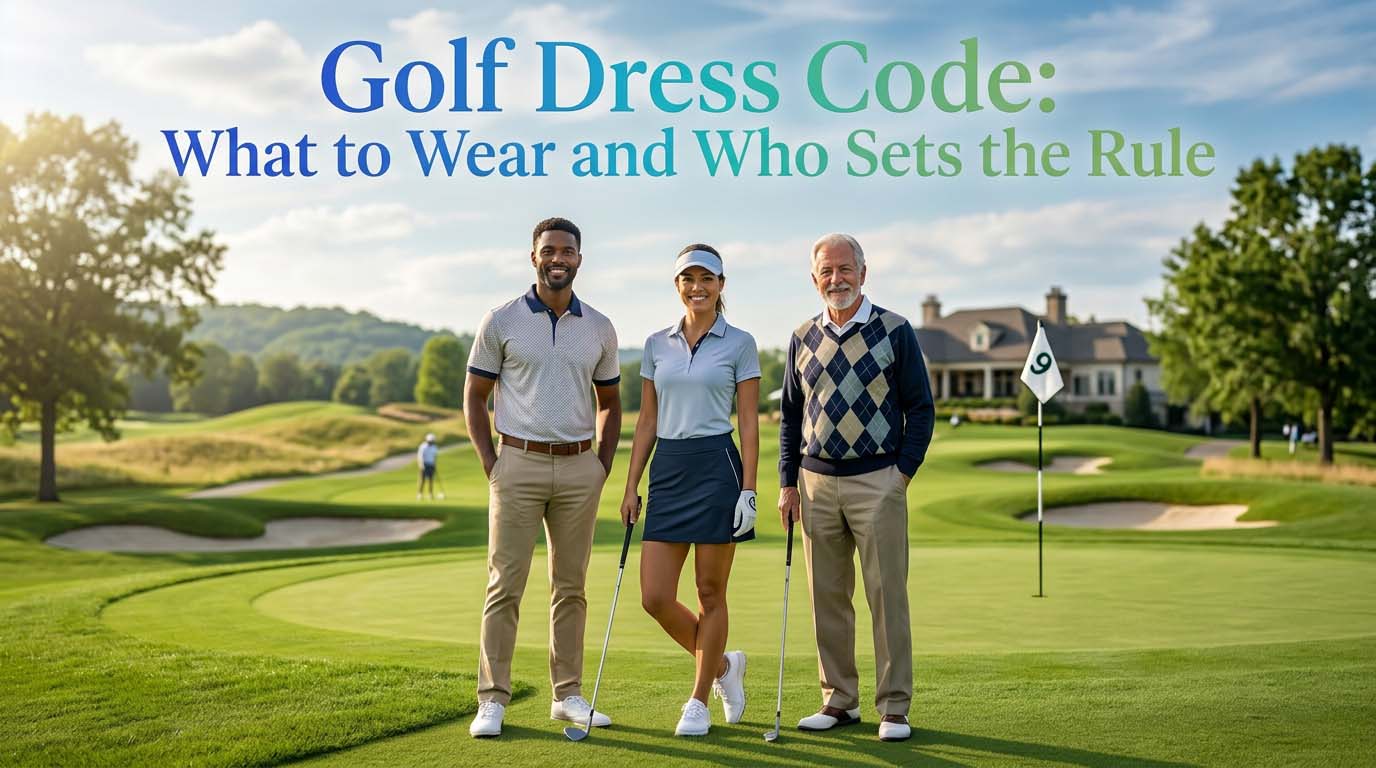
For the golf dress code, what to wear depends on the course, not on the Rules of Golf. The official Rules only regulate clothing that could help you make a stroke; collars, denim and shorts are each course's own policy. Across the published US policies we checked, one combination passed all of them: a collared or mock-neck golf shirt, tailored pants or shorts that are not denim or athletic wear, and golf shoes or closed-toe athletic shoes without metal spikes. Check the specific course's page before you go, because denim, the driving range and even the month can change the answer.
We are not golfers writing from the first tee. This is built from the Rules of Golf as published by The R&A and from dress code pages that courses and a golf association publish themselves, all read on September 24, 2026.
The Rules of Golf Say Almost Nothing About What You Wear
It surprises a lot of people, but nothing in the Rules of Golf requires a collar. Rule 4.3, on The R&A's site, covers gloves and gripping materials in Rule 4.3a(5) and then notes that further guidance on other types of equipment, "such as clothing and shoes," is found in the Equipment Rules.
The Equipment Rules deal with clothing in one short section, and it is about performance, not appearance. Part 6 of The R&A's Equipment Rules, read September 24, 2026, says in section 6.4 that articles of clothing must not incorporate features designed to assist the player with alignment, or that might otherwise assist the player in making a stroke or in their play. That is the whole clothing rule.
Shoes get similar treatment. Section 6.3 says shoes that assist the player in obtaining a firm stance may be worn and that, "subject to the conditions of competition, features such as spikes on the sole are permitted." They must not include features designed to help you build a stance or line up.
Put plainly: a T-shirt, jeans and metal-spiked shoes break no Rule of Golf. When a course turns someone away for wearing them, it is enforcing its own policy. That distinction matters, because it tells you where to look for the real answer: the course, not the rulebook. If you want to read the Rules yourself rather than a summary, here is where to find the official Rules of Golf.
Golf Dress Code: What to Wear at the Courses We Checked
Because every course writes its own policy, the honest way to describe "the" golf dress code is to read a few real ones. We picked three US facilities that publish their policy in full, one run by a city, one by a university and a third golf club, and read each on September 24, 2026.
| Sandhill Crane (City of Palm Beach Gardens, FL) | UGA Golf Course (University of Georgia) | Colorado National Golf Club | |
|---|---|---|---|
| Shirts | Men: collared or mock-collar required; T-shirts, jerseys, tank tops not permitted | Men: collared shirts. Women: collared shirt or blouse | Collared shirt required at all times; T-shirts and tank tops never allowed |
| Denim | Not permitted | Not permitted on the course | Not allowed March through October |
| Other bottoms | Men: pants or Bermuda-length shorts; running, workout and basketball shorts not permitted | No sweat pants, gym shorts or cutoffs | Not specified beyond denim |
| Shoes | Golf or closed-toe tennis shoes; no sandals, flip-flops or metal spikes | Not specified | Not specified |
| Driving range | Not specified separately | Denim, sweat pants, T-shirts and gym shorts allowed at the range | Rules apply to the range and practice areas too |
The Palm Beach Gardens policy is on the city's official dress code page and applies to its Sandhill Crane Championship Golf Course. For women, it permits golf and tennis apparel, lists tank tops, halters, crop tops and swimwear as not permitted, requires skirts, shorts, leggings and dresses to be "golf-appropriate in length," and adds high heels to the banned shoe list.
What the Differences Tell You
Three policies are not a survey, and we would not draw national percentages from them. But the pattern is useful, because it shows which parts of the answer are stable and which are not.
Collars are the constant. All three require a collared shirt, and one explicitly accepts a mock collar for men. If you only own one thing that looks like golf clothing, make it a collared or mock-neck golf shirt.
Denim is the variable. One course bans it outright, one bans it on the course but allows it on the range, and one bans it only from March through October. "Can I wear jeans?" has no national answer. It has a course answer, and sometimes a seasonal one.
The range is not always the course. UGA relaxes its code at the driving range; Colorado National applies the same rules to its range and practice areas. Never assume the practice area is casual.
Metal spikes are a course ban, not a Rules ban. The Equipment Rules permit spikes, subject to the conditions of competition. Sandhill Crane bans metal spikes anyway. Whatever a course's reasons, its policy is the one enforced at the desk.
Athletic wear is where people get caught. Running, workout, basketball and gym shorts appear on the banned lists even where tailored shorts are fine. In these policies the line is drawn by the type of garment, and Sandhill Crane also names the fabric: cotton or synthetic blend.
When the Dress Code Carries a Penalty
In casual play, the worst a dress code can do is keep you off the first tee. In competition it can cost strokes, and here the Rules of Golf do come in, through a side door.
Rule 1.2b, as published by The R&A, lets a Committee "set its own standards of player conduct in a Code of Conduct adopted as a Local Rule," with penalties "such as a one-stroke penalty or the general penalty," and disqualification for serious misconduct. A dress code can be one of those standards. How a Local Rule sits alongside the main Rules is covered in Local Rules vs the Rules of Golf.
The Palm Beach County Golf Association's Code of Conduct, read September 24, 2026, is a clear US example. It requires collared shirts tucked in at all times and hats worn brim forward, and it prohibits tank tops, T-shirts, jeans, sweat pants, and denim, cargo, gym and short-shorts. Its Tournament Committee may impose a one-stroke penalty for each breach of the Code. It also says that if a host course has a stricter dress code, the course's policy takes precedence, and that "players in violation will not be allowed to tee off."
So if you enter an amateur event, read two documents: the event's Code of Conduct and the host course's own policy. The stricter one is the one that applies to you in practice.
A Kit That Passes Almost Anywhere
This is a budget-first site, so here is the minimum, built only from what the policies above actually require:
- Shirts: one or two collared golf polos, or mock-neck golf tops where the course accepts them. No logo or brand requirement appears in any policy we read.
- Bottoms: tailored pants or tailored shorts in a cotton or synthetic blend, not denim and not athletic shorts. Chinos you already own may well pass.
- Shoes: golf shoes without metal spikes, or clean closed-toe athletic shoes where the course allows tennis shoes, as Sandhill Crane does.
- Hat: optional, but where a code mentions hats, wear them brim forward.
- Layers: check the course's wording. UGA explicitly accepts "appropriate winter golf attire," a reminder that cold-weather layers are expected in season.
Nothing on that list needs to be golf-branded to pass a policy. The equipment the Rules do govern closely is your clubs and ball, and for most players the equipment rules that actually affect amateurs matter far more than the shirt.
How to Check Before You Go
Dress codes change, and the page you read today may not be the one enforced next season. Palm Beach Gardens' current policy, for example, carries its own effective date. A two-minute check saves an awkward conversation at the pro shop:
- Find the course's own policy page. Look under "policies," "course information" or "dress code" on the course or city site, not on a golf retailer's blog.
- Check denim and shorts specifically, since those vary most.
- Ask whether the range follows the same code if you plan to warm up there.
- Check the season. Some policies change by month.
- For an event, read the Code of Conduct too. A stroke penalty is a worse outcome than a polite refusal at the desk.
- When in doubt, call the pro shop. The course sets the answer, so the course is the only source that is always right.
FAQ
Do the Rules of Golf require a collared shirt?
No. The Equipment Rules, section 6.4, only bar clothing with features that help with alignment or the stroke. Collar requirements come from each course's policy, or from a Code of Conduct that a competition Committee adopts under Rule 1.2b.
Can you wear jeans on a golf course?
It depends on the course. Of the three US policies we read, one bans denim outright, one bans it on the course but allows it at the driving range, and one bans it only from March through October. Check the specific course's page.
Are metal spikes allowed?
The Equipment Rules permit spikes, subject to the conditions of competition. Courses can still ban them, and Sandhill Crane's published policy does. Spikeless golf shoes or closed-toe athletic shoes, where allowed, avoid the question.
Can a dress code cost me strokes?
Only in competition. Under Rule 1.2b a Committee can adopt a Code of Conduct with penalties, and the Palm Beach County Golf Association's code allows a one-stroke penalty per breach and says violators will not be allowed to tee off.