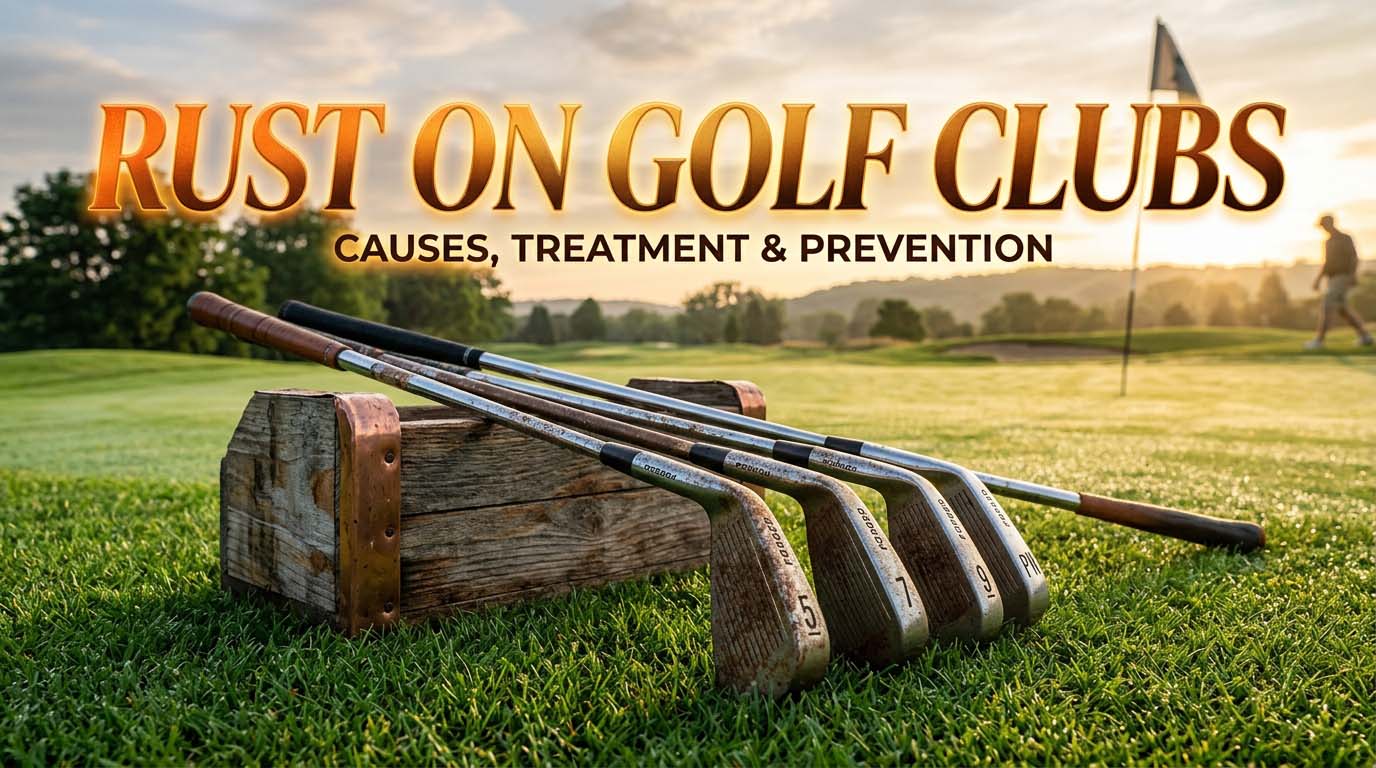
Most rust on golf clubs is cosmetic, not a defect. If it’s an even, orange-brown patina on the face of a raw wedge, the club was likely made that way on purpose and it isn’t losing you distance or spin. Rust becomes an actual problem when it’s uneven and pitted, when it’s spreading across the grooves themselves, or when it shows up on a steel shaft, especially near the hosel, where pitting can eventually weaken the metal.
The trick is knowing which kind you’re looking at before you decide to scrub it off, ignore it, or replace the club.
Both kinds show up often enough on secondhand clubs that the difference becomes obvious once you know what to check for. Here’s how to tell them apart, what actually causes each, and when rust is worth acting on.
Why Some Clubs Rust and Others Don’t
Forged irons and wedges are typically made from soft carbon steel because it gives better feel at impact. Carbon steel also corrodes easily, so most clubs get a layer of chrome or nickel plating to seal it off from air and moisture. As long as that plating is intact, the club shouldn’t rust.
Two things break that seal. The first is ordinary wear: dings from cart paths, bunker sand, and years of shots gradually thin the plating until bare steel is exposed underneath. The second is intentional: more and more tour-style wedges ship “raw,” meaning the manufacturer skips plating entirely.
The bare steel starts oxidizing almost immediately, sometimes before the club is ever swung. That’s a design choice, not a manufacturing fault, and it’s why you’ll see brand-new raw wedges with a faint rust bloom already forming in the box.
Finish names on a spec sheet matter here too. Chrome and nickel plating are the two most common protective finishes, and both hold up well until they chip or scratch.
Black oxide and other dark PVD-style finishes sit somewhere in between: they resist rust better than raw steel but tend to wear thin at contact points over a season or two, showing bright or rusty patches exactly where the club meets the ball and the turf.
None of that is a defect either; it’s just how a coating that thin behaves under repeated impact.
Cosmetic Rust on Golf Clubs vs. the Kind That’s Actually a Problem
The fastest way to judge rust is by where it sits on the club and what it looks like there.
| Location | What it looks like | What it means |
|---|---|---|
| Face of a raw wedge | Even, fine, orange-brown patina spread across the whole face | Cosmetic. This is the intended finish; leave it alone. |
| Face of a chrome/nickel wedge or iron | Small rust spots where plating has chipped | Cosmetic for now, but the exposed spot will keep growing if left wet |
| Grooves | Rust filling the groove channels themselves | Worth cleaning out. Debris and rust in the grooves reduce their ability to grip the ball, which matters more than the rust itself |
| Shaft, especially near the hosel | Rough, flaky, or pitted texture rather than smooth discoloration | Take seriously. Pitting on a steel shaft is a structural concern, not a cosmetic one |
If you’re staring at your own set trying to decide which row applies, the honest test is texture, not color. Surface patina is smooth to the touch. Damaging rust is rough, flaky, or starting to pit the metal. Run a finger over it before you panic.
Does Rust Add Spin? The Myth, Debunked
There’s a long-running belief among golfers that a rusted face grips the ball better and adds spin. It’s intuitive: rust looks rough, rough should mean more friction, but it isn’t how spin actually works on a wedge.
Independent testing on raw versus chrome wedges found spin numbers between a rusted face and a fresh one landing close together, within a modest margin, with launch and ball speed also close to a wash.
Spin comes from groove sharpness and face texture at a microscopic level, not from a layer of surface oxidation.
What raw, unplated wedges do have going for them is a real but different advantage: in wet conditions, they tend to hold spin better than plated ones, because the lack of plating lets the grooves themselves do more of the work without a slicker surface interfering.
That’s a groove and material story, not a rust story. If your wedge is rusting and you’re hoping that’s the reason you’re spinning it better, the more likely explanation is the grooves are simply doing their job, and you should check whether they’re still within legal limits using the groove rule for wedges before crediting the rust for anything.
Is a Rusted Club Still Legal to Play?
Yes, in essentially every case. The Rules of Golf draw a distinction between damage and normal wear. A club that changes gradually through ordinary use, and rust from moisture exposure over time fits that description, keeps its conforming status even though its condition has changed.
According to the USGA Rules of Golf (read 2026-09-18), a club is treated as still conforming if it changes through normal wear rather than a specific damaging event, and there’s no penalty for continuing to use it. Rust doesn’t disqualify a club from competition play. It just looks like it should.
Where the rules do matter is if you’re trying to swap the club out mid-round for a fresh one. You generally can’t replace a club you damaged yourself during a round with a new one; you can repair it or keep using it as is.
Since rust builds up over weeks and months rather than during a single round, this rarely comes up in practice, but it’s worth knowing if a groove fills in badly enough mid-round that you’re tempted to pull a spare from the bag.
What Actually Causes Rust, and How to Slow It Down
Moisture sitting on bare or exposed steel is the entire mechanism. Everything else is a variation on that theme:
- Wet rounds without drying. Dew, rain, and wet rough leave water on the clubhead. Left to sit in a bag, that moisture does the damage overnight rather than during the round itself.
- Storage in the wrong place. A damp garage, a car trunk that swings between hot and cold, or a basement with humidity all accelerate rust on exposed steel. If your clubs live somewhere with big temperature or humidity swings between rounds, leaving clubs in a cold garage is worth reading before your next off-season.
- Skipping the off-season wipe-down. Clubs that go into storage for winter without being cleaned and dried first spend months sitting with whatever moisture and grit were on them at the last round. Putting golf clubs away for winter properly is a fifteen-minute job that prevents a spring full of rust spots.
- Never wiping the face between shots. This mostly matters for raw wedges, where there’s no plating buffer at all. A dry towel clipped to the bag, and a quick wipe after each shot slows the patina from turning uneven.
None of this eliminates rust on a raw wedge, and it isn’t supposed to. The goal is to keep it even and light rather than letting it turn into pitting, which is the difference between cosmetic and genuinely damaging.
When Rust Is a Genuine Problem
Three situations move rust from “leave it alone” to “deal with it”:
Pitting on the shaft. A smooth, discolored shaft is cosmetic. A rough, cratered one has lost material, and pitting near the hosel specifically is a stress point where a shaft is more likely to fail under load. This is the one case where continued play carries real risk, not just a resale hit.
Rust filling the grooves. Grooves that are packed with rust and debris can’t do their job, which shows up as flyers and inconsistent spin from the rough, not from anything wrong with your swing.
Uneven, spreading corrosion on a plated club. A single chip in chrome plating that’s been left wet for months can spread well beyond its starting point. At that stage, it’s a sign the plating has failed, not that the club has a raw finish, and it will keep getting worse.
Buying Used Clubs With Rust: What to Check
Rust is common enough on the secondhand market that it shouldn’t be an automatic dealbreaker, but it should change how carefully you inspect a set.
Run a finger over any rust you see before buying: smooth means patina, rough means wear that’s already progressed. Check the shaft near the hosel specifically, since that’s the spot most likely to hide pitting under a light coat of surface rust, and check the grooves for the same rough, pitted texture rather than just a dusting of surface color.
If you’re weighing a rusted set against a cleaner one at a similar price, buying used golf clubs covers what actually wears out on a club versus what’s just cosmetic, which is the same judgment call rust forces you to make.
A seller who can’t or won’t explain why a wedge is rusty, raw finish, or neglect is worth a second question before you hand over money.
The Short Version
If the rust is smooth and even, it’s cosmetic and probably intentional; keep playing and stop worrying about it.
If it’s rough, flaking, or working its way into a groove or a shaft near the hosel, that’s wear that’s gone further than it should, and it’s worth cleaning, watching, or, in the shaft case, having someone look at it before you swing it hard again.
FAQ
Does rust on a golf club hurt performance?
Light, even surface rust on a raw wedge face does not meaningfully change spin or distance. Rust that fills the grooves or pits a shaft can hurt performance, but the rust itself isn’t the direct cause; groove condition and shaft integrity are.
Is it okay to use a rusty club in a tournament?
Yes. A club that rusts through normal wear over time keeps its conforming status under the Rules of Golf. There’s no rule against playing a rusted club.
Should I clean the rust off my raw wedge?
If it’s even and light, no; that’s the intended finish, and removing it doesn’t improve anything. If it’s uneven, flaking, or filling the grooves, a light cleaning with a groove brush and a damp cloth is reasonable.
Avoid soaking the club or scrubbing aggressively, since that can strip more finish than you intended.
How do I stop my clubs from rusting in storage?
Dry them completely before they go away, store them somewhere with stable temperature and low humidity, and avoid leaving them in a garage or car trunk for extended stretches between rounds.
Does rust lower the resale value of golf clubs?
It can, especially if a buyer can’t tell at a glance whether it’s intentional raw patina or neglect. Clean, even rust on a known raw model rarely hurts resale; uneven or pitted rust on a plated club usually does.