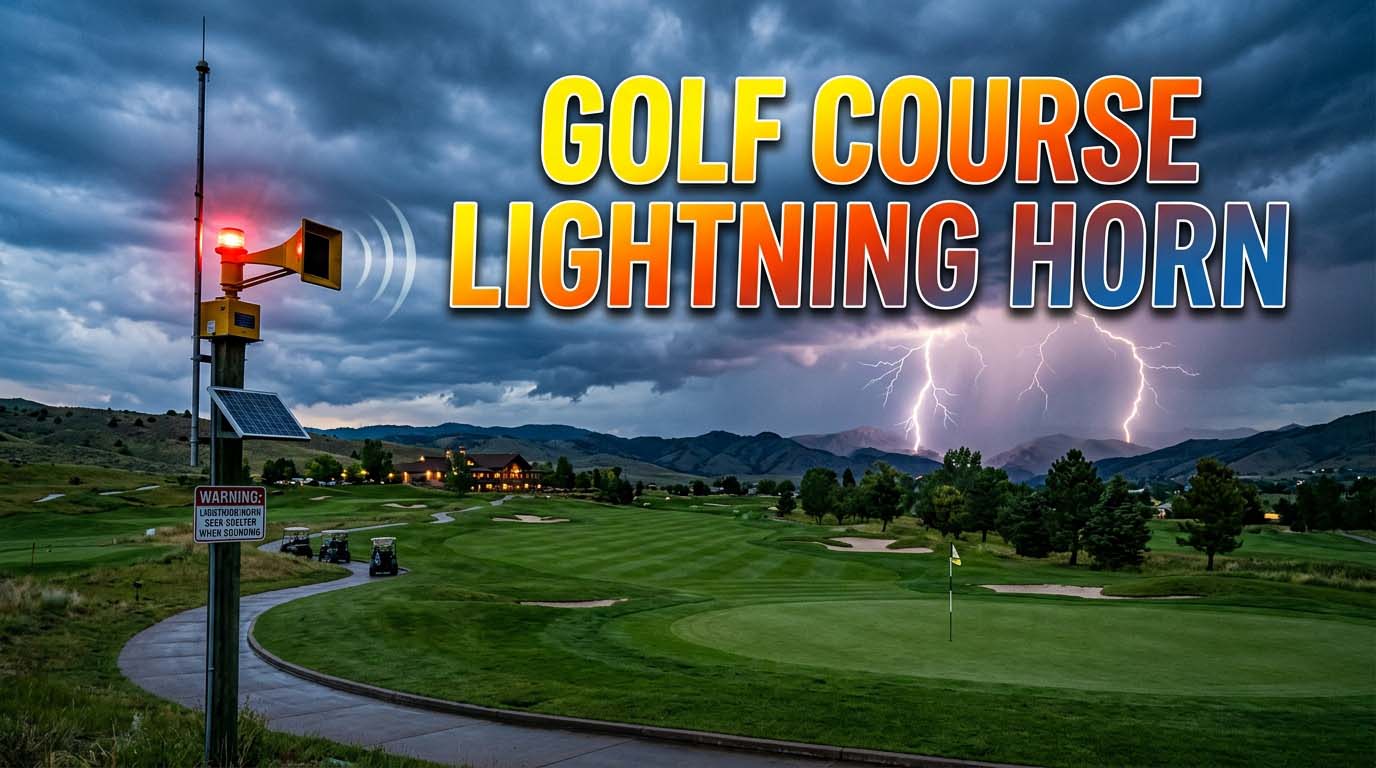
If you hear the golf course lightning horn, what to do is simple: stop playing immediately, do not hit another shot or finish the hole, and head straight for a substantial building or a hard-topped vehicle. Do not wait for rain, and do not shelter under trees, in a golf cart or in an open course hut. The National Weather Service says there is no safe place outside when a thunderstorm is in the area, and under the Rules of Golf an immediate suspension means no further strokes. The short putt can wait. Stay inside until the course signals that play has resumed.
The rest of this page walks through that first minute step by step, explains why "finish the hole" is the wrong instinct, and covers what the Rules say when you stop.
Why the Answer Is Not "Finish the Hole"
The instinct to tap in is understandable. You are standing on the green, the ball is two feet away, and it feels absurd to walk off. But the horn is not a scheduling notice. On a course that uses a lightning warning, it means someone monitoring the storm has judged the danger close enough to clear the course.
The National Weather Service's lightning safety overview (read September 27, 2026) is blunt about the situation: "When Thunder Roars, Go Indoors!" and there is "no safe place outside when thunderstorms are in the area." The NWS sports lightning page adds that a significant lightning threat extends outward from the base of a storm about 6 to 10 miles, and the NWS myths page states that lightning often strikes more than three miles from the center of the storm, outside the rain. The sky over your green can look fine while you are already inside the danger zone.
The Rules of Golf say the same thing in their own language. Under Rule 5.7b, when a Committee declares an immediate suspension of play, "a player must not make another stroke until the Committee resumes play." That wording, from the R&A's text of Rule 5 (read September 27, 2026), does not carve out short putts.
Golf Course Lightning Horn: What to Do, Step by Step
Seconds 0 to 10: Stop
Stop where you are. Do not hit the shot you were lining up, do not putt out, and do not tee off on the next hole. If you are unsure whether the horn meant lightning or something routine, treat it as lightning. Guessing wrong in the cautious direction costs a few minutes.
Seconds 10 to 30: Decide where "safe" actually is
The NWS defines safe shelter narrowly. Its overview states that "substantial buildings and hard-topped vehicles are safe options" and that "rain shelters, small sheds, and open vehicles are not safe." Its sports lightning page says substantial buildings with wiring and plumbing provide the greatest protection and that a hard-topped metal vehicle with the windows closed provides good protection.
On a golf course, that usually means:
| Place | Safe in lightning per NWS? |
|---|---|
| Clubhouse or a fully enclosed building with wiring and plumbing | Yes |
| Your car, if hard-topped with windows closed | Yes |
| Golf cart | No, it is an open vehicle |
| Open-sided rain shelter or small on-course hut | No |
| Under a tree | No, and the NWS names it the second leading cause of lightning casualties |
Some courses build shelters intended for lightning protection, but a structure is not safe just because it has a roof. If you do not know that a particular shelter was built for that purpose, assume it is the "rain shelter" kind the NWS warns about.
Seconds 30 to 60: Move
Head for the nearest safe place by the most direct route. A cart may be a quicker way to reach the clubhouse or parking lot than walking, but it is transport, not shelter: nobody should sit in it waiting out the storm.
A few NWS points are worth knowing while you move:
- Crouching does not help. The NWS myths page states that crouching does not make you any safer outdoors and advises running to a substantial building or hard-topped vehicle.
- Metal is not what attracts lightning. The same page says height, pointy shape and isolation are the dominant factors, and that the presence of metal makes no difference to where lightning strikes. There is no need to waste time emptying your bag; the point is to get indoors.
- Stay away from high, isolated spots such as open ridges and lone trees on your way in, since height and isolation are the factors the NWS names.
What Counts as a Warning Before the Horn
Courses differ in how they detect storms. Some use lightning detection systems with an automatic horn; others rely on staff watching the weather. The NWS sports lightning page lists three triggers for stopping outdoor activity: if you see lightning, if you hear thunder, and if the skies look threatening. None of those depend on a horn.
That matters because Rule 5.7a lets you stop on your own. According to the R&A text, a player may stop play if they reasonably believe there is danger from lightning, but must report to the Committee as soon as possible. In a casual round with no committee, the practical version is simpler: if you hear thunder, you do not need anyone's permission to walk in.
Immediate Suspension vs a Normal Suspension
Not every horn means lightning. The Rules distinguish two kinds of stoppage:
- Immediate suspension. Used for danger such as lightning. Players must not make another stroke until the Committee resumes play.
- Normal suspension. For situations such as darkness or an unplayable course. According to the R&A's text of Rule 5.7b, players between holes must stop, while players who have started a hole may choose to finish it or stop, taking a brief time, normally no more than two minutes, to decide.
Breaching Rule 5.7b carries disqualification in a competition, with an exception where the Committee decides circumstances justified the failure to stop.
The horn or siren patterns themselves are set by each course or Committee, not printed in the core Rules. Check the scorecard, the local rules sheet or ask in the pro shop before the round, especially at a course you have not played before. If a horn sounds and you are not certain which kind it is, treat it as the immediate kind.
Waiting It Out and Going Back
Once inside, stay there. The NWS overview advises waiting 30 minutes after the last lightning or thunder before going back outside. In an organized event, play resumes only when the Committee signals it, and the NWS guidance is a sensible floor for a casual round too. A brighter sky or a pause in the rain is not the all-clear.
Questions about exactly how and where to restart after a suspension are answered in the full text of Rule 5.7; our guide to where to read the official Rules of Golf points to the R&A and USGA versions so you are reading the rule itself rather than a paraphrase.
If Someone Is Struck
A lightning strike is a medical emergency. The NWS page on lightning strikes states that immediate medical attention, including calling 911, starting CPR and using an AED, may be critically important to keep the person alive until more advanced care arrives. The NWS sports page adds that most victims can survive a strike but need immediate medical attention and says to call 911. Whether a course has an AED, and where it is kept, is worth asking before you ever need it.
FAQ
Should I finish the hole when the lightning horn sounds?
No. Under Rule 5.7b, after an immediate suspension a player must not make another stroke until play resumes, and the NWS states there is no safe place outside when a thunderstorm is in the area. Stop and head for shelter.
Is a golf cart safe during lightning?
No. The NWS lists open vehicles as not safe. A hard-topped vehicle with the windows closed or a substantial building is the safe option.
Are on-course rain shelters safe from lightning?
Not automatically. The NWS lists rain shelters and small sheds as not safe. A substantial building with wiring and plumbing is what the NWS describes as the greatest protection.
How long should I wait before going back out?
The NWS advises waiting 30 minutes after the last lightning or thunder. In a competition, resume only when the Committee signals it.
Can I stop playing if I hear thunder but no horn has sounded?
Yes. Rule 5.7a allows a player to stop when they reasonably believe there is danger from lightning, as long as they report to the Committee as soon as possible.