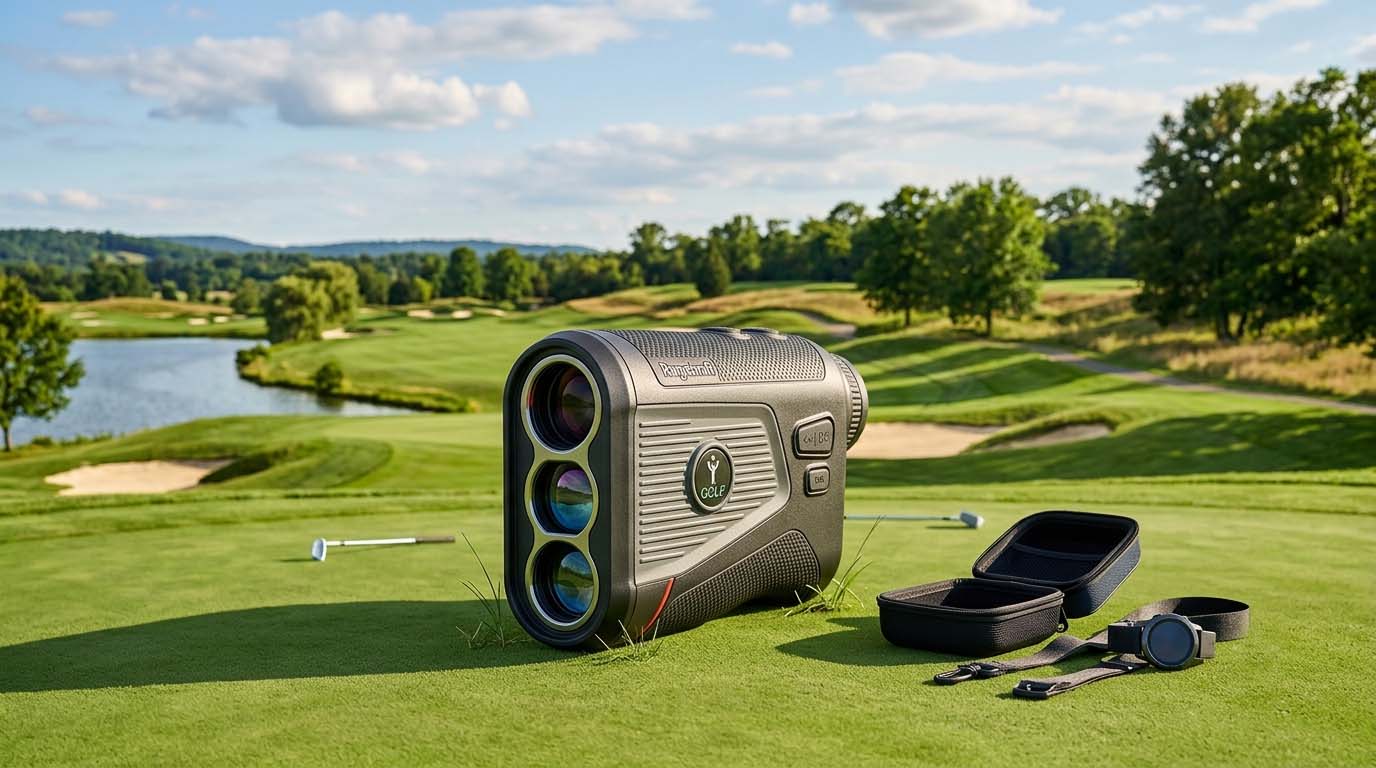
A sub-$150 laser rangefinder measures distance using the same core principle as a $400 one: a laser pulse is timed on its round trip to a target, and that timing produces a yardage. The base physics does not change with price. What changes at a lower price band is a specific, nameable set of secondary features and build qualities, and a reasonable decision comes from knowing exactly what those are rather than assuming "cheap" means "worse in every way."
A note on how this article is written: this site does not currently carry an affiliate disclosure page, so no specific product is named, ranked, or linked to here. This is a decision framework for evaluating any budget rangefinder you are considering, not a roundup of picks.
What is commonly cut at the budget price band
Based on how budget and premium rangefinders are typically differentiated in spec sheets and retailer comparisons, these are the areas most consistently affected as price drops toward and below $150:
Slope adjustment. Many budget models either omit slope adjustment entirely or include it as a togglable feature, while premium models build it in as standard. Whether this matters to you depends heavily on how you play. Slope-adjusted readings are restricted in sanctioned stroke-play competition under the Rules of Golf, so if you play competitively, this is a rules question as much as a features question. See /what-is-slope-on-a-golf-rangefinder/ for what the feature actually measures.
Target-lock speed. Budget devices commonly take a little longer to return a confirmed, locked reading, especially on a cluttered background. This is a real, felt difference in pace of use, though it is a speed difference rather than an accuracy one.
Battery type. Rechargeable batteries, where they appear at all, are more common on mid-range and premium devices. Budget models more often rely on a standard replaceable CR2 lithium battery. See /golf-rangefinder-battery-life/ for what that means in practice, including in cold weather.
Build materials and weather sealing. Premium devices more often carry a more robust housing and a stated water or fog resistance rating. Budget devices vary more in this respect, and a lower-priced unit is somewhat more exposed to damage from drops or moisture over time.
Magnification and optical clarity. Most devices across the price range still ship close to the common 6x standard (see /golf-rangefinder-magnification/), but the glass and coatings used to deliver that magnification clearly can vary in quality between price points, affecting how crisp the view looks rather than what number is printed on the box.
Warranty length. Warranty terms vary by manufacturer and price tier rather than by price alone, but it is worth checking specifically rather than assuming a budget device carries the same coverage as a flagship one. See /golf-rangefinder-warranty/.
What is not meaningfully different
The core distance-measurement principle, laser timing, is not a premium feature. A well-functioning budget rangefinder and a well-functioning premium one are both doing the same fundamental job, and neither this site nor most manufacturer literature supports a claim that base measurement accuracy scales directly with price. Where accuracy specs differ between models, that difference should be stated by the manufacturer directly rather than assumed from price alone. See /golf-rangefinder-accuracy-explained/ for how to read an accuracy claim rather than take it at face value.
Laser vs. a budget GPS device or a phone app
Part of the "is cheap good enough" question is really a different question: whether a laser rangefinder is the right category at all versus a GPS handheld, GPS watch, or a phone app, several of which are available at or below the same budget price point. Lasers measure a specific point you aim at directly; GPS-based tools instead give you preset distances to the front, center and back of a green from a course database, with no aiming required. Neither is inherently more accurate for its intended job, since they answer slightly different questions, and this trade-off is covered on its own terms at /golf-rangefinder-vs-gps/, which is worth reading before assuming "budget" only means "budget laser."
A framework for deciding, rather than a pick
Instead of asking "is the cheap one good enough" in the abstract, three concrete questions get you to a more useful answer:
How often do you play, and how much does locking speed matter to your pace? An occasional player is less likely to notice or mind a slightly slower target lock than someone playing weekly rounds where pace of play is already a friction point.
Do you play sanctioned competition where slope-adjusted readings are restricted? If so, the presence or absence of a togglable slope feature, and whether it is compliant with the Model Local Rule framework, matters more than it would for purely casual, non-competitive rounds.
How exposed will the device be to moisture, drops, and general wear? A golfer who walks and carries their own bag in variable weather is putting more physical stress on a device than one who rides a cart and stores it carefully. Build quality and weather sealing matter more in the first case.
The honest trade-off in plain terms
Choosing a budget rangefinder generally means accepting a slightly slower confirmed reading, a higher chance of a standard replaceable battery instead of a built-in rechargeable one, and somewhat more variability in build durability and weather sealing, in exchange for a meaningfully lower price for the same core measurement function. None of that makes a budget device a false economy on its own. Whether it is the right call depends on which of those trade-offs actually affects how and how often you play.
FAQ
Does a cheap rangefinder measure distance less accurately than an expensive one?
Not inherently. Both use the same core laser-timing principle. Differences between specific models should be checked against each manufacturer's own stated accuracy spec rather than assumed from price.
What's the biggest thing I actually give up at a lower price?
Most commonly: slower target-lock speed, a standard replaceable battery instead of built-in rechargeable, and somewhat less robust build and weather sealing. Slope adjustment is also more often missing or basic at lower price points.
Do I need slope adjustment on a budget rangefinder?
Only if it matters to how you play. If you compete in sanctioned stroke play, slope-adjusted readings are restricted under the Rules of Golf, which is a separate question from whether the feature is useful for casual rounds. See /what-is-slope-on-a-golf-rangefinder/.
Will a budget rangefinder hold up as well over time?
Generally expect somewhat more variability in build quality and weather resistance at lower price points, which matters more if the device will regularly face moisture, drops, or heavy carrying.
Should I just buy the cheapest option that has good reviews?
A better approach is checking the specific trade-offs in this article against your own playing habits, rather than relying on reviews alone, since "good reviews" does not tell you which specific compromise a given model made to hit its price point.
For the fuller buying framework this spoke sits inside, see /golf-rangefinder-buying-guide/.