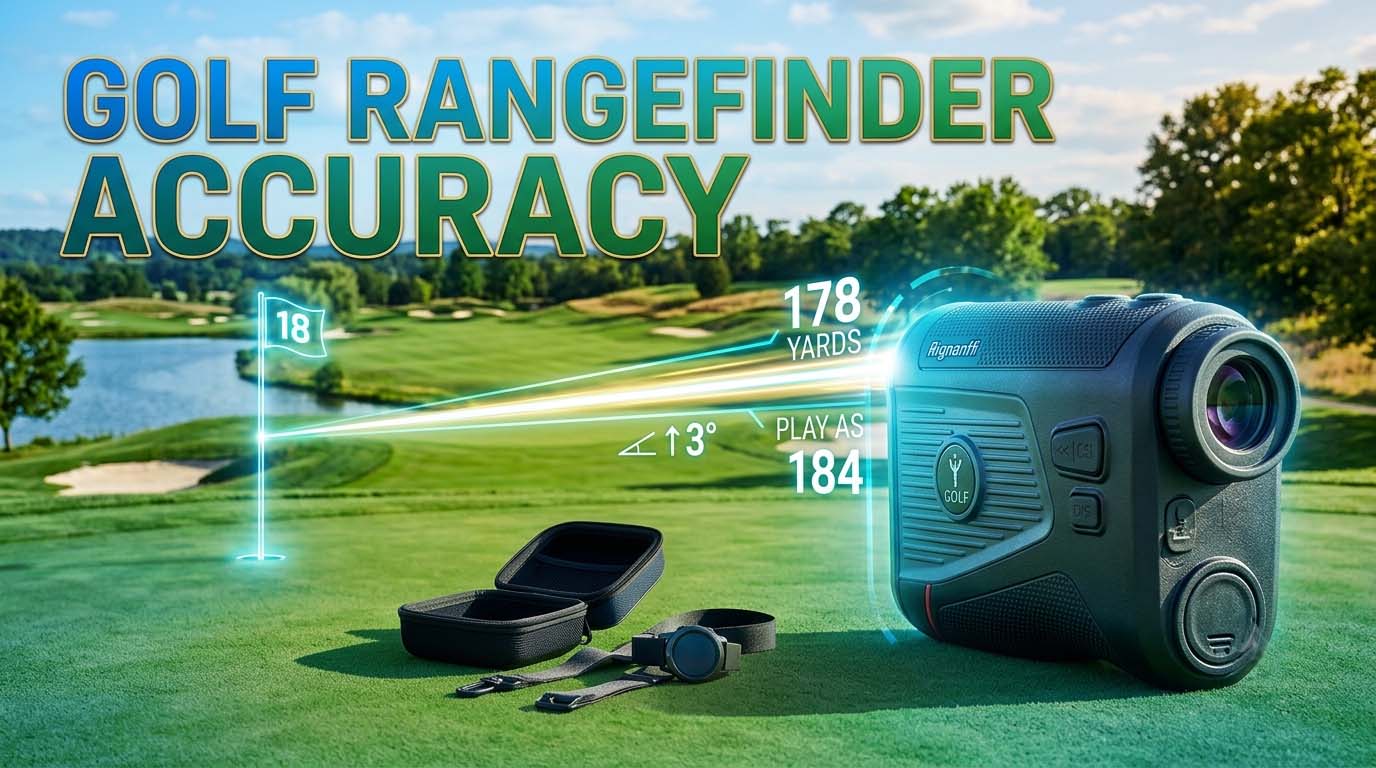
An accuracy spec like “±1 yard” printed on a rangefinder listing describes a manufacturer’s stated measurement tolerance under stated test conditions, not a guarantee about every reading you will ever take on your own course. It is a real number and worth paying attention to, but it is measured against a fixed, reflective target under controlled conditions, and several real-world factors, weather, target reflectivity, distance, and how steadily you hold the device, can widen the gap between that printed number and what you actually see in the field.
How the reading is actually produced
A laser rangefinder works by time-of-flight measurement: it sends out a laser pulse, times exactly how long the pulse takes to travel to the target and bounce back, and converts that time into a distance using the known speed of light. Many devices take this measurement multiple times within a fraction of a second and average the results, which is one way manufacturers improve consistency without changing the underlying physics.
This is a genuinely precise method, and it is the same core mechanism across essentially every laser rangefinder on the market regardless of brand. The differences between models show up less in the fundamental measurement technique and more in optics quality, processing speed, and how well the device isolates the intended target from background clutter, which is a separate feature covered in /rangefinder-pin-lock-flag-lock-explained/.
What “under stated conditions” actually means
When a manufacturer publishes an accuracy tolerance, that figure is established under specific test conditions, typically a fixed, highly reflective target at a controlled distance, in good light, with the device held steady. That is a legitimate way to state a spec, and it is standard across the industry, but it is worth being clear that it describes a best-case scenario rather than an average round.
None of that means the published figure is misleading on its own. It means the figure answers “what is this device capable of under ideal conditions,” not “what will this device read on my course today,” and those are different questions a buyer should not confuse.
What actually changes accuracy in the field
Several real factors affect how close a field reading comes to the manufacturer’s stated tolerance, and none of them are about the device being defective.
Target reflectivity matters because the laser pulse needs a strong enough return signal to produce a confident reading. A metal flagstick or a reflective marker returns a stronger signal than a matte, low-contrast target, which is part of why flag-lock technology exists in the first place: to help the device confidently isolate a thin, sometimes low-reflectivity target from everything behind it.
Weather affects the laser path. Rain, fog, and haze scatter and absorb part of the laser’s signal, which can slow the return or reduce how confidently the device locks onto a distant target. Heavy fog or persistent rain has a more noticeable effect than a dry, overcast day, and this is a physical limitation of light-based measurement in general, not a flaw specific to any one brand or model.
Distance to target matters because signal strength naturally decreases the farther the laser pulse has to travel. Most devices are more consistent at moderate distances than at their stated maximum range.
Hand steadiness and aim are the most overlooked variable, and they are entirely on the golfer, not the equipment. A rangefinder held at arm’s length without support, especially at longer distances, is harder to keep precisely aimed at a thin target than one braced against a cart, a golf bag, or two hands close to the body.
Why GPS distances are not on the same accuracy scale
It is worth separating laser accuracy from GPS accuracy, since the two get compared as if they were measuring the same thing. A laser reading is a direct, real-time measurement to the exact point you aim at. A GPS-based distance is calculated from the device’s location relative to pre-mapped course data, which introduces its own separate margin of error tied to GPS signal precision and how accurately the course was originally mapped. Neither is “more accurate” in some universal sense; they are different measurement approaches with different sources of error, a distinction covered more fully in /golf-rangefinder-vs-gps/.
A way to sanity-check a reading, without special equipment
You do not need a lab to get a rough sense of whether a rangefinder reading looks reasonable. Many golf courses mark yardages on sprinkler heads or fixed yardage posts at known distances from the green. Taking a reading toward the green while standing near a marked point and comparing the two numbers is a simple, practical way to see whether a device’s readings are landing in the right neighborhood, though it is a rough check against a course’s own markings, not a substitute for a manufacturer’s controlled test, and course markings themselves are not always perfectly precise either.
Reading a spec sheet with this in mind
None of this means an accuracy spec is meaningless or that manufacturers are overstating their devices. It means the number belongs in the same category as the other specs covered in this site’s buying guide: a genuinely comparable figure, published under stated conditions, that tells you something real without telling you everything. Treat it as a starting point for comparing listings, not as a promise about a specific round on a specific day, and the rest of the picture, target reflectivity, weather, distance, and your own steadiness, fills in the gap between the spec sheet and the reading you actually see.
FAQ
Is a higher-priced rangefinder always more accurate?
Not necessarily to the degree the price difference might suggest. Many mid-range and premium models publish similar accuracy tolerances; the price difference more often reflects optics quality, locking speed, and additional features rather than a dramatically tighter accuracy spec. See /golf-rangefinder-buying-guide/ for how to weigh specs against price generally.
Why does my rangefinder sometimes give a different number for the same shot?
Small variations between readings of the same target can come from hand movement between shots, slightly different aim points on the flagstick, or brief signal interference. This is normal and is part of why some devices average multiple pulses per reading rather than relying on a single pulse.
Does rain or fog actually reduce accuracy, or just make the device harder to use?
Both, to some degree. Moisture in the air can scatter or absorb part of the laser signal, which can affect the reading itself, not only your ability to see the target clearly.
Can I trust a GPS distance as much as a laser distance?
They answer different questions rather than one being simply more trustworthy. A laser gives a direct measurement to your exact aim point; a GPS distance is calculated from mapped course data and inherently carries a different kind of margin. See /golf-rangefinder-vs-gps/ for the fuller comparison.
Do flag-lock and similar features improve raw accuracy?
No. They improve the device’s ability to correctly identify and hold onto the intended target rather than a background object, which reduces the chance of measuring the wrong thing. They do not change the underlying measurement tolerance of the laser itself. /rangefinder-pin-lock-flag-lock-explained/ covers what this feature does and does not do.