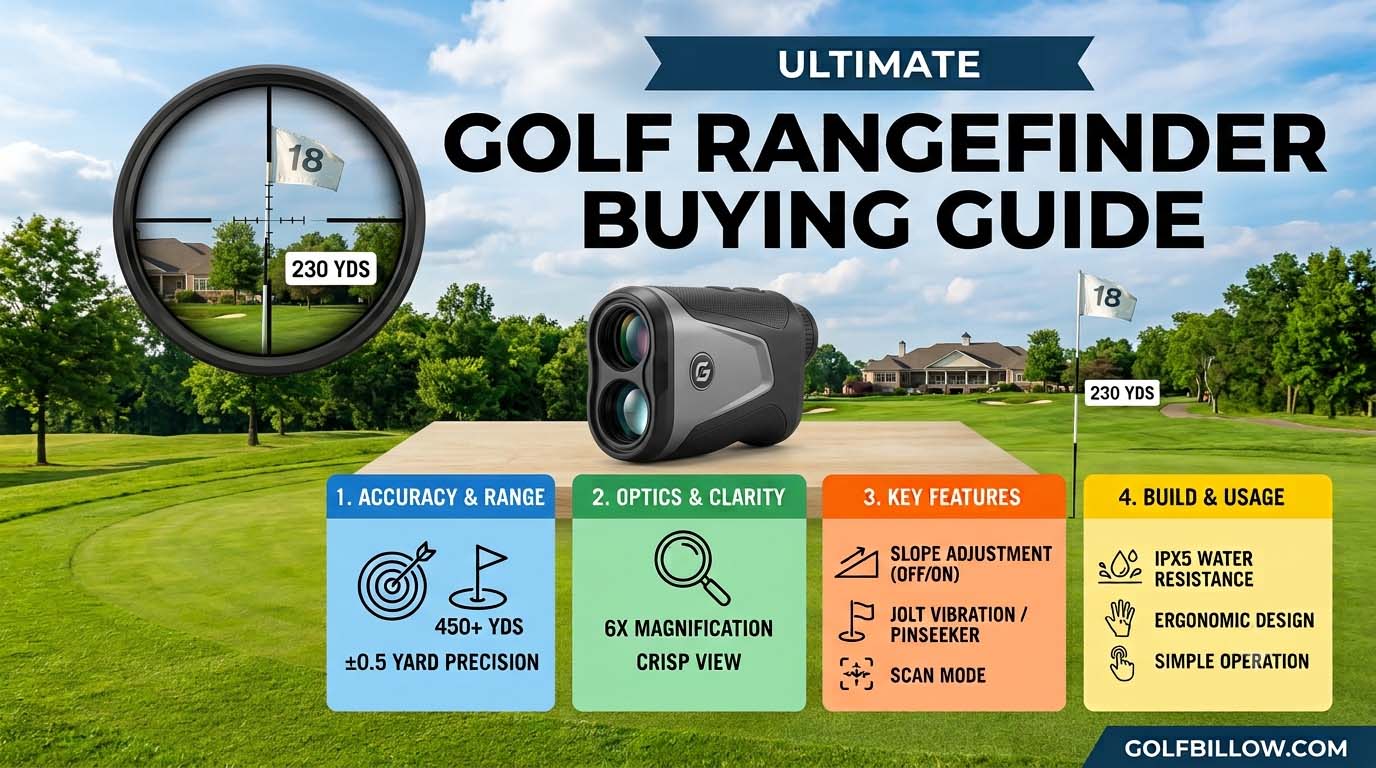
Every golf rangefinder listing reads almost the same: accuracy to within a yard, some multiple of magnification, a slope switch, a flag-locking feature, and a battery that "lasts a season." A useful rangefinder buying guide has to sort that list into three buckets. First, specs that are genuinely comparable across brands, like stated accuracy tolerance and magnification. Second, features that are the same underlying technology wearing a different brand name, like flag-lock. Third, language that a reader cannot verify at all and should treat as marketing rather than a decision input. Getting that sorting right matters more than any single spec number.
The three buckets, up front
Before going device by device, here is the framework this whole page runs on.
Bucket one: genuinely comparable specs. These are numbers manufacturers publish under stated test conditions, and you can put two listings side by side and compare them directly: accuracy tolerance, magnification power, maximum stated range, and water-resistance rating. They are not proof of real-world performance, but they are at least apples-to-apples between brands.
Bucket two: one feature, several brand names. Flag-lock technology is the clearest example. Bushnell calls part of it "PinSeeker" and the vibration confirmation "Jolt." Other brands call the whole thing "Pin Lock," "Flag Lock," or "Target Lock." It is functionally one feature family, and a listing that makes it sound unique to that brand is doing marketing, not informing you. /rangefinder-pin-lock-flag-lock-explained/ breaks this down feature by feature.
Bucket three: unverifiable claims. "Tour-proven," "professional-grade," "the most accurate rangefinder ever made": none of this can be checked by a reader, and none of it should move a buying decision on its own.
What is genuinely comparable
Four specs are worth lining up side by side when you compare listings, because manufacturers publish them under stated conditions and the numbers mean roughly the same thing from brand to brand.
Accuracy tolerance is the manufacturer's stated margin of error under its own test conditions, commonly expressed as a fraction of a yard. It is a real number, but it describes a best case, not every round you will ever play. /golf-rangefinder-accuracy-explained/ goes into what actually affects that number on a real course.
Magnification determines how large the flagstick appears in the eyepiece before you even try to lock onto it. Most rangefinders ship around 6x, which is a genuine, comparable spec, not a marketing flourish, because it changes how easy the target is to find.
Maximum stated range is usually far beyond any distance you will play. What matters more than the top number is whether the reflective range (to a flagstick, not a reflective board) covers the yardages you actually face.
Water and weather resistance ratings are worth comparing directly, especially if you play in a climate with real rain or fall/winter rounds. A device rated for splash resistance is not the same as one rated for sustained rain exposure.
Slope: useful, but restricted where it counts
Slope adjustment is a genuinely useful feature for a casual round: it adjusts a straight-line laser reading for the incline or decline between you and the target. It is also the one rangefinder feature that is commonly switched off for competitive rounds under the Rules of Golf, which is worth knowing before you assume "more features is always better." /what-is-slope-on-a-golf-rangefinder/ covers what slope actually measures and why the restriction exists.
Choosing a device category, not just a model
Before comparing individual rangefinders, it is worth deciding what category of device actually fits how you play: a dedicated laser rangefinder, a GPS watch or handheld, or simply a phone app you already have. These solve different problems, and the right category decision matters more than any single model choice within it. /golf-rangefinder-vs-gps/ walks through that decision directly.
Reading a listing without being misled
Most listings present their spec sheet and their marketing copy in the same block of text, with no visual distinction between the two. A magnification figure and a phrase like "tour-proven performance" often sit in the same bullet list, as if they carry the same weight. They do not. One is a number you can compare against a competing listing; the other is a phrase no reader can independently check.
A practical habit: read the listing twice. On the first pass, underline (mentally or otherwise) every number, including accuracy tolerance, magnification, stated range, battery life in rounds or hours, and water-resistance rating. On the second pass, look at what is left. If a claim survives that second pass without a number, a named standard, or a cited test behind it, treat it as packaging rather than a reason to choose one device over another.
This also applies to how a feature is named. A brand-specific name for a targeting feature is not, by itself, evidence that the feature works differently from a competitor's version with a different name. It is only evidence that the two companies chose different words for their marketing department to use.
A short checklist before you buy
- Compare accuracy tolerance and magnification across listings side by side, not in isolation
- Recognize flag-lock, pin-lock, and similarly named features as one technology family, not a unique selling point
- Decide whether slope adjustment matters for how you actually play, and whether you need to switch it off for any round type
- Confirm the water-resistance rating actually matches your climate, not just the marketing photo
- Treat unverifiable superlatives ("the most accurate ever") as noise, not signal
Where this site stands on testing claims
This site researches specifications, terminology, and how features actually work from manufacturer documentation and public sources. It does not run hands-on product testing, and nothing on this page should be read as a first-hand comparison of specific models. If a claim cannot be traced to a manufacturer spec sheet or a cited source, it is left out rather than guessed at. More on the site's scope and approach is on the /about-me/ page.
FAQ
Do I need slope adjustment if I only play casual rounds?
It is a genuine convenience for casual play, since it gives you a "plays-like" distance on uneven terrain. It becomes a consideration rather than a pure benefit once you play any round under standard Rules of Golf conditions, since slope-adjusted readings are commonly restricted there. See /what-is-slope-on-a-golf-rangefinder/ for the detail.
Is a more expensive rangefinder always more accurate?
Not automatically. Price often buys you build quality, faster locking, better optics in low light, and additional features, but the core accuracy tolerance gap between a budget model and a premium one is frequently smaller than the price gap suggests. Compare the stated tolerance directly rather than assuming price tracks accuracy.
What is the difference between a rangefinder and a GPS device?
A laser rangefinder measures the exact distance to one target you aim at, typically the flagstick. A GPS device gives you pre-mapped distances to the front, middle, and back of the green without needing a clear line of sight. See /golf-rangefinder-vs-gps/ for the fuller comparison.
Do I need a rangefinder at all, or can my phone do this?
A phone app can cover a lot of casual rounds, and it is worth taking seriously as a genuine option rather than a last resort. What it gives up compared to a dedicated device is also worth knowing before you decide. See /golf-rangefinder-vs-gps/.
Why do different brands use different names for what sounds like the same feature?
Because it often is the same feature. Flag-lock, pin-lock, PinSeeker, and Target Lock describe the same underlying targeting technology, marketed under different brand names. /rangefinder-pin-lock-flag-lock-explained/ lays the terms out side by side.