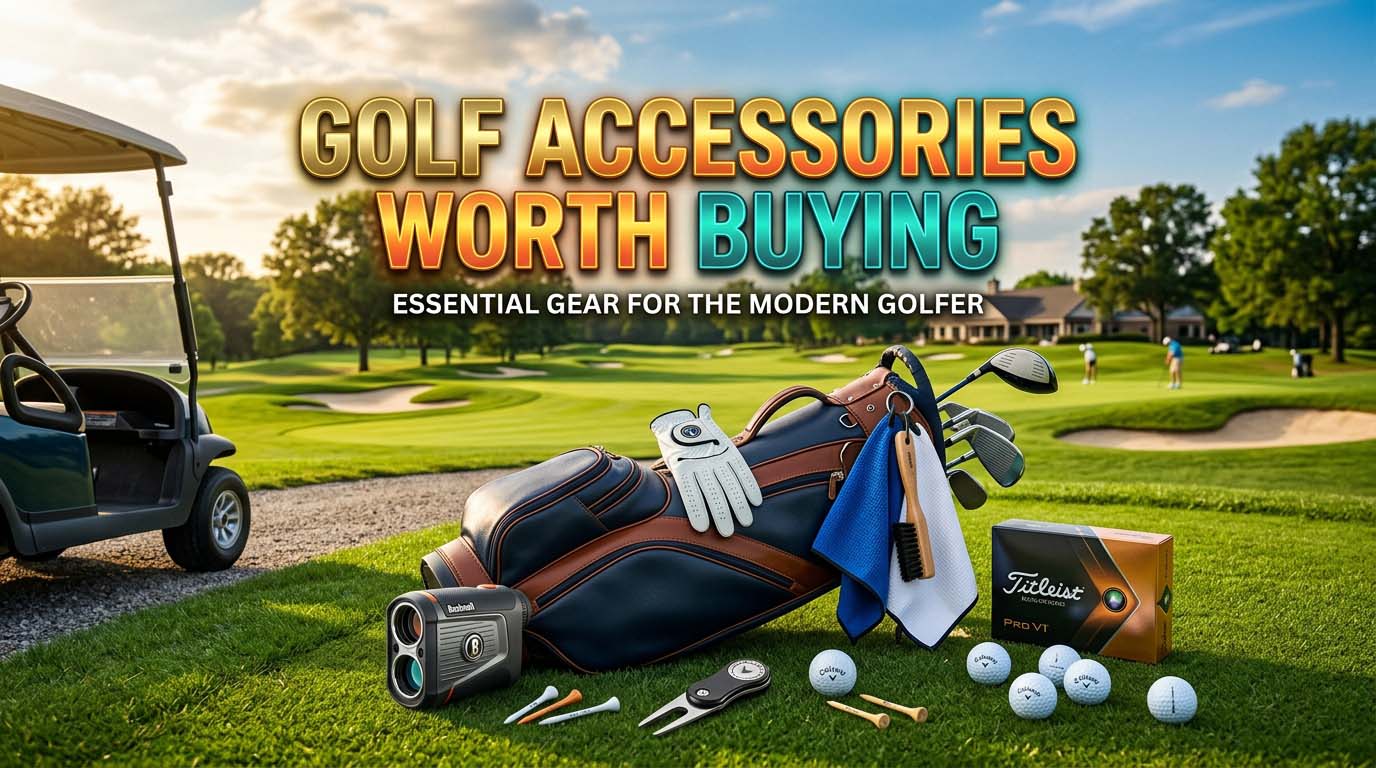
The golf accessories worth buying are the ones you use on almost every hole: a ball-mark repair tool, a couple of ball markers, tees, a towel, a glove that fits, and one reliable way to get yardages. Next come items that pay off only in certain conditions, like rain gloves or a bag rain hood. Most gadgets beyond that are dead weight, and a few (alignment rods, weighted swing aids) can cost you a penalty if you use them during a round. Buy in that order and stop when a real problem is solved.
That is the short version. The rest of this page explains how we sorted the list, which items belong in each tier, and where the Rules of Golf quietly decide the question for you.
How we sorted the list
We have not played rounds with these items, so this is not a "we tested it" ranking. It is a filter built from three questions you can apply to anything in a pro shop:
- How often does it get used? Every hole, every round, some rounds, or almost never.
- Does it fix a real problem or a comfort preference? Holding the club and knowing the distance are problems. A fancier tee is a preference.
- Is it legal to use during a round? The Rules of Golf allow some gear freely, allow some only with limits, and ban others outright once play starts.
An accessory that scores well on all three earns its place. One that fails the third is something to leave in the car.
Tier 1: the golf accessories worth buying first
These are used on nearly every hole and are cheap enough that the budget version is fine.
A ball-mark repair tool. Your ball will leave a dent in a soft green, and fixing it is basic course etiquette. The Rules explicitly allow it. Rule 13.1c of the Rules of Golf (read 2026-09-25) lets you repair damage on the putting green, including ball marks and shoe damage, "by using their hand, foot or other part of the body or a normal ball-mark repair tool, tee, club or similar item of normal equipment." A tee technically works. A proper tool does it better and costs very little. Metal lasts longer than plastic.
Ball markers, two or three. Rule 13.1b says "the spot of the ball must be marked before it is lifted" on the putting green. A coin works. A dedicated marker that clips to a cap or glove is simply harder to lose. Carry a spare.
Tees in two lengths. Longer tees for the driver, shorter for irons and hybrids on par 3s. That is the whole tee strategy for most players.
A towel. Clean grooves and a dry grip matter more than most accessories on this list. A towel that clips to the bag handles both.
A glove that fits. For most right-handed players, a single glove on the lead hand. Fit matters more than brand: snug across the palm, no loose fabric at the fingertips.
One distance source. A laser, a GPS unit or a phone app. You only need one, and the right one depends on how you play. Our comparison of rangefinder vs GPS vs your phone explains the differences so you do not buy two devices that do the same job. Distance devices are allowed under Rule 4.3a(1), which permits "getting information on distance or direction (such as from a distance-measuring device or compass)."
Tier 2: worth it in the right conditions
These are real tools, but only for certain players or certain weather.
| Accessory | Earns its place if… | Skip it if… |
|---|---|---|
| Rain gloves (a pair) | You play in spring and fall rain or have sweaty hands | You only play dry days |
| Bag rain hood | You ride carts or walk in showers | Your bag lives in the trunk on wet days |
| Umbrella | You walk and play through rain | You ride and your cart has a roof |
| Headcovers for woods | Your clubs ride in a car trunk or a cart bag | You rarely move the bag |
| Sunscreen and a hat | You play afternoon rounds in summer | Never, really |
| Spare glove in a sealed bag | You play long rounds or wet mornings | You play nine holes in the dry |
Notice that none of these are gadgets. They protect you, your grip, or your clubs. If an accessory does not do one of those three things, it has to work hard to justify the space.
Tier 3: dead weight for most golfers
Some items get bought, carried for a season, and never touched again. That is not always because they are bad products. Often they solve a problem the owner does not have.
- Duplicate distance devices. A laser and a GPS watch and a phone app, all doing the same job. Pick one.
- Novelty tees and "performance" tees. Tee choice matters much less than tee height, which is free.
- Bag-mounted speakers and gadget clips. Fine if you enjoy them. They do not change your score, and some courses or playing partners will not welcome the speaker.
- Every-club headcovers. Iron covers add weight and fuss for little protection. Wood covers, as above, are the ones that matter.
- Grip-trainer attachments and swing gadgets. Useful on the range, and in some cases a penalty if used on the course (see below).
If the budget is tight, the money you save here is usually better spent on the thing most bags need: fresh grips.
The accessory rules most buying guides skip
This is where a simple list goes wrong, because some popular "accessories" are not allowed to be used during a round. The Rules of Golf, Rule 4.3 (read 2026-09-25), sets out what you can and cannot use while you play.
Training aids. Rule 4.3a does not allow "using any type of golf training or swing aid (such as an alignment rod or a weighted headcover or 'donut')" in any way that creates a potential advantage. Carrying one is a different question from using one, which is the distinction covered in our explainer on training aids during a round.
Distance devices that do too much. The same rule allows distance and direction information but does not allow "measuring elevation changes" or getting "a recommended line of play or club selection." That matters for rangefinders with slope and for GPS apps with club advice. Whether slope mode is legal in your event is a question of which features are switched on and what the committee allows, which we cover in are slope rangefinders legal.
Gripping help. Rule 4.3a(5) allows "resin, powders and other moisturizing or drying agents," "wrapping a towel or handkerchief around the grip," and a plain glove. It does not allow a non-conforming glove or anything that gives "an unfair advantage with hand position or grip pressure."
Accessories and the 14-club limit. Only clubs count toward the limit. Rule 4.1b counts "all clubs carried by or for the player," so a rangefinder, towel or umbrella never pushes you over. The limit itself is explained in the 14-club rule.
The practical takeaway: before you buy anything that changes your swing, your aim or the information you get, check whether you can use it once the round starts. If you cannot, it belongs in your practice bag, not your playing bag.
A buying order that avoids waste
Put together, the list above becomes a simple sequence:
- Repair tool, markers, tees and a towel. These are the table stakes of playing.
- A glove that fits.
- One distance source, chosen for how you play.
- Weather gear that matches your climate: rain gloves, a bag hood, an umbrella.
- Protection for expensive clubs: headcovers for woods.
- Everything else, only after a real round shows you what is missing.
That last step is the one that saves money. The accessories that get used are almost always ones bought to fix something that went wrong on the course. The ones that sit in a side pocket all season were usually bought before the problem existed.
What this list cannot tell you
No list replaces your own rounds. A golfer who plays twilight nine-hole rounds on a flat course needs almost nothing from Tier 2. A golfer who walks 18 in coastal weather needs most of it. We have kept this list to what the Rules and common sense support, without brand picks or prices, because both depend on where and how you play, and prices change faster than any page can keep up with.
FAQ
What golf accessories does a beginner actually need?
A ball-mark repair tool, a couple of ball markers, tees, a towel, a glove that fits and one way to get yardages. Everything else can wait until your rounds show you a real need.
Are rangefinders allowed during a round?
Yes, for distance. Rule 4.3a(1) allows distance-measuring devices, but using a device to measure elevation changes or to recommend a club or line is not allowed.
Can I carry alignment sticks in my golf bag?
Carrying is not the problem. Using an alignment rod or other training aid during a round in a way that creates a potential advantage breaks Rule 4.3a.
Do accessories count toward the 14-club limit?
No. Rule 4.1b counts clubs only, so towels, umbrellas, rangefinders and other accessories do not count toward the limit.
Is a divot tool necessary if I can use a tee?
Rule 13.1c allows a tee or a normal ball-mark repair tool to fix damage on the green. A tee works in a pinch, but a proper repair tool does the job more cleanly and costs very little.