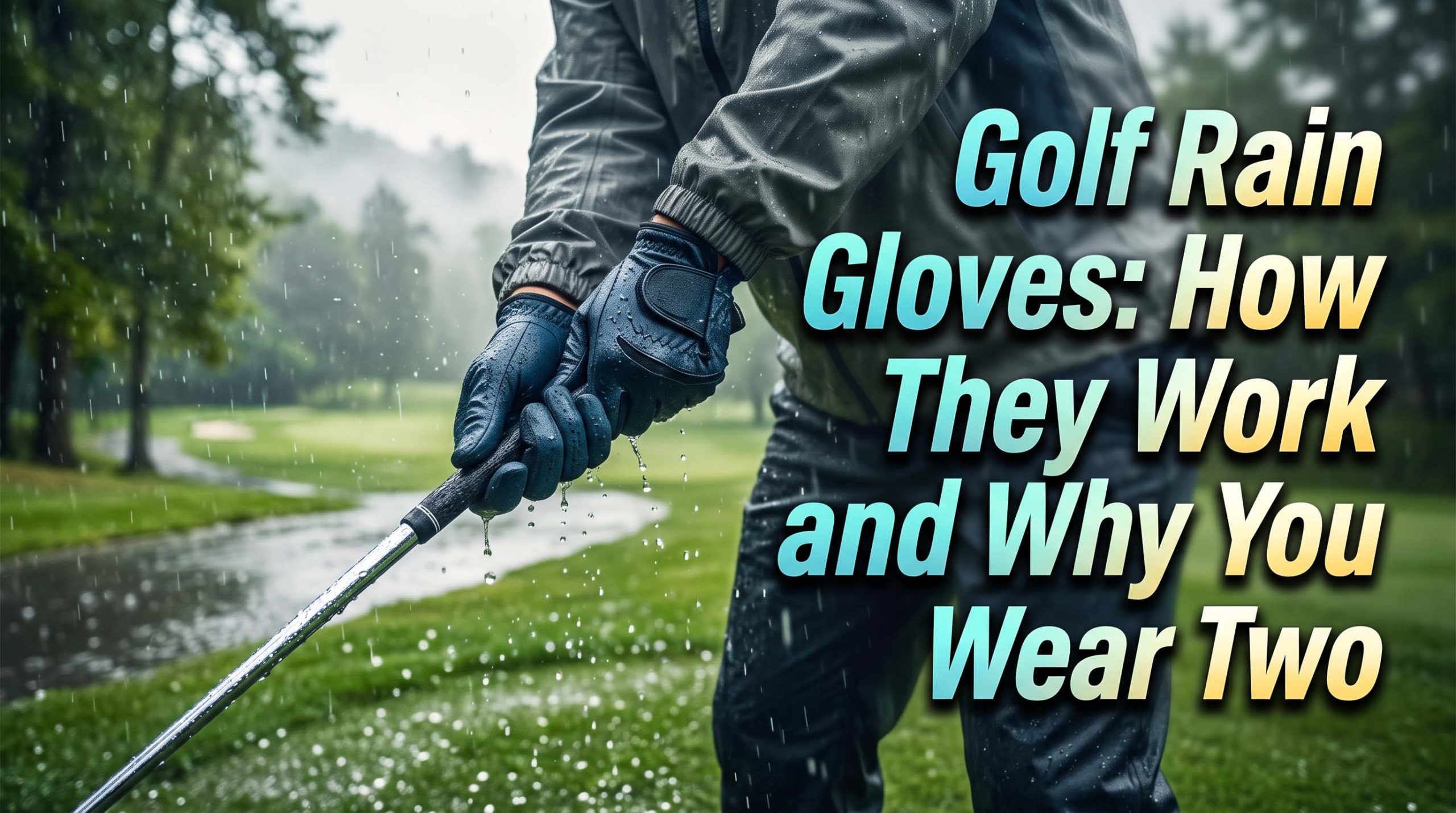
Golf rain gloves do one job, and they do it well: they keep the club from twisting in wet hands. Unlike a leather glove, which gets slick as it soaks, a rain glove uses a fabric palm that absorbs water and grips harder the wetter it gets. They come as a pair because you wear one on each hand, and they are legal under the Rules of Golf as plain gloves. Most wet-weather gear makes a rainy round more comfortable. A pair of golf rain gloves is the piece that affects whether you can hold the club.
That distinction matters when you are deciding what to buy with a limited budget. A jacket, an umbrella and waterproof shoes keep you drier. None of them does anything for the connection between your hands and the grip, and that connection is where a wet round actually falls apart.
Why wet hands are the real problem in the rain
Being wet is uncomfortable. A club that slips is a different kind of problem. When the grip gets slick, most players respond by squeezing harder, and a tight grip changes how the club moves through the swing. The miss that follows usually gets blamed on the rain in general, when the specific cause was the hands.
Leather is the reason a normal glove struggles. A standard golf glove uses thin leather that feels tacky when dry. Water changes that: soaked leather loses its tack, gets heavier, and often dries stiff afterward. Many golfers find the same glove never feels quite right again after one very wet round.
Everything else in a wet-weather kit protects you from water. Golf rain gloves are designed to use it.
How golf rain gloves work
The idea runs backward from what you might expect. A rain glove is not trying to stay dry. It is built from a synthetic fabric, often a microfiber or a suede-like knit, that soaks up water rather than shedding it. Once damp, that fabric conforms to both your hand and the rubber grip, so hand, glove and club move as one piece.
National Club Golfer's explainer on how rain gloves work (read 2026-09-25) sums it up in one line: "The wetter a glove is, the more grip will be created." It also quotes FootJoy's description of its autosuede material as "designed to use rain water to help create traction with the grip, rather than to repel it away."
Two practical things follow from that design:
- Wet them before the first swing. A rain glove is at its best damp, not dry. Put them on before your hands are cold and wrinkled; it is much harder to pull a snug glove over soaked skin.
- Mud is the enemy, not water. The palm grips because it is clean fabric pressed against rubber. Mud and grit between the two reduce that contact, so wipe the palms on a towel when they get dirty.
Why they come in pairs
A standard glove goes on your lead hand only, and the trail hand holds the grip bare. In dry weather that works because a dry palm grips reasonably well.
In the rain, your bare trail hand becomes the weak link. It is holding wet rubber with wet skin, while your gloved hand has a fabric designed for exactly that job. That is why golf rain gloves are nearly always sold as a pair, one left and one right. A pair also means there is no "which hand" choice to get wrong when ordering.
National Club Golfer notes that some golfers wear only the lead-hand glove from a pair, out of habit, and points out that this can leave the two hands gripping with noticeably different friction. If you play in genuine rain, wear both.
Are golf rain gloves legal under the Rules of Golf?
Yes, provided the glove is a "plain glove," and ordinary rain gloves from mainstream makers are designed to be.
Rule 4.3a(5) of the Rules of Golf (read 2026-09-25) allows "using a plain glove that meets the requirements in the Equipment Rules." The same rule also allows "using resin, powders and other moisturizing or drying agents" and "wrapping a towel or handkerchief around the grip." What it does not allow is a non-conforming glove, or "other equipment that gives an unfair advantage with hand position or grip pressure." A breach of Rule 4.3 carries the general penalty for the first breach and disqualification for a second, where there was an intervening event.
The R&A's Rules of Equipment, Part 6 (read 2026-09-25) defines the plain glove. It must be "a fitted covering of the hand with a separate sheath or opening for each digit" and made "of smooth materials on the full palm and gripping surface." It must not have padding, straps to stop the club slipping, adhesive material or alignment aids. Padding means material "more than 0.025 inches (0.635 mm) thicker than the adjacent areas." And importantly for rain gloves, material "may be added for wear resistance, moisture absorption or other functional purposes, provided it does not exceed the definition of padding."
So an absorbent palm is fine. What would cross the line is anything sticky, strapped or padded beyond that limit. If you are unsure about a specific product, the question is the same one covered in golf equipment rules that actually affect amateurs: does the maker state that it conforms, and is there anything on it beyond a fitted, smooth glove?
Rain gloves vs the other wet-grip fixes
Rain gloves are not the only way to keep hold of a wet club. Here is how the common options compare on function.
| Option | What it fixes | Where it falls short | Legal in play? |
|---|---|---|---|
| Golf rain gloves (pair) | Slipping in both hands, even in steady rain | Less feel than dry leather; need wetting and cleaning | Yes, as plain gloves (Rule 4.3a(5)) |
| Regular leather glove | Lead-hand grip in dry weather | Loses tack when soaked, can dry stiff | Yes |
| Towel wrapped around the grip | Drying the grip between shots | Stays dry only as long as the towel does | Yes, explicitly allowed |
| Drying agents or powders | Sweaty or damp hands | Wash off in real rain | Yes, explicitly allowed |
| Umbrella with grips kept under it | Keeping grips dry before the swing | Nothing once you step out to hit | Yes |
| Worn, shiny grips | Nothing; they make wet play worse | Replace them | Yes, but slippery |
The last row is the one people forget. A glove can only grip what it is holding. Rubber that has hardened and gone glossy loses tack in the dry and gets far worse in the wet, which is why knowing when to regrip your clubs is part of the same problem. New rain gloves on dead grips is a half fix.
What rain gloves will not do
This is the honest section, because the marketing tends to skip it.
- They will not keep your hands warm or dry. They are designed to be wet. On a cold, wet morning your hands will be cold and wet, just not slipping. Winter gloves are a different product built for a different problem.
- They will not feel like leather. Many players describe less feel for the club in fabric gloves. That is a trade, not a defect. In real rain, a secure grip matters more than feel.
- They will not fix a grip that is the wrong size. A grip that is too small or too large for your hands is a separate issue, and grip size is the cheapest spec change most golfers ignore.
- They will not last forever. Fabric palms wear, especially where the grip rubs. When the palm goes thin or shiny in one spot, it grips less.
Wearing and caring for them
A few habits get more rounds out of a pair:
- Carry them in a dry pocket of the bag and put them on at the first sign of real rain, before your hands are soaked.
- In on-and-off showers, some golfers keep a dry leather glove for the dry spells and switch to the pair when rain sets in. Keep the leather glove in a sealed bag so it stays usable.
- After the round, take them out of the bag. A wet glove balled up in a pocket stays wet for days. Lay them flat to air dry, away from direct heat.
- Follow the care tag on your specific pair. Makers use different fabrics and treatments, and the tag is the only instruction that applies to the glove you actually own.
Sizing follows the same logic as any golf glove: snug across the palm with no loose fabric at the fingertips. Loose material in a rain glove folds against the grip and defeats the point.
Who should buy them, and who can skip them
Buy a pair if you play league nights, fixed tee times, or anywhere rain is common in spring and fall. Among wet-weather purchases, this is the one most directly tied to hitting the ball rather than staying comfortable.
They are also worth a look if your hands sweat heavily in summer humidity. The same absorbent palm that handles rain handles sweat, and National Club Golfer reports that some tour players use rain gloves as their everyday glove for that reason.
You can skip them if you only play dry days and cancel when it rains. A towel and a spare dry glove cover the occasional shower.
For anyone building a kit on a budget, the order is simple: good grips first, a pair of golf rain gloves second, and the waterproof clothing after that. The first two decide whether you can hold the club; the rest decides how you feel about it.
FAQ
Do golf rain gloves really work better when wet?
Yes, that is how they are designed. The palm fabric absorbs water and conforms to both the hand and the grip, so grip improves as the glove gets damp, which is the opposite of how leather behaves.
Why do golf rain gloves come in pairs?
Because in the rain your bare trail hand is the one most likely to slip on a wet grip. Wearing a glove on each hand gives both hands the same wet-weather grip.
Are rain gloves legal in tournaments?
Yes, when they are plain gloves. Rule 4.3a(5) allows a plain glove that meets the Equipment Rules, and those rules permit added material for moisture absorption as long as it does not count as padding.
Can I wear rain gloves in dry weather?
You can. Some golfers with sweaty hands use them in humid conditions. In fully dry weather, many prefer the feel of leather, so it comes down to preference.
How do I dry golf rain gloves after a round?
Take them out of the bag, lay them flat and let them air dry away from direct heat. Check the care tag on your pair for any washing instructions, since fabrics differ between makers.