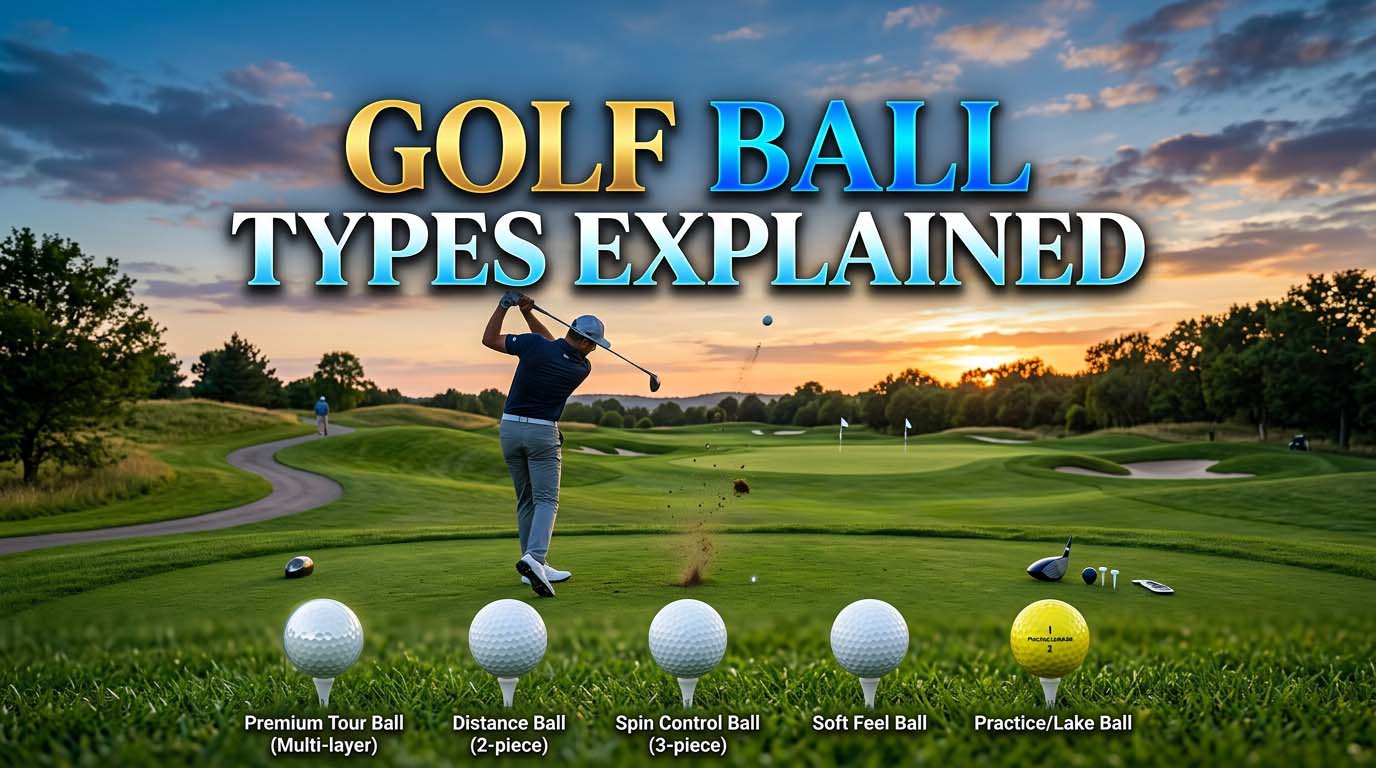
Short answer: golf ball types explained properly come down to one question, not five. What is the cover made of? A two-piece ball usually has a hard, durable ionomer cover (Surlyn is the best-known trade name) wrapped around a big rubber core, and it is built to last and to spin less. A urethane-covered ball is softer on the outside and grips a wedge face harder, so it spins more on short shots and scuffs faster. The number of layers matters far less than the box suggests. For most budget golfers, a cheap ball costs you very little until your strokes are being lost around the green rather than in the trees.
That is the whole article in one paragraph. The rest is why, and how to tell which type you are actually holding.
Golf Ball Types Explained in One Table
Most guides sort balls by piece count, one-piece through five-piece. I think that is the wrong axis for a buyer, because two balls with the same layer count can behave very differently depending on the cover. Here are the four groups that actually matter when you are standing in a shop aisle.
| Group | Typical build | Cover | What it does well | What it gives up | Who it tends to suit |
|---|---|---|---|---|---|
| Distance ball | Two-piece | Firm ionomer | Durability, low spin, price | Greenside spin, soft feel | Anyone losing several balls a round |
| Soft ionomer ball | Two- or three-piece, lower compression | Softer ionomer blend | Softer feel at a budget price | Still limited wedge spin | Slower swings that dislike a clicky feel |
| Value urethane ball | Usually three-piece | Thermoplastic urethane (TPU) | Real short-game spin for less | Scuffs faster than ionomer | Mid handicaps who reach greens with wedges |
| Tour urethane ball | Three- to five-piece | Cast (thermoset) urethane | Most short-game spin and control | Price, durability | Players whose misses are around the green |
One-piece balls exist too, but you mostly meet them at the driving range. They are built to survive heavy range use, not to score, so they are not a real option for your bag.
Pieces Are the Wrong Thing to Count
A golf ball's "pieces" are its layers. The core sits in the middle and supplies most of the speed. Wrapped around it, a premium ball has one or more mantle or casing layers. On the outside sits the dimpled cover.
Extra layers let an engineer separate how the ball behaves off a driver from how it behaves off a wedge. In broad terms, a high-speed, low-loft driver strike compresses the ball deep into the core, while a soft wedge shot mostly works the outer layers and the cover. More layers means more places to tune those two behaviors independently.
Here is the part the piece-count guides skip. Titleist, describing its own construction, says the casing layer is not necessary in ionomer-covered models, and that in its urethane balls an ionomer casing sits under the cover and protects the core from moisture. So "three-piece" on a box tells you the ball has a middle layer. It does not tell you whether the cover is the soft, grippy kind. A three-piece ionomer ball is still an ionomer ball on a wedge shot. If you want to read other golf spec sheets with the same skepticism, the logic is the same as in the golf club spec sheet, translated: a number is only useful once you know which behavior it actually controls.
What "Urethane" Actually Means, and Why It Is the Line That Matters
Urethane is a softer, tougher polymer than ionomer, and on a lofted club it behaves differently. According to Titleist's Learning Lab page on golf ball cover materials (read 2026-09-23), ionomer covers are more durable, while urethane's advantages include a softer feel, more spin in the short game and better control of shot shape and distance. That is a manufacturer describing its own products, so treat the framing as theirs, but the direction of the trade-off matches every independent guide I read while researching this piece.
There are also two kinds of urethane, which is where the "value urethane" category comes from. Titleist separates cast thermoset urethane, used on its Pro V1 family, from thermoplastic urethane (TPU), an injection-molded process it uses on the AVX and describes as less expensive, with slightly different performance. When a ball is sold as "urethane at a lower price," check which of the two you are getting.
What urethane does not do is add driver distance for a slow swing. Off the tee, the core and the overall construction do most of the work. The cover earns its money on shots where a grooved, lofted face brushes the ball: pitches, chips and full wedges. That also means the benefit depends on the club. Worn or packed grooves grip any ball less well, and if your wedges are old enough that you are wondering about them, the groove rule on wedges is worth a read before you blame the ball.
What "Two-Piece" and Ionomer Give You
Ionomer is a hard, durable plastic. Surlyn is a trade name for one type of ionomer, which is why the two words get used interchangeably on boxes and in forums. Titleist describes its ionomer blends as offering a range of firm to soft feel with enhanced durability, and aims them at recreational and distance-focused golfers.
In practice, a two-piece ionomer ball gives you three things:
- Durability. It shrugs off cart paths and thin wedge strikes that leave marks on a urethane cover.
- Lower spin across the bag. Less spin off the driver generally means a curve you already hit curves somewhat less. It will not fix a slice, but it will not add to it either.
- A lower price per ball. This is the big one if balls regularly end up in water or woods.
The trade is short-game stopping power. A firm ionomer cover grips the wedge face less, so pitches and chips release and roll further. Whether that costs you anything depends on how often you hit those shots with a real chance of holding a green.
Compression, Briefly
Compression describes how much a ball deforms under a load. Low-compression balls feel softer, and they are often marketed to slower swings. Firmer balls are marketed to faster swings. The numbers printed on boxes are not standardized across brands, so comparing one maker's compression figure to another's tells you less than it seems to. Treat "soft" as a feel preference first and a performance claim second.
Am I Losing Anything With the Cheap Balls?
This is the question people are really asking, and the honest answer depends on where your strokes go, not on the ball. Here is how I would rank what actually decides it, most important first.
| What decides it | Why it matters | What it points to |
|---|---|---|
| How many balls you lose per round | A lost ball never reaches a wedge, so its cover never mattered | Losing several a round: distance or soft ionomer |
| How often you hit greens with a wedge or short iron | That is where urethane's extra spin actually shows up | Regularly: value urethane is worth trying |
| Whether you pitch and chip with spin, or bump and run | Low, running chips barely use cover spin at all | Bump and run: ionomer loses little |
| Feel preference | Real, but personal; soft ionomer covers much of it cheaply | Try a sleeve of each before a dozen |
| Piece count on the box | Mostly describes internal tuning, not your result | Lowest priority |
Read the table from the top. If the first row applies to you, the rest barely matters yet. Paying a premium for a ball that goes out of bounds off the tee is buying spin you never get to use.
The shift happens when your ball stays in play and your wasted strokes move to the last hundred yards. At that point, a urethane cover can make pitches stop closer to where they land, and the value category exists precisely so you can find out without paying tour-ball prices.
My own view, and it is an opinion rather than a test result: pick one model in the group that fits you and keep buying that same model. Switching between a firm distance ball and a soft urethane ball every week means every chip reacts differently, and you will never learn which one you actually prefer.
The Rules: Every One of These Types Is Legal, With a Footnote
No construction or cover material is banned by type. The requirement is simpler. Under Rule 4.2a in the R&A's Rules of Golf (read 2026-09-23), in making each stroke a player must use a ball that conforms to the requirements in the Equipment Rules. Two-piece, urethane, soft, firm, all of them can conform.
The USGA and The R&A publish a List of Conforming Golf Balls, which the USGA says is updated on the first Wednesday of each month. For most golfers that list only becomes binding when a committee adopts Model Local Rule G-3, which the governing bodies recommend only for competitions involving highly skilled players. If G-3 is not in effect, the official interpretation allows X-Out and practice balls unless there is strong evidence a ball does not conform. Where G-3 is in effect, X-Out and refurbished balls must not be used even if their markings appear on the List. The details of what makes a ball fail are in non-conforming golf balls, and the broader picture of which equipment rules affect a weekend player is in golf equipment rules that actually affect amateurs.
How to Tell Which Type You Are Holding, Without a Launch Monitor
You do not need to cut a ball open. Three checks usually settle it.
- Read the box or the maker's product page for the word "urethane." It is the premium selling point, so makers print it prominently. If a listing talks about "soft feel" and "distance" but never names the cover, assume ionomer.
- Separate "soft" from "urethane." A soft-compression ionomer ball can feel gentle off the putter and still spin like an ionomer ball off a wedge. The two words describe different things.
- Check whether the urethane is cast or TPU. Makers that sell both usually say which, and TPU is what makes the value category possible.
For used and "lake" balls, the category of the original ball still applies, but you cannot see how the ball was treated before it reached you. Refinished balls have been reworked on the outside, and where G-3 applies they must not be used at all.
What This Article Cannot Tell You
I have not measured spin on any of these balls. I do not own a launch monitor, and I am not going to quote rpm numbers from marketing material as though they described your swing. Most spin and distance figures in ball advertising come from the company selling the ball, measured under its own conditions.
What I can tell you is the mechanism, and the mechanism is enough to make a sensible budget decision: the cover decides short-game spin, the core decides most of the speed, and your lost-ball count decides whether either one is worth paying for yet. Titleist's own ball-fitting approach, for what it is worth, starts with shots around the green and works back to the tee, which says a lot about where even the maker thinks the difference lives.
FAQ
Are two-piece golf balls bad?
No. A two-piece ionomer ball is built for durability, lower spin and a lower price, and those are the right priorities for anyone who loses several balls a round. What it gives up is short-game spin, which only matters once your ball regularly reaches the green area.
Is a urethane ball worth it for a high handicapper?
Usually not yet. Urethane's advantage shows up on wedge shots into and around the green. If most wasted strokes happen off the tee or in the trees, the extra spin rarely gets used. A value urethane ball is a sensible trial once your ball is staying in play.
Do more layers mean more distance?
Not by themselves. Extra layers let a manufacturer tune driver behavior and wedge behavior separately, but the core and your swing do most of the work off the tee. A higher piece count is not a distance guarantee.
What is the difference between Surlyn and ionomer?
Surlyn is a trade name for one type of ionomer, a hard, durable plastic used on golf ball covers. Most budget and distance balls use an ionomer blend, whether or not the box uses the Surlyn name.
Are X-Out or refurbished golf balls legal?
In ordinary play, yes, unless there is strong evidence a particular ball does not conform. If a committee has adopted the List of Conforming Golf Balls as a Local Rule (Model Local Rule G-3), X-Out and refurbished balls must not be used, even if their markings appear on the List.