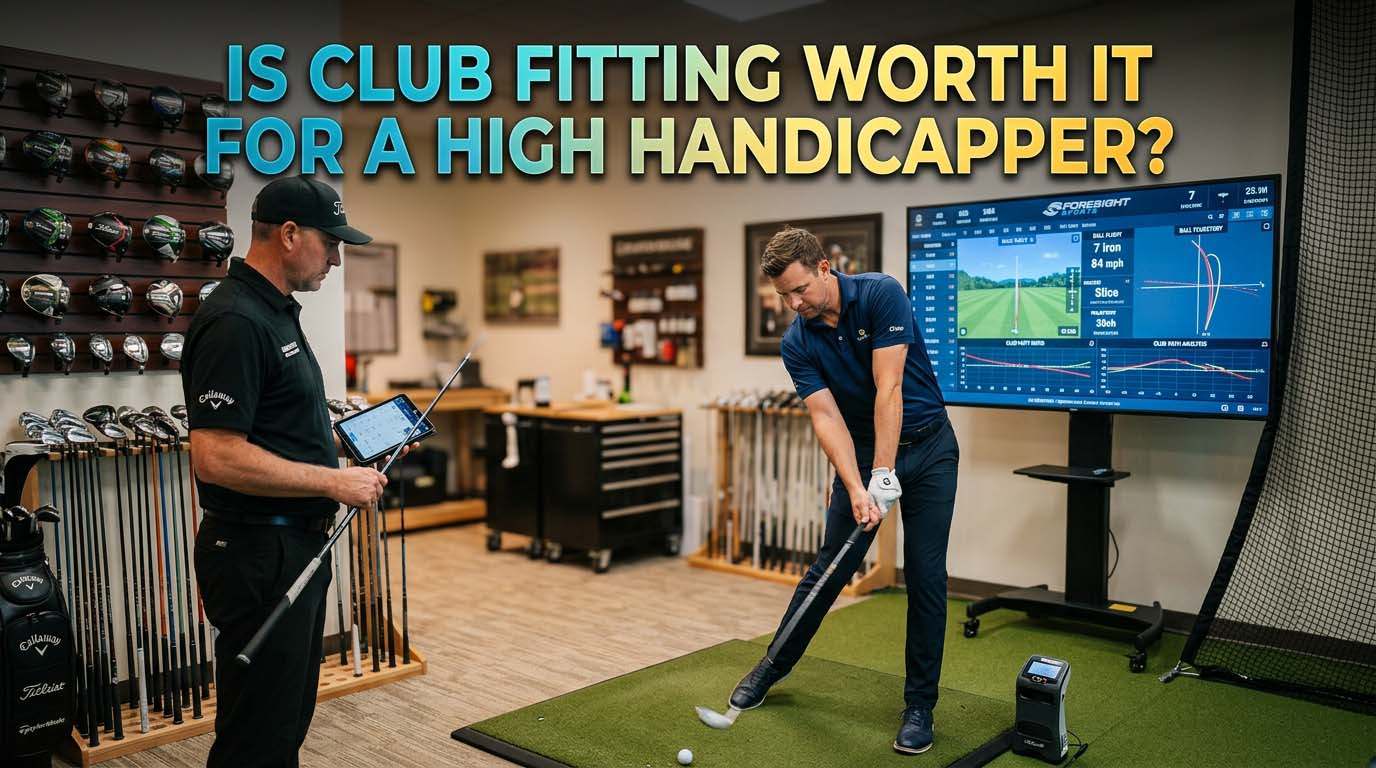
For most 20-handicap golfers, a club fitting is worth it for the specs that do not depend on skill (club length, lie angle, grip size and shaft weight) and much less worth it as a hunt for extra distance. If lessons are about to change your swing, book the lessons first and the fitting after, because a fitter can only measure the swing you bring on the day.
That is the short version. The longer one covers what a fitting can change without you changing, what the popular claim that high handicappers gain the most actually rests on, and a simple way to decide between a fitting, lessons, or neither.
What a fitting can fix at a 20 handicap without changing your swing
A high handicap usually means inconsistent contact and a face that arrives at the ball pointing in different directions from shot to shot. A fitting does not cure either of those. What it can do is remove equipment reasons for them, and several of those reasons have nothing to do with how good you are.
- Length. A club that is too long or too short changes your posture at address and where the club bottoms out. That matters at every skill level.
- Lie angle. If the toe or heel sits up at impact, the face points off-line even when you deliver it square. Our explainer on how lie angle quietly aims you somewhere else covers why a face delivered square can still start the ball off-line, which is a problem at any handicap.
- Grip size. Grips that are too thin or too thick for your hands change how you hold the club, and they are cheap to change.
- Shaft weight and flex. A shaft that is far too heavy or too stiff for your speed is hard to deliver consistently. If you already suspect you are between two flexes, our piece on choosing regular or stiff when you sit between them covers how that call is actually made.
- Set makeup. Which long irons you can realistically hit, and whether hybrids or higher-lofted woods should replace them.
Mizuno's own custom-fit page (read September 11, 2026) makes a point worth repeating for anyone nervous about their handicap: its fitting tool has "No handicap, age or gender bias" and "can only see your swing." That is the maker's framing, but the underlying idea is sound. The measurements do not care how many strokes you took last Saturday.
What a fitting cannot fix
A fitting cannot give you a repeatable low point, a consistent face angle or a swing path you do not already have. It can tighten a pattern that exists. It cannot invent one.
This is where the "fit or lessons" question really lives. If your misses are scattered in every direction because contact is still a lottery, the fitter is measuring noise. Good fitters look for the pattern inside that noise, but there is a limit to how much signal a very inconsistent swing produces in one session.
There is also a timing problem nobody selling a fitting has a reason to raise. If a coach is about to change your swing, the numbers a fitter recorded before that change describe a swing you are trying to leave. Clubs built around today's compensation can work against the move your coach is teaching. That is not an argument against fitting. It is an argument about order.
The claim that high handicappers gain the most, and what it rests on
You will see it said often that fitting helps average golfers more than it helps good ones. The most quoted version comes from a golf.com article published December 15, 2020 (read September 11, 2026), in which Tim Briand, a senior vice president at the fitting company True Spec Golf, says research "through some of the big OEMs" found that "87 percent of all golfers who are fit are able to reduce their handicap by at least 10 percent." The article's arithmetic follows: 10 percent of a 20 handicap is two strokes, while 10 percent of a 1 handicap is a tenth of a stroke.
Two honest caveats belong next to that number.
- The article does not name the study, its sample, or how handicaps were tracked. The figure is a fitting executive's summary of manufacturer research, not a published result a reader can check.
- The source sells fittings. That does not make the figure false. It means it should be read as a claim from an interested party, not as settled evidence.
The direction of the claim is plausible for the reasons in the first section: a golfer playing clubs that are the wrong length or lie has more to gain from correcting them than a golfer whose clubs already fit. The size of the gain is the part nobody outside the industry has verified.
Fitting or lessons: a decision table
| Your situation | Better first spend | Why |
|---|---|---|
| Playing under a year, swing changing week to week | Lessons | A fitting would measure a swing that will not exist in two months |
| Midway through a block of lessons | Finish the block, then fit | Fit the swing your coach is building, not the one you are replacing |
| Stable swing, playing hand-me-down or secondhand clubs of unknown spec | Fitting, or at least a length and lie check | The equipment may be a cause of your misses, and the check is objective |
| Well above or below average height, or unusually large or small hands | Fitting | Length, lie and grip size are the specs most likely to be off for you |
| Buying new clubs soon anyway | Fitting | The purchase is happening regardless; the fitting decides what you buy |
| Contact is decent and the only goal is more distance | Probably neither, for now | Distance promises are the weakest part of any fitting pitch |
| Set on a boxed complete set | A basic flex and length choice | Boxed sets offer limited options, so a full fitting has little to act on |
On that last row, Callaway's own complete-set buying guide (read September 11, 2026) is candid: with a boxed set "you'll often have the choice between certain shaft materials and flexes," some sets come in versions for taller or shorter golfers, and "that's the extent of the customization." The same guide describes boxed sets as "designed to assist beginners, occasional golfers, or those with high handicaps."
What a fitting costs you besides money
This article does not quote fitting prices, because they vary by fitter, by region and by how many clubs you are fitting, and a number here would be wrong for most readers. Check the fitter's own booking page.
Time is easier to pin down. Club Champion's published process page (read September 11, 2026) says to count on "about an hour to fit a single club and up to four hours for an entire bag."
The other cost people worry about is pressure to buy. Club Champion's page states "You are under no obligation to purchase." True Spec Golf's explainer (read September 11, 2026) says the results "will sometimes lead to you purchasing new golf clubs; other times, they will simply be printed out for you to take." Before you book, ask any fitter whether you leave with your spec sheet if you do not buy. Their answer tells you what you are actually paying for.
A cheaper order of operations for a 20 handicap
If a full-bag fitting feels like too big a step, there is a sensible ladder.
- Learn what your current clubs are. Length, lie and shaft are measurable at most club repair shops. Our guide to the numbers on a golf club spec sheet explains what each one does, so you know what you are being told.
- Use a demo day or a store hitting bay to try heads and shafts without committing. It is not a fitting, but it is real information.
- Fit only the clubs you are about to buy. A fitting for a club you are not replacing is information, not a purchase.
- Revisit after your swing settles. A fitting done after a block of lessons is measuring something stable.
Fitting is only one of several buying decisions that move money, and our pillar on where the money actually goes when you buy golf clubs puts it alongside new versus used and set versus individual clubs.
The honest limits of this advice
Nothing on this page comes from being fitted. This site has not been fitted and does not run fitting sessions, so every statement about what happens in one is attributed to the business that published it. Most of the material available on this topic, including several pages quoted here, is published by companies that sell fittings or clubs. That is normal and it is not a reason to dismiss it, but it is a reason to separate the parts that are measurable (length, lie, grip size, shaft weight) from the parts that are promises (strokes saved, yards gained).
FAQ
Is a club fitting worth it for a beginner who has played less than a year?
Usually lessons come first. A swing that is still changing week to week gives a fitter unreliable numbers. A quick length and lie check on the clubs you own is still worthwhile if you are unusually tall, short, or playing clubs of unknown origin.
Can a club fitting lower my handicap?
It can remove equipment causes of misses, such as the wrong length or lie. The widely quoted figure that most fitted golfers cut their handicap by 10 percent comes from a fitting company executive summarizing unpublished manufacturer research, so treat it as a claim rather than a measured result.
Do I have to buy clubs after a fitting?
Not necessarily. Club Champion's process page says there is no obligation to purchase, and True Spec says results are sometimes just printed for you to take. Ask the fitter before booking whether you keep the spec sheet if you do not buy.
Is a fitting worth it if I am buying a complete boxed set?
Rarely a full one. Boxed sets offer a limited choice of shaft material, flex and sometimes length, so there is little for a full fitting to change. A basic flex and length decision covers most of it.
The bottom line
At a 20 handicap, a fitting earns its keep on the specs that are objectively measurable and independent of skill. It is a weaker buy as a distance play, and it is the wrong first purchase if a coach is about to rebuild your swing. Get the order right and a fitting stops being a gamble.