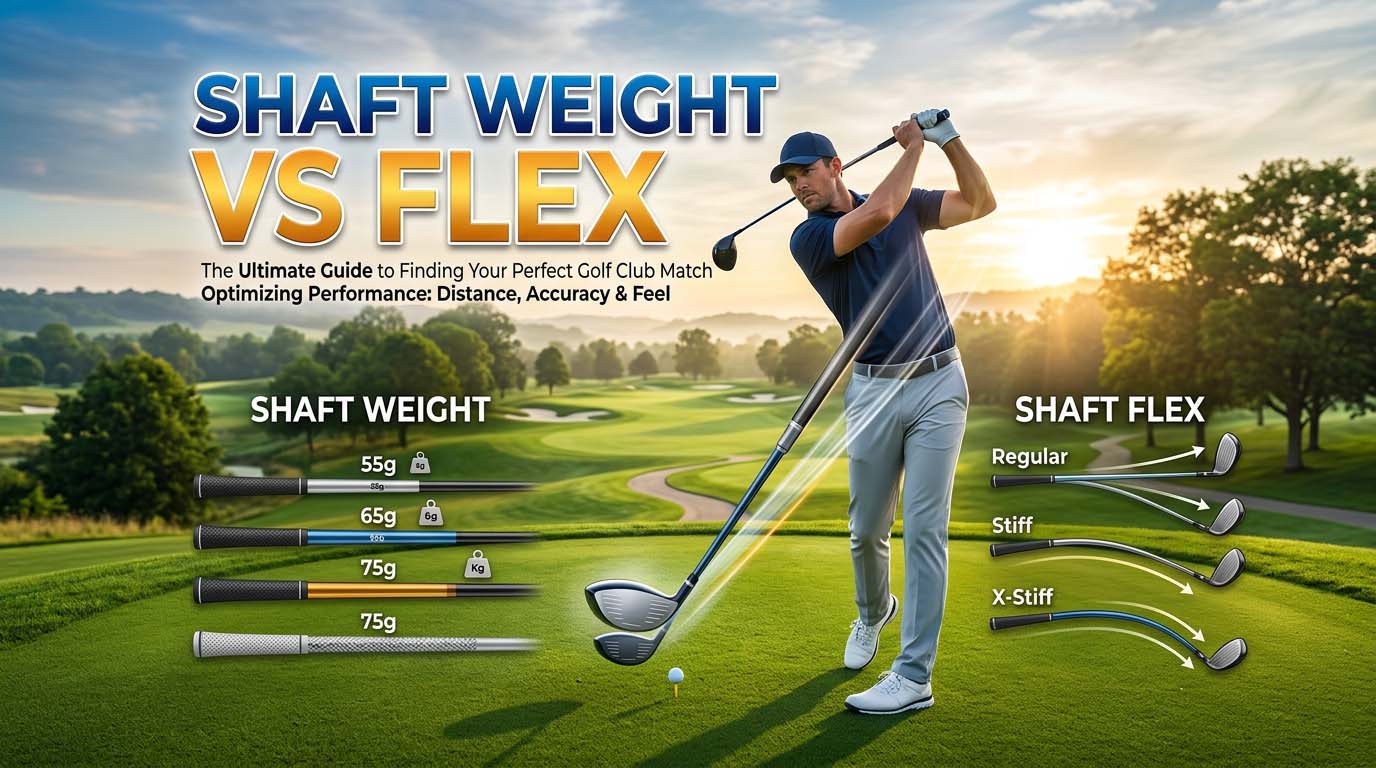
Golfers spend a great deal of time choosing between R and S and almost none choosing a weight. That is roughly backwards, and the reason is worth understanding.
The difference between the two specs, in one paragraph
Flex is a label. No governing body defines it, no test qualifies a shaft for it, and each manufacturer sets its own boundaries relative to its own range. Two shafts labeled S from two companies are not claiming to be the same thing.
Weight is a measurement. It is published in grams, it means the same thing at every company, and it is directly comparable across every shaft on the market. There is no interpretation involved.
One of those is a specification and the other is a category name. When you are trying to compare two clubs, the difference matters.
What shaft weight actually changes
Weight is not a small variable applied to a big club. On a modern driver, the shaft is a substantial share of the assembled club's mass, and changing it changes several things at once.
Total club weight, which is what you lift and swing.
Swing weight, which is a measure of how heavy the head feels relative to the grip when the club is swung. It is not total weight; it is a balance measurement. A change in shaft weight moves it, and so does a change in grip weight, head weight or club length. This is the reason a club can feel heavy while weighing less.
Where the mass sits along the shaft. Two shafts of the same total weight can distribute it differently, which affects how the club feels in transition.
Timing. A heavier club generally moves more slowly for the same effort, and that changes the tempo of the swing more directly than a stiffness change does.
Why fitters keep starting with weight
This is a pattern worth reporting rather than a claim about what is best for you.
In a great deal of published fitting process, weight is treated as a primary variable and flex as a secondary one, and the reasoning given is consistent: weight is a defined quantity, and a golfer's response to a weight change is more repeatable than their response to a flex label change.
There is also a practical reason. Because flex has no standard, a fitter changing from R to S within one product family is making a known change within one company's ladder. Changing weight is a known change everywhere.
None of that means light or heavy is better. It means that if you are going to reason about a shaft, weight is the variable you can actually reason about.
The confusions worth clearing up
Lighter is not automatically faster. The idea is intuitive: less mass, more speed. In practice a shaft too light for a golfer can cost control and timing, and the net result is not more distance. Whether the trade is worth it is individual and it is not a rule.
Heavier is not automatically more controlled. A club too heavy for the person swinging it deteriorates in both speed and consistency, and it does so gradually over eighteen holes rather than obviously on the first swing.
"Senior" and "ladies" shafts are weight-and-flex combinations with a label on them. The label describes a market segment, not a measurement, and there is nothing about the underlying product that ties it to age or gender. Plenty of golfers of all descriptions are best served by a lighter assembly and are steered away from it by a word.
Total weight and swing weight are different questions. Adding weight to the grip end and adding it to the head end move total weight the same way and swing weight in opposite directions. This is a common source of confusion when someone changes a grip and reports the club feels different.
Where weight shows up across the set
Drivers and woods are where the range of available shaft weights is widest and where the effect on speed is most discussed.
Irons are where the steel-and-graphite question sits, and it is largely a weight question wearing a materials label. That is its own subject and this site covers it separately.
Wedges are frequently built heavier than the corresponding irons, deliberately, for control on short shots.
And the grip is part of the equation. Grips are published with weights too, and swapping to a heavier or lighter grip changes swing weight for a small fraction of the cost of a shaft. That is the cheapest lever on the whole club, and it is covered in its own article on this site.
What to actually check
Practical, and none of it is a recommendation.
Look up the published weight of the shaft in the club you currently play. Most people have never done this. It is on the maker's spec page, it takes two minutes, and it turns "I play stiff" into an actual data point about your own equipment.
When comparing two clubs, compare grams before letters. A stock shaft in one brand's driver and a stock shaft in another's may differ meaningfully in weight, and that difference will be more noticeable than the fact that both are labeled S.
On a used club, the weight is whatever is in it. The model name is the information. Our guide to buying used golf clubs covers the checks that are worth running on a used purchase, and the shaft is one of the least visible of them.
And if you are being fitted, ask what weights were tried. A fitting that tested one weight in three flexes explored a narrower space than one that did the reverse.
The summary, without a number in it
Flex is a category name set by each manufacturer for its own range. Weight is a measurement that means the same thing everywhere. If you are going to pay attention to one spec on a shaft, the second one is the one you can compare, and it is frequently the one you notice.
This article publishes no gram figure, because every shaft's weight belongs to that shaft, published on its own maker's page, and a representative number would describe nothing you could buy. That is the same reason our page on the golf club spec sheet, translated sends you to the maker's own sheet rather than reproducing one.
FAQ
Is shaft weight more important than flex?
Weight is the spec you can actually reason about: it is published in grams, means the same thing at every company, and is directly comparable across every shaft on the market. Flex is a label each maker defines for its own range, and much published fitting process treats weight as the primary variable for exactly that reason.
Does a lighter shaft automatically mean more distance?
No. The idea is intuitive, less mass and more speed, but a shaft too light for a golfer can cost control and timing, and the net result is not more distance. Whether the trade is worth it is individual, not a rule.
Is a heavier shaft automatically more controlled?
No. A club too heavy for the person swinging it deteriorates in both speed and consistency, and it does so gradually over eighteen holes rather than obviously on the first swing.
What is the difference between total weight and swing weight?
Total weight is what you lift and swing. Swing weight is a balance measurement, how heavy the head feels relative to the grip when the club is swung. Adding weight to the grip end and to the head end move total weight the same way and swing weight in opposite directions.
Are senior and ladies shafts actually different products?
They are weight-and-flex combinations with a market-segment label on them. Nothing about the underlying product ties it to age or gender, and plenty of golfers of all descriptions are best served by a lighter assembly and steered away from it by a word.