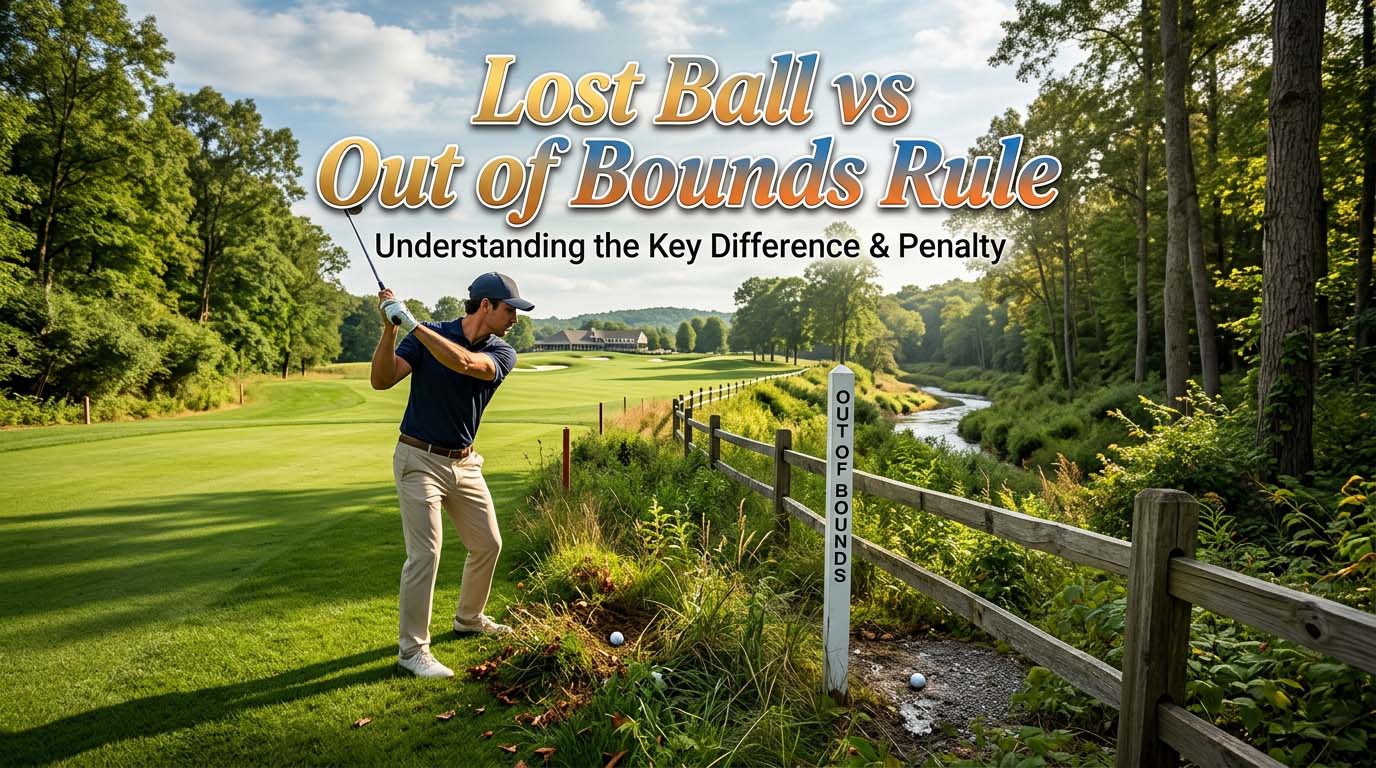
Under the lost ball vs out of bounds rule, the penalty is the same and the test is different. Rule 18.2 of the Rules of Golf treats both the same way: add one penalty stroke and play again from where you hit the previous shot, which golfers call stroke and distance. What separates them is how you get there. A ball is lost when it is not found within three minutes of starting the search. A ball is out of bounds only when all of it is outside the boundary edge of the course. The argument in your group is almost always about the test, not the penalty.
That is the whole answer for most rounds. The rest of this page covers the edge cases that start the arguments: balls on the line, balls found at minute four, balls that might be in a penalty area, and the optional Local Rule that lets some courses skip the walk back.
What the Rule Actually Says
The wording below comes from Rule 18 in the R&A's online Rules of Golf (read October 2, 2026). The R&A's Rules Hub lists the 2023 Rules of Golf as the current edition, and the USGA and The R&A publish the same Rules.
- Lost: "A ball is lost if not found in three minutes after the player or their caddie begins to search for it."
- Out of bounds: "A ball at rest is out of bounds only when all of it is outside the boundary edge of the course."
- What to do in either case: the player "must take stroke-and-distance relief by adding one penalty stroke and playing the original ball or another ball from where the previous stroke was made."
Breaching that requirement (dropping near where the ball disappeared, for instance, when no Local Rule allows it) carries the general penalty under Rule 14.7a, which means two penalty strokes in stroke play or loss of the hole in match play. That is on top of the stroke-and-distance penalty you already owed.
Why They Are Two Different Situations
People say "lost or OB" as if it were one thing, and the shared penalty encourages that. But the two conditions are decided by completely different facts, which is why one group member can be sure and another can be equally sure of the opposite.
Out of bounds is a question of position. Under Rule 2.1, the Committee sets the course boundaries, and areas not on the course are out of bounds. How the boundary is marked on a given course (stakes, lines, fences) is something the scorecard or the posted local rules tell you, so check before you tee off rather than guessing on the third hole. The test is about where the ball came to rest relative to the boundary edge, and it is strict: all of the ball has to be outside. If any part of the ball is on or inside the edge, it is in bounds and you play it.
Lost is a question of time. It does not matter how sure you are the ball is somewhere in that bush. If it is not found within three minutes of you or your caddie starting to look, it is lost. The reverse is also true: a ball does not become lost just because you expect not to find it. It is either found in time, found out of bounds, or lost when the clock runs out.
Lost Ball vs Out of Bounds Rule: Side by Side
| Question | Lost ball | Out of bounds |
|---|---|---|
| What decides it | Not found within 3 minutes of starting the search | All of the ball at rest is outside the boundary edge |
| Need to find the ball? | No, that is the point | Usually yes, or be certain where it finished |
| Penalty | 1 stroke, stroke and distance | 1 stroke, stroke and distance |
| Where you play next | Where the previous stroke was made | Where the previous stroke was made |
| Provisional ball allowed? | Yes, if it might be lost outside a penalty area | Yes, if it might be out of bounds |
| Model Local Rule E-5 option | Yes, if the course has adopted it | Yes, if the course has adopted it |
The Three-Minute Clock, in Detail
The clock starts when the player or their caddie begins searching, not when the group arrives in the area. If a ball turns up inside three minutes but you are not sure it is yours, Rule 18.2a(1) gives you "a reasonable time" to identify it, even if that runs past the three minutes. That is why marking your ball with something unique before the round is worth the ten seconds: Rule 7.2 lets a player identify a ball by "seeing the player's identifying mark on the ball."
Two related points that save penalties while you search:
- If you accidentally move your ball while looking for it, Rule 7.4 says there is no penalty. Put it back where it was.
- Under Rule 7.1, you may move or bend grass, bushes and branches to find the ball, but if what you do improves your conditions beyond what is reasonable for searching, a penalty applies.
When It Is Not Lost: The Penalty Area Exception
This is the edge case that matters most. If a ball has not been found but it is "known or virtually certain" that it came to rest in a penalty area (the red or yellow staked areas), Rule 17.1c says you may take penalty area relief instead. That relief also costs one stroke, but it usually lets you play from much closer to where the ball went in, rather than going all the way back.
The reverse also applies. If it is not known or virtually certain that the ball is in the penalty area, and you cannot find it, it is a lost ball and stroke and distance applies. "It probably went in the water" is not the same as "it is virtually certain it went in the water."
The Optional Fix: Model Local Rule E-5
Courses and committees can adopt Model Local Rule E-5, which is published in the R&A's Committee Procedures (read October 2, 2026). Where it is in effect, a player whose ball is lost or out of bounds can, "for two penalty strokes," drop in a relief area between the estimated spot where the ball came to rest or went out and the nearest point of the fairway that is not nearer the hole, extending two club-lengths onto the fairway.
Three limits on E-5 that often get missed:
- It is optional. If the course has not adopted it, it does not exist for your round. Our explainer on how local rules work against the Rules of Golf covers where to find a course's local rules.
- It cannot be used for an unplayable ball or a ball known or virtually certain to be in a penalty area.
- It cannot be used for the original ball if you have already played a provisional ball. If the provisional itself is not found or is out of bounds, E-5 can be applied to the provisional.
The Committee Procedures also say E-5 is not appropriate for competitions limited to highly skilled players, meaning professional and elite amateur events. So a rule your local course allows on a Saturday may not be in effect at a club championship, and it is not what you see at professional events.
The Stroke Count, Worked Through
The arithmetic is where friendly groups go wrong, so here it is for a tee shot:
- Tee shot out of bounds or lost, no provisional: one stroke for the tee shot, one penalty stroke, so you are hitting your third shot from the tee.
- Tee shot lost or out of bounds, provisional played: the provisional counted as your third shot, so your next shot with it is your fourth.
- Tee shot lost or out of bounds, E-5 in effect: one stroke for the tee shot, two penalty strokes, so you drop in the fairway area and hit your fourth shot.
E-5 is not cheaper than stroke and distance on the scorecard. It is a trade: one extra penalty stroke in exchange for not walking back. Whether that trade suits you depends on how far you would otherwise have to walk and what the replayed shot would likely leave you.
Why a Provisional Ball Is the Practical Answer
Because both situations send you back to where you last played, the time-saving fix is the same for both: when the ball might be lost outside a penalty area or might be out of bounds, hit a provisional before you walk forward. Rule 18.3b requires you to announce it before the stroke, and it says merely saying "another ball" or "playing again" is not enough. Use the word "provisional" or otherwise clearly indicate it. Without the announcement, the second ball becomes your ball in play under stroke and distance. If the original turns up outside a penalty area within three minutes, you abandon the provisional and play the original, and the strokes with the provisional do not count.
Related Rules Worth Knowing
If the argument in your group is about what is in your bag rather than where the ball went, the 14-club rule explains the limit and its penalty. For the official text rather than summaries, see our guide on where to read the official Rules of Golf.
Frequently Asked Questions
Is the penalty for a lost ball the same as out of bounds?
Yes. Under Rule 18.2b both cost one penalty stroke, and you must play again from where the previous stroke was made. Only the way each one is decided is different.
Is a ball on the out of bounds line in or out?
In. A ball is out of bounds only when all of it is outside the boundary edge of the course. If any part of it is on or inside the edge, the ball is in bounds.
What if I find my ball after three minutes?
It is lost. The three minutes start when you or your caddie begin searching. The only extension is a reasonable time to identify a ball that was found within the three minutes.
Can I drop where my ball went out of bounds with a one-stroke penalty?
No. Dropping near where the ball went out is only allowed under Model Local Rule E-5, and it costs two penalty strokes. Without E-5 in effect, you must go back to where you last played.
Is a ball in the water a lost ball?
Not if it is known or virtually certain the ball came to rest in a penalty area. Then you take penalty area relief under Rule 17. If you cannot be virtually certain and cannot find it, it is a lost ball.