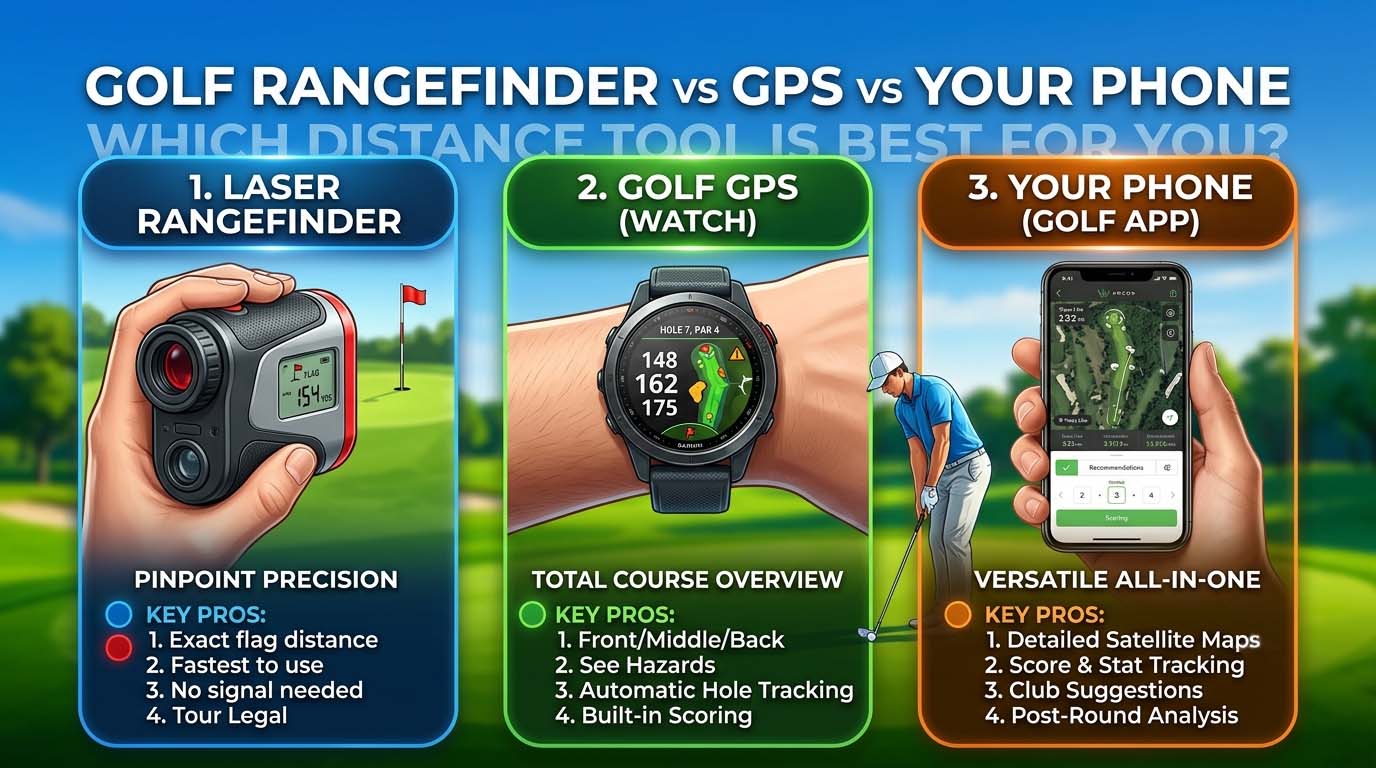
A laser rangefinder, a GPS watch or handheld, and a free phone app all answer the same broad question, how far is it, but they do it in genuinely different ways and none of them is a strictly better version of the others. A laser rangefinder gives you a precise distance to one specific target you aim it at, usually the flagstick. A GPS device gives you pre-mapped distances to the front, middle, and back of the green without needing to see anything at all. A phone app gives you most of what a GPS device gives you, at no extra cost, with some real trade-offs. The right choice depends on how you actually play, not on which category sounds more serious.
What a laser rangefinder is actually for
A laser rangefinder does one thing very precisely: it measures the straight-line distance to whatever you point it at. Aim it at the flag, and (assuming a clean line of sight and a functioning flag-lock feature) you get a specific number to that exact point, not an approximation of where the green starts.
This is the category's real strength. It rewards a golfer who wants to know the precise distance to the pin on an approach shot, not just a rough sense of range. The trade-off is that it needs a clear line of sight to the target, it requires you to physically aim and hold it steady, and it tells you nothing about hazards or layout features you are not currently pointing at.
What a GPS watch or handheld is actually for
A GPS device works from pre-mapped course data rather than a line-of-sight laser measurement. Instead of aiming at a single target, it shows you distances to multiple reference points on the current hole, typically the front, middle, and back of the green, and often hazards and layup points as well, all at once and without needing to see any of them directly.
This solves a different problem than a laser rangefinder does. It is genuinely more convenient when the pin is obscured, when you want a quick sense of the whole hole rather than one precise number, or when you are moving quickly and do not want to stop and aim a device. What it gives up is the pin-specific precision a laser provides; a GPS distance to "the green" is not the same as a laser distance to "the flag on that green."
What a free phone app gives up
This is the option most buying guides treat as an afterthought, and it deserves a real look, because it is genuinely free if you already own a smartphone. Course-mapping apps exist that function similarly to a GPS handheld: front, middle, and back yardages, hole layouts, sometimes hazard distances.
What you give up compared to a purpose-built device is real, though, and worth naming plainly rather than glossing over. Battery life is shared with everything else you use your phone for during the round, and a full round of GPS use with the screen active drains a phone meaningfully faster than a dedicated GPS unit built for exactly that job. Screen visibility in direct sunlight is often worse on a phone than on a device designed for outdoor use. And pulling your phone out between shots is a different physical habit than glancing at a wrist device or raising a rangefinder, which some golfers find slows their pace of play. None of these are reasons to dismiss the phone-app option; they are the honest cost of the free option, and a golfer who plays casual rounds and does not mind these trade-offs may find a free app entirely sufficient.
A decision framework by how you actually play
Rather than asking which category is objectively best, it helps to ask how you actually play most rounds.
If you play competitive rounds, or you consistently want the most precise possible number to the pin for approach-shot decisions, a laser rangefinder is built for exactly that job, and its precision is the reason it exists as a category.
If you play courses where the pin is often not visible, you value having hazard and layup distances without stopping to aim at each one, or you want a faster, more continuous sense of the hole, a GPS watch or handheld solves that more directly than a laser device does.
If you play mostly casual rounds, are cost-conscious, and do not mind the phone-specific trade-offs above, a free course-mapping app is a legitimate starting point rather than a compromise you are forced into before you can afford "real" equipment.
Some golfers end up using more than one of these across different rounds. That is not indecision; it reflects that the three categories solve genuinely different problems rather than competing versions of the same one.
FAQ
Is a laser rangefinder always more accurate than GPS?
For the single target you point it at, a laser reading is a direct distance measurement to that point. A GPS distance is calculated from pre-mapped course data and is inherently an estimate to a mapped point (like the center of the green) rather than a live measurement of wherever the pin actually is that day. See /golf-rangefinder-accuracy-explained/ for how accuracy claims are measured and what actually affects them in the field.
Can I use slope adjustment with GPS or only with a laser rangefinder?
Slope adjustment, as most golfers encounter it, is a laser-rangefinder feature built around a real-time incline measurement to the exact target you aim at. Some GPS devices offer elevation-adjusted distances using pre-surveyed course data instead, which is a related but different calculation. See /what-is-slope-on-a-golf-rangefinder/ for how slope actually works.
Do I really need to buy anything if my phone already has a golf app?
Not necessarily, if you play casual rounds and the trade-offs above (battery drain, screen visibility, phone-out-between-shots habit) do not bother you. A free app is a legitimate choice, not just a placeholder until you can afford a device.
Which option is best for a beginner?
A GPS watch or a phone app is generally the more forgiving starting point, since it gives whole-hole context without requiring you to aim and hold a laser device steady on a small target. A laser rangefinder rewards more precision-focused play, which tends to matter more as your course management gets more specific.
Is there a device that combines laser and GPS?
Hybrid devices exist that combine laser measurement with GPS course mapping in one unit. They add convenience by covering both jobs, generally at a higher price than a laser-only or GPS-only device, and are worth considering if you genuinely want both functions rather than one or the other.
For a broader framework on what to actually check before buying any of these, see /golf-rangefinder-buying-guide/.