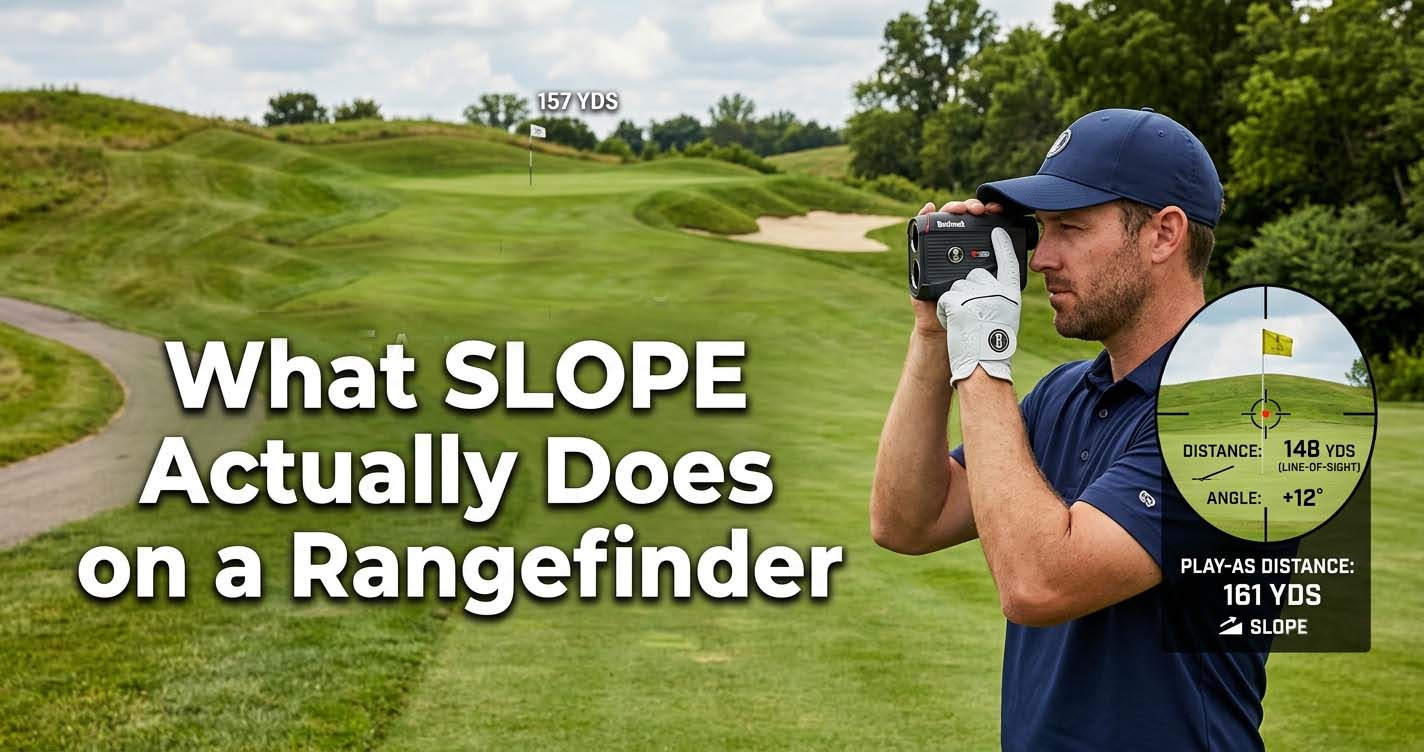
Slope, on a golf rangefinder, is a feature that adjusts the straight-line laser distance to account for the change in elevation between you and your target. It does this using a built-in inclinometer, a small sensor that measures the angle of incline or decline, and combines that angle with the laser distance to give you a "plays-like" number instead of the flat, measured distance. It is a genuinely useful feature for casual rounds and a genuinely restricted one in competitive play, and those are two separate facts, not one.
How it actually works
A laser rangefinder without slope tells you exactly one thing: the straight-line distance between the device and the target, measured by timing how long a laser pulse takes to travel there and back. That number is honest, but it does not tell you anything about the ground between you and the flag.
Add an inclinometer, and the device now also knows the angle of the shot. Hit uphill, and the ball has to fight gravity for longer, so the shot plays farther than the flat number suggests. Hit downhill, and the opposite happens. A slope-enabled device combines the laser distance and the incline angle into an adjusted "plays-like" figure that accounts for that difference.
This is not a guess or an estimate layered on top of the laser reading. It is a second measurement (the angle) combined mathematically with the first (the distance). The laser part of the reading is exactly as accurate as a non-slope device; the adjustment is simply added information about the terrain.
Uphill and downhill, without a specific number
Every golfer who has played a course with real elevation change knows the frustration slope solves: a shot that reads at one distance on the flat but clearly needs more club going up, or less club going down. Slope takes that judgment call and gives it a mechanical basis instead of a guess.
It's worth being precise about what this means without inventing a specific figure. The relationship between elevation change and effective playing distance depends on the actual slope angle of the shot, and that varies from hole to hole and course to course. Any single example number you see quoted online for "how much yardage an uphill shot adds" is describing one specific slope angle, not a universal constant, so treat any such figure as illustrative at best rather than something you can apply to your own course.
Why it is restricted where competition rules apply
Here is the part that confuses a lot of golfers who are new to buying a rangefinder: the same feature that makes a casual round easier is commonly switched off for rounds played under standard competitive conditions. This is not because slope is unreliable or fake. It is a rules decision about what kind of information a player may access mid-round, and it sits with the Rules of Golf and the equipment-conformity side of the game rather than with the device itself.
This site covers the precise rule number, the relevant Model Local Rule, and the actual penalty for a breach in a dedicated piece on golf equipment rules and conformity, because that is a citation-first topic that deserves its own careful treatment rather than a paragraph here. What matters for a buying decision is simpler: almost every slope-enabled rangefinder ships with a physical or menu toggle to turn slope off, specifically so the same device can be used for both a casual round and a round played under stricter conditions. Check for that toggle before assuming a slope device locks you out of one type of play or the other.
Why casual players still want it
None of the above means slope is a feature only for rules trivia. For the overwhelming majority of rounds most golfers play, with friends, on a weekend, with no committee checking device settings, slope is simply useful information. It turns "that looks uphill, so maybe more club" into a specific adjusted number instead of a guess, and it removes one more variable from club selection on a course with real elevation change.
Whether it is worth paying extra for depends on the terrain you actually play. A golfer who mostly plays flat courses gets comparatively little from slope. A golfer whose home course has real elevation change on approach shots will get real, repeated use out of it.
What slope does not do
It is worth being clear about the limits of this feature too, since a spec sheet rarely spells them out. Slope does not improve the base accuracy of the laser measurement itself; a slope-enabled reading is only as precise as the underlying distance reading, plus the incline calculation on top of it. It also does not account for wind, temperature, altitude above sea level, or how the ball itself is behaving that day; those are separate variables that no rangefinder, slope-enabled or not, measures. And it does not replace course knowledge. A green with a false front or a severe back-to-front tilt still needs to be read by eye. Slope tells you what the shot plays like in terms of elevation change between two points; it does not describe the shape of the ground once the ball lands.
Treating slope as one input among several, rather than a single number that settles the club selection, is the realistic way to use it.
FAQ
Does slope make a rangefinder less accurate?
No. The laser-measured straight-line distance is unaffected by whether slope is enabled. Slope adds a second piece of information (the incline angle) rather than changing how the laser measurement itself works.
Can I turn slope off if I need to?
Yes, on essentially every slope-enabled rangefinder currently sold, there is a physical switch or a menu setting to disable the plays-like adjustment and show only the raw laser distance. Confirm this is present and easy to reach before buying, since some designs bury the toggle deeper than others.
Is slope the same thing as GPS elevation data?
No. Slope on a laser rangefinder measures the actual incline angle to the specific target you aim the laser at, in real time. GPS-based elevation data on a course map is a separate feature built from pre-surveyed course data, and the two are not interchangeable. /golf-rangefinder-vs-gps/ covers how laser and GPS devices differ more broadly.
Do I need slope if I mostly play flat courses?
Probably not as a priority feature. Slope earns its value on courses with real, repeated elevation change between tee and green. On mostly flat terrain, the feature has little to adjust for.
Why do some rangefinder listings barely mention the restriction on slope use?
Because it is easy to treat as a footnote when the real subject is equipment rules and conformity rather than the device itself. It is worth knowing the restriction exists before you buy, even if the detailed rule citation belongs in dedicated equipment-rules content rather than a buying-focused page like this one.
For the full picture on choosing between device types before you compare individual models, see /golf-rangefinder-buying-guide/.