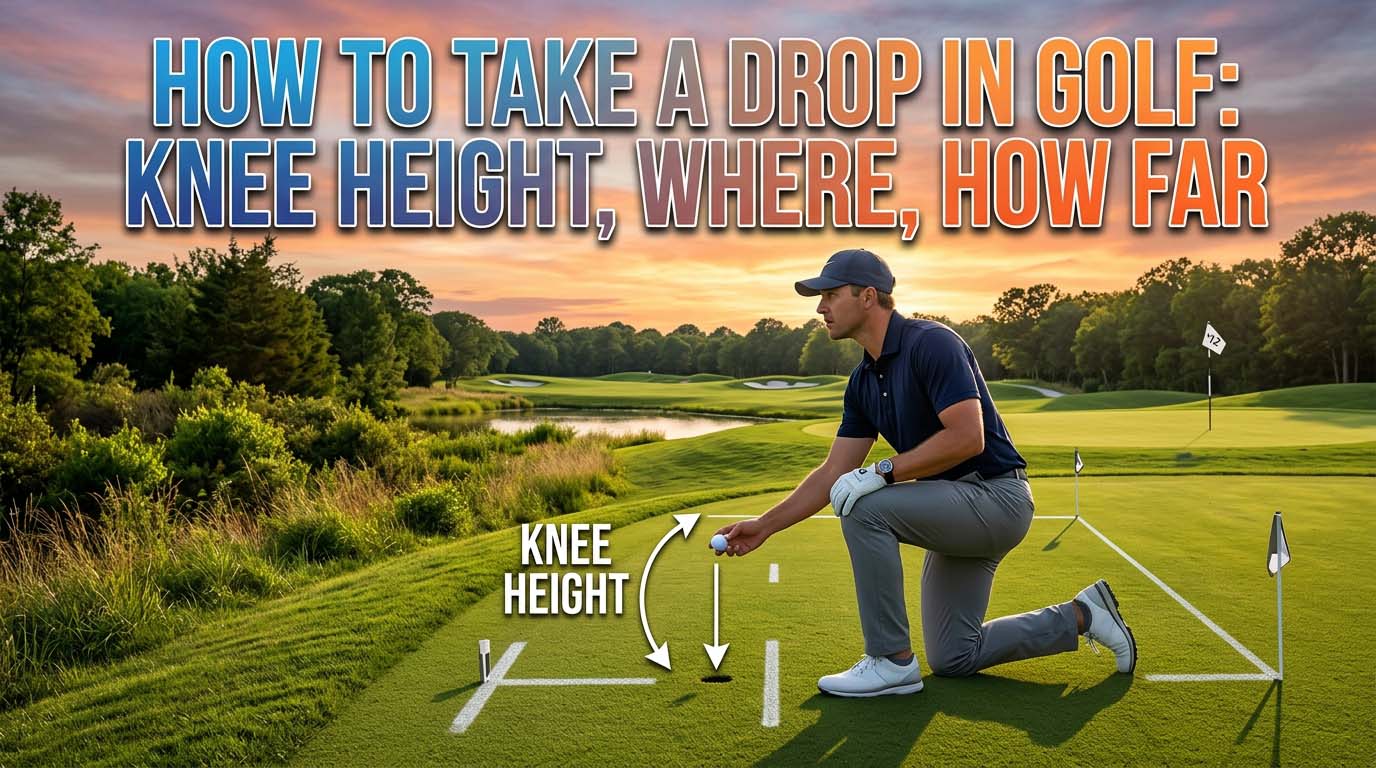
Here is how to take a drop in golf under the current 2023 Rules of Golf: work out your reference point, measure a relief area of one or two club-lengths from it (no nearer the hole), then drop the ball yourself from knee height so it falls straight down without touching you or your equipment. The ball must land in the relief area and come to rest there. If it rolls out, drop again. If it rolls out a second time, place it on the spot where the second drop first touched the ground. Knee height replaced the old shoulder-height drop in 2019.
That is the whole procedure. What trips people up is not the drop itself but the setup: which reference point, which size of relief area, and what "knee height" actually means. Each is covered below with the Rule number, so you can settle it on the course.
Which Edition This Is Based On
Dropping rules have changed within living memory, so the edition matters. The R&A's Rules Hub lists the 2023 Rules of Golf as the current edition (read October 2, 2026), with its latest listed clarifications dated July 1, 2026. Those clarifications update the 2023 edition rather than replace it. The USGA and The R&A publish the same Rules, so this applies on US and UK courses alike.
The big change came earlier. The Ohio Golf Association's 2019 rules series (read October 2, 2026) describes the old method: "a player held the ball in the fingers at shoulder height with arm fully-extended and let it go." From 2019, the ball has had to be dropped from knee height. Any guide still telling you to stand up straight and drop from your shoulder is describing rules that ended in 2018. If you want the primary text rather than any summary, our guide on where to read the official Rules of Golf points to it.
How to Take a Drop in Golf: The Five Steps
The procedure itself is Rule 14.3, quoted from Rule 14 in the R&A's online Rules of Golf (read October 2, 2026).
Step 1: Know which Rule you are taking relief under
You do not drop just because you dislike a lie. A drop always follows from a specific relief Rule: free relief from an abnormal course condition (Rule 16.1), an embedded ball (Rule 16.3), penalty area relief (Rule 17.1d), unplayable ball relief (Rule 19.2), or a Local Rule such as Model Local Rule E-5. That Rule sets both the reference point and the size of the relief area.
Step 2: Find the reference point
The reference point is where the measuring starts:
- Free relief from a cart path, sprinkler head, ground under repair, animal hole or temporary water: the nearest point of complete relief in the general area (Rule 16.1b).
- Embedded ball in the general area: the spot right behind the ball (Rule 16.3).
- Red penalty area, lateral relief: the estimated point where the ball last crossed the edge of the penalty area (Rule 17.1d(3)).
- Unplayable ball, lateral relief: the spot of the original ball (Rule 19.2c).
- Back-on-the-line relief: a different method, explained in its own section below.
Step 3: Measure the relief area
A club-length is the length of the longest club you have for the round, other than your putter. For most golfers that is the driver. You measure from the reference point, and the relief area must not be nearer the hole than the reference point. Some Rules add further limits; free relief under Rule 16.1b, for example, must leave you in the general area with complete relief from the condition, including your stance and swing.
Step 4: Drop from knee height
Rule 14.3b sets three requirements:
- Who: "The ball must be dropped only by the player."
- How: "The player must let go of the ball from a location at knee height so that the ball falls straight down, without the player throwing, spinning or rolling it," and it must not touch any part of the player's body or equipment before it hits the ground.
- Where: "The ball must be dropped in the relief area."
Knee height, as the Rules define it, means "the height of the player's knee when in a standing position." So the height is fixed by your knee as you stand, and you crouch, bend or squat to bring your hand down to that level. Getting your body lower does not lower the required height.
Step 5: The ball must come to rest in the relief area
Under Rule 14.3c, if the ball comes to rest in the relief area, you are done and you play it as it lies. If it comes to rest outside, drop a second time. If the second drop also finishes outside, place a ball on the spot where the second dropped ball first touched the ground.
Relief Area Sizes at a Glance
| Situation | Rule | Penalty | Reference point | Relief area |
|---|---|---|---|---|
| Cart path, sprinkler, ground under repair | 16.1b | None | Nearest point of complete relief | 1 club-length |
| Embedded ball, general area | 16.3 | None | Spot right behind the ball | 1 club-length |
| Red penalty area, lateral | 17.1d(3) | 1 stroke | Where the ball last crossed the edge | 2 club-lengths |
| Unplayable ball, lateral | 19.2c | 1 stroke | Spot of the original ball | 2 club-lengths |
| Back-on-the-line (penalty area, unplayable, bunker) | 16.1c, 17.1d(2), 19.2b, 19.3b | Depends on the Rule | Where the dropped ball first touches the ground | 1 club-length in any direction |
| Lost or out of bounds, E-5 in effect | Model Local Rule E-5 | 2 strokes | Ball and fairway reference points | Up to 2 club-lengths onto the fairway |
The quick rule of thumb: free relief and back-on-the-line relief use one club-length, lateral penalty relief uses two.
Back-on-the-Line Relief Works Differently
Back-on-the-line relief is the option that keeps a spot between you and the hole: the original ball's spot for an unplayable ball, or the point where the ball last crossed the edge of a penalty area. It is available for both yellow and red penalty areas and for unplayable lies.
Under the current Rule 14.3b, "when taking back-on-the-line relief… the ball must be dropped on the line in a location allowed by that Rule, and the spot on which the ball is dropped creates a relief area." For an unplayable ball, Rule 19.2b sets that relief area at one club-length in any direction from where the ball first touches the ground, no nearer the hole than the original ball's spot.
In practice that means you pick how far back you want to go, stand on the line from the hole through the reference point, and drop on that line. You do not pick a spot to the side of the line first.
What If You Drop the Wrong Way?
This is where the 2023 edition is forgiving, and where a lot of old penalty talk is wrong. Rule 14.3b says that if a ball is dropped the wrong way, "the player must drop a ball again in the right way, and there is no limit to the number of times the player must do so." There is no penalty for the bad drop itself as long as you correct it before you play.
The penalties only arrive if you play the ball anyway:
- Played from the relief area after a wrong-way drop: one penalty stroke.
- Played from outside the relief area, or after placing when you should have dropped: the general penalty, which is two strokes in stroke play or loss of the hole in match play.
Playing from a wrong place in general is also a general penalty under Rule 14.7a.
Common Mistakes on the Course
- Measuring with the putter. A club-length is your longest club other than the putter, so a long putter does not help.
- Dropping from shoulder height out of habit. It is a wrong-way drop under the current Rules. Pick it up and drop again from knee height.
- Stopping at the edge of the cart path. Free relief means complete relief, stance included. If your feet are still on the path, you have not finished.
- Assuming you can place after one roll-out. You drop twice before you place.
- Using E-5 where it does not exist. The two-stroke fairway drop for lost or out-of-bounds balls is a Local Rule. Our explainer on how local rules relate to the Rules of Golf covers how to check whether a course has adopted it.
Does Your Driver Length Matter?
Slightly, yes. Because the club-length is set by your longest non-putter club, a golfer carrying a longer driver gets a slightly larger relief area than one carrying a shorter one. The difference is small, and it is fixed for the round, so you cannot borrow a friend's longer club to measure. If you want to know how long your own driver is, the golf club spec sheet explained shows where length is listed.
Frequently Asked Questions
Do you drop from knee or shoulder height in golf?
Knee height. The shoulder-height drop ended when the 2019 Rules took effect, and the current 2023 edition keeps knee height, defined as the height of your knee when you are standing.
How far can a dropped ball roll?
It must come to rest inside the relief area, which is one or two club-lengths from the reference point depending on the Rule. If it rolls out, you drop again; if it rolls out a second time, you place it where the second drop first touched the ground.
Can someone else drop the ball for me?
No. Rule 14.3b says the ball must be dropped only by the player.
What is a club-length in golf?
The length of the longest club you have for the round, other than your putter. It is used to measure relief areas.
Is there a penalty for dropping incorrectly?
Not if you fix it. You must drop again in the right way, with no limit on attempts. A penalty applies only if you play the ball after an incorrect drop: one stroke if played from the relief area, the general penalty if played from outside it or after placing instead of dropping.