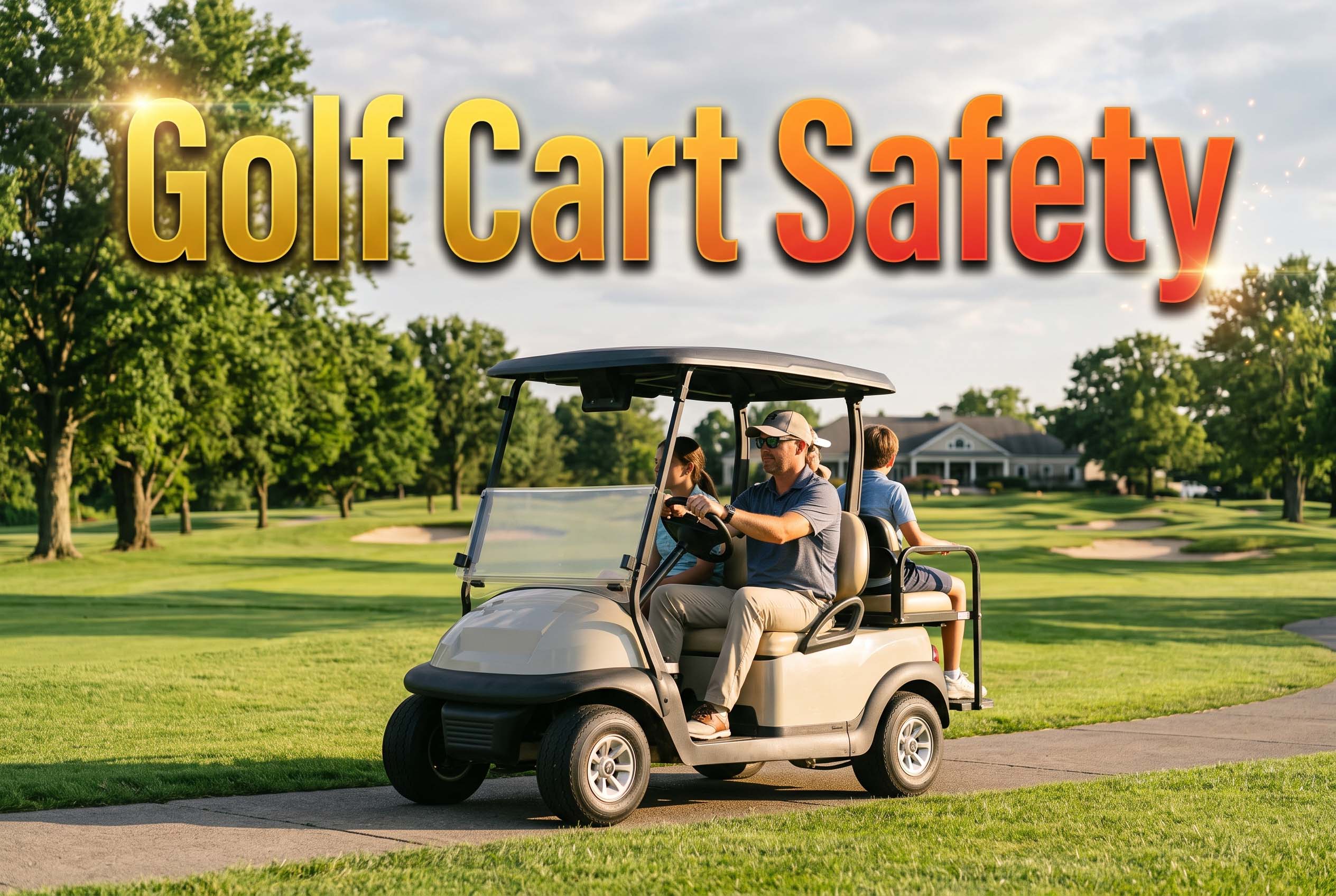
For golf cart safety, rollover is a real risk, not a joke, and it has predictable causes. The manufacturer's own manual names them: turning quickly or at sharp angles, turning at speed, driving across a slope instead of straight up or down it, stalling and rolling back on a hill, and sliding on wet or loose ground and then regaining traction suddenly. Injury research adds the part that matters most: what hurts people is often being thrown out of the cart, and hard cornering raises the odds of that. Slow down before every turn, drive straight up and down slopes, and keep everyone seated and holding on.
There is no single, reliable national rollover rate we could verify, so this page does not invent one. What it does is walk through what the maker and the published studies actually say, and turn that into habits.
How Often Does This Actually Happen?
People joke about cart crashes because most of them are minor. The published numbers show the injuries are not rare, even if a clean national rollover figure is hard to find.
- National emergency department estimate. A 2008 study from the Center for Injury Research and Policy at Nationwide Children's Hospital, described in the hospital's news release (read September 27, 2026), estimated about 148,000 golf cart related injuries treated in US emergency departments between 1990 and 2006. The release says injuries rose 132 percent over that 17-year period and that "the most common cause of injury for all ages was falling or jumping from the cart."
- A trauma center registry. A study published in 2024 in the Journal of Trauma and Acute Care Surgery by DeJesus and colleagues, Identifying community safety and policy-based injury prevention opportunities to reduce golf cart injuries (read September 27, 2026), reviewed golf cart injuries at the University of Texas Medical Branch trauma center in Galveston from 2012 to 2022. It found 235 patients, reported that annual golf cart related traumas doubled starting in 2020, and noted that 3 percent of the patients died.
Those are the figures we could trace to a named source. Many web pages quote a single yearly rollover percentage; we could not confirm one on a primary page, so it is left out here.
Golf Cart Safety: Rollover Is Mostly a Turning Problem
The clearest description of what tips a cart over comes from the people who build them. E-Z-GO's owner's manual for its Valor golf car (model year 2024 onward, read September 27, 2026) lists rollover in several separate warnings. Taken together, they describe six situations.
| Situation | What the manual says |
|---|---|
| Turning | "Improper or careless turning can cause loss of traction, loss of control, accident, or rollover. Do not turn quickly or at sharp angles. Do not turn at high speeds." |
| Crossing a slope | "Traversing a hillside is not recommended. Improper procedure can cause loss of control or a rollover." |
| Going downhill | "Drive straight down the hill. Avoid descending the hill at an angle that could cause the vehicle to lean sharply to one side." |
| Stalling uphill | "A rollover can result from stalling or rolling backward while climbing a hill." |
| Slippery ground | "Skidding or sliding can cause rollover if tires have lost traction, then regain traction suddenly." |
| Loads over the sides | Loads that extend over the load deck sides can affect stability "and increase risk of rollover." |
Notice how many of these involve direction rather than raw speed. A cart that is fine going straight at its top speed can tip in a turn at a much lower one, especially if the turn happens on a side slope or at the bottom of a hill where speed has built up.
The turn is where speed shows up
The manual's instruction is to "decrease speed before and during turns," and to practice turning at slow speeds before attempting faster ones. The same manual tells operators to "drive the vehicle at appropriate speeds for the terrain and conditions" and warns that "sudden braking or turning can cause the loss of vehicle control."
Golf courses are full of the exact combination the manual warns about: cart paths that curve around greens, drop down to the next tee, and cross the side of a hill. The fix is not complicated. Brake before the curve, not in it.
Slopes: straight up, straight down
The manual repeats the same rule in several places: drive straight up and straight down hills, and avoid crossing the side of one. If you do stall on a climb, it gives a specific procedure: apply the brakes, check that the area behind you is clear, select reverse, and let the vehicle roll slowly straight back down under control. Turning around on the slope is the move that puts the cart sideways to the hill.
Why Being Thrown Out Is the Bigger Danger
The Galveston study adds an important detail. The abstract reports that "ejection was associated with more severe injury," and the results state that "hard cornering" and "rollovers" both "increased odds of ejection." The abstract also reports that 41 percent were ejected and that most were front-facing passengers.
That lines up with the Nationwide finding that falling or jumping from the cart was the most common cause of injury across all ages.
The practical point is that passengers are part of rollover safety, not just drivers. The E-Z-GO manual's dash label says: "Do not start moving until all occupants are PROPERLY SEATED and HOLDING ON. KEEP entire body INSIDE VEHICLE while moving." The same label says "If so equipped, wear seatbelts," and the manual describes hip restraints that "help people stay in position while the vehicle is in motion."
A passenger with one foot hanging out, or turned sideways to talk, is the person most likely to leave the cart if it tips or corners hard.
Habits That Actually Reduce the Risk
None of this needs special equipment. Drawn from the manual and the studies above:
- Brake before the turn. Slow down on the straight, then steer.
- Drive straight up and down slopes. Do not cut across a hillside to save a few yards.
- Take downhill curves slowly. Speed builds on the descent and the turn at the bottom is where it matters.
- Everyone seated, holding on, feet inside. Not moving until they are.
- Nobody on the back. The manual says, "Never allow a passenger to ride on the load deck," and the rear-facing seat, where fitted, requires passengers to hold both the hand rail and the rear grab handle.
- Respect the seat count. The label says "NEVER carry more than 2 occupants on each bench seat."
- Slow down on wet grass and loose gravel. The manual lists ice, water, loose gravel and freezing temperatures as conditions requiring reduced speed.
- No alcohol before driving. The manual states: "Never drink alcohol or use drugs or medications before or during operation of the vehicle."
Modified and Faster Carts
Some owners fit parts that raise a cart's top speed. The E-Z-GO manual is blunt about it: "NEVER alter this vehicle to increase travel speeds above factory specifications," and the warranty is terminated if the vehicle is modified to increase speed or power.
There is a legal side too. The same manual explains that when a golf car is modified to operate at or above 20 mph on public roads, under federal law it becomes a Low Speed Vehicle subject to Federal Motor Vehicle Safety Standard 571.500, which requires equipment such as headlights, turn signals, mirrors and seat belts. A faster cart with the same short wheelbase and the same seats is not a safer cart.
On the Course: Follow the Course's Cart Rules
Courses set their own cart policies: which paths to use, where carts may not go, and when it is cart path only. These are course operating rules, separate from the Local Rules that change how the game itself is played. The Rules of Golf are about playing the game, not about driving, so if you want to see what they actually cover, start with where to read the official Rules of Golf rather than a summary. Cart policies exist for the same reason the manual's warnings do: cart paths are laid out where the ground is suitable, and the steep bank beside the green is not.
If a Cart Tips Over
If anyone is hurt, especially with a blow to the head, loss of consciousness, neck or back pain, or trouble breathing, call 911 and do not move them unless they are in further danger. Head, neck and serious injuries need a clinician to assess them, not a wait-and-see.
For the cart itself, the manual says to "always have the vehicle checked by an authorized dealer if it is involved in an accident," and that a damaged vehicle "must not be operated until repairs are made." Steering, brakes and suspension are safety systems. A cart that has been on its side goes back to a dealer or a qualified technician before anyone drives it again.
FAQ
What causes most golf cart rollovers?
The manufacturer's manual we read points to turning quickly or sharply, turning at speed, crossing a slope, descending at an angle, stalling and rolling back on a hill, and sliding on slippery ground and regaining traction suddenly.
How common are golf cart rollovers?
We could not verify a reliable national rollover rate on a primary source. What is documented is the wider injury picture: a Nationwide Children's Hospital study estimated about 148,000 emergency department visits for golf cart injuries in the US from 1990 to 2006.
Is the rollover or the fall more dangerous?
In a 2024 trauma center study from Galveston, Texas, ejection was associated with more severe injury, and hard cornering and rollovers both raised the odds of ejection. Staying seated and holding on is part of rollover safety.
Do golf carts have seat belts?
Some do and many do not. E-Z-GO's label says to wear seat belts "if so equipped." Low Speed Vehicles covered by FMVSS 571.500 are required to have them.
Should I drive a cart after it has rolled over?
No. The manufacturer says to have any vehicle involved in an accident checked by an authorized dealer before it is operated again.