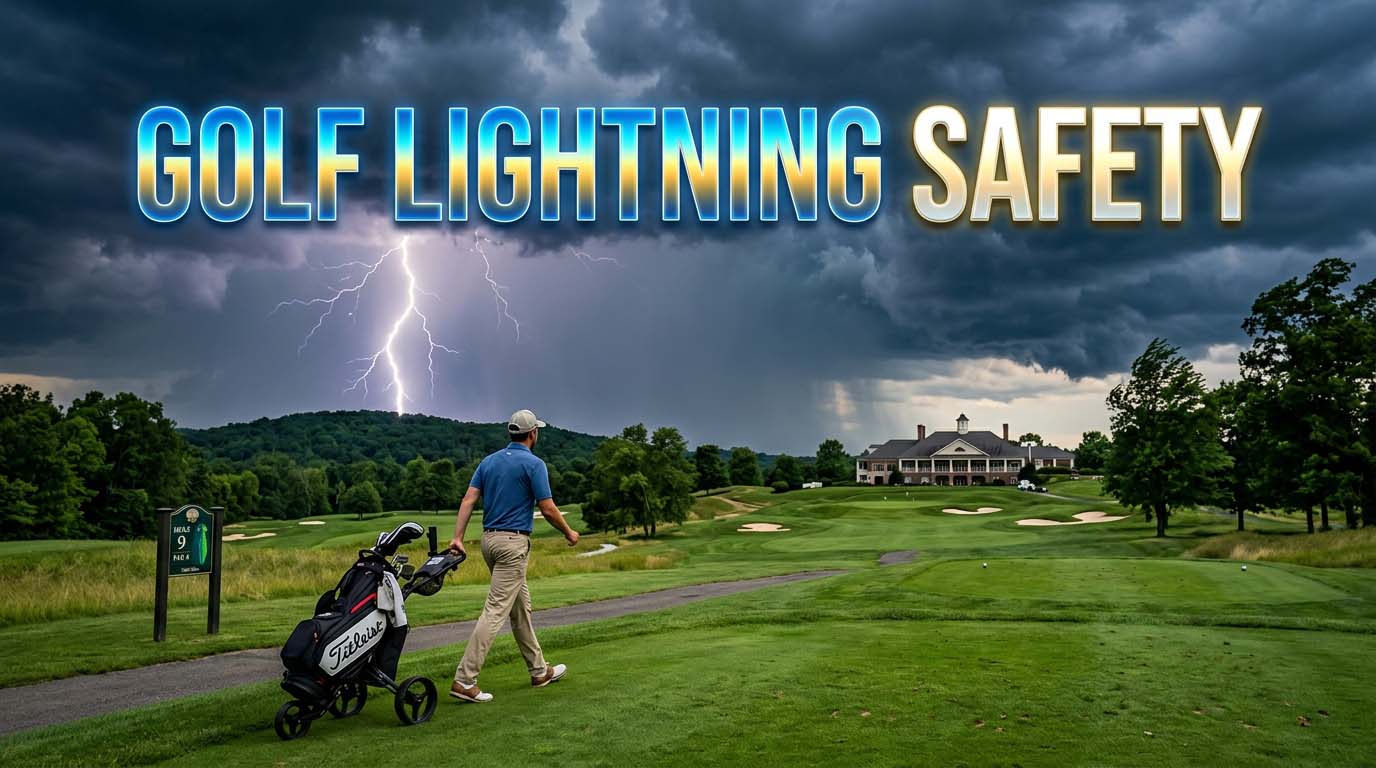
On golf lightning safety, when to stop playing has a clear answer from the National Weather Service, and it does not involve waiting for a horn. Stop and head for a substantial building or a hard-topped vehicle as soon as you hear thunder, see lightning, or the sky looks threatening. The NWS says thunder can only be heard about 10 miles from a strike, and that hearing it means you are within striking distance. Under Rule 5.7a of the Rules of Golf you may stop on your own if you reasonably believe there is danger from lightning. The horn is a backstop, not the trigger.
The rest of this page covers why the first rumble is the signal, why people who die from lightning usually waited too long rather than too little, and how to plan your walk in so you are indoors before the danger arrives.
Why the First Thunder Is the Signal
Most golfers wait for one of two things: rain, or the course horn. Both come late.
The National Weather Service's page on thunder and how far it carries (read September 27, 2026) says thunder "can be heard for a distance of only about 10 miles from the lightning strike," and that "the sound of thunder should serve as a warning to anyone outside that they are within striking distance of the storm and need to get to a safe place immediately."
The NWS sports lightning page, read the same day, adds that "a significant lightning threat extends outward from the base of a thunderstorm cloud about 6 to 10 miles." And the NWS lightning myths page notes that lightning "often strikes more than three miles from the center of the thunderstorm, far outside the rain or thunderstorm cloud."
Put those three together and the practical meaning is simple. By the time you can hear the storm, you are inside the zone where it can reach you, and the rain may still be miles away.
Golf Lightning Safety: When to Stop Playing, the Three Triggers
The NWS sports page lists three conditions for stopping an outdoor activity:
- If you see lightning.
- If you hear thunder.
- If the skies look threatening.
None of the three depends on a siren, a marshal or a text from the pro shop. Any one of them is enough.
The third trigger is the one people argue with, because "threatening" feels subjective. It is meant to be. The point is to start moving while you still have a margin, and a dark, building sky on a hot afternoon is exactly the situation where waiting for proof costs you that margin.
What about counting seconds between flash and thunder?
Older advice asks you to count the seconds between a flash and its thunder and to shelter only below a certain number. The current NWS pages we read on September 27, 2026 do not ask you to count. They treat any thunder you can hear as the signal to go inside, summed up in the NWS slogan "When Thunder Roars, Go Indoors!" If you can hear it, you have your answer. There is nothing to calculate.
The Real Danger Is Starting Too Late
It is tempting to think lightning deaths happen to people who ignored a storm completely. The data points somewhere less comfortable.
John Jensenius of the National Lightning Safety Council analyzed US lightning deaths from 2006 through 2019 in a report hosted by the NWS, A Detailed Analysis of Lightning Deaths in the United States from 2006 through 2019 (read September 27, 2026). Of 418 deaths in that period, the report counts 10 associated with golf, compared with 40 for fishing. So golf is not the deadliest activity, and the report calls the belief that golfers account for the most lightning deaths "a myth."
The finding that matters more for golfers is about timing. The report says "many victims were either headed to safety at the time of the fatal strike or were just steps away from safety," and that "a number of lightning victims in this study were seeking safety when they were struck." The problem, in the report's words, is that "they just didn't start soon enough." It adds that "in some cases, people decided to wait to see if the conditions improved rather than heading toward safety immediately."
For sports in particular, the report notes that "for most incidents, safety was nearby in the form of a building or vehicle" and that "many victims failed to react quickly to the imminent danger."
That describes a golfer on the 14th hole deciding whether to finish the hole before walking in.
Plan Your Walk In, Not Just Your Stop
Here is the piece most lightning advice for golfers skips. Knowing when to stop is only half of it. The other half is how long it takes you to get somewhere safe once you do stop, and on a golf course that varies enormously from hole to hole.
A short walk from the 1st green to the clubhouse is a very different situation from the far end of the back nine, where the nearest enclosed building may be a long way off. The NWS Lightning Safety Toolkit for outdoor venues (read September 27, 2026) builds this into its sample plan. It notes that "lightning radii will vary based on venue size, capacity, and the amount of time it takes patrons to get to safe structures," and for organized storms it says "a 30 minute lead-time or more should be considered for an evacuation." Venues using the plan begin preparing when lightning is still far away, not when it is overhead.
You can apply the same logic to your own round without any equipment:
- Before you tee off, find out where the enclosed buildings are. Ask the pro shop which structures count as lightning shelters. Open rain huts do not; the NWS lists rain shelters as not safe.
- Notice the point on the course that is farthest from any of them. That is where you have the least margin, and where the first rumble should send you in without discussion.
- If you are riding, use the cart to get in faster. A cart is transport, not shelter. The CDC lists golf carts among open vehicles to avoid, and E-Z-GO's Valor owner's manual tells drivers, "If there is a risk of lightning, leave the vehicle and look for a safe location to wait until the lightning has stopped."
- Do not stop to finish the hole. The putt will still be there in half an hour.
Before the Round Even Starts
The Jensenius report makes one more point that is easy to overlook: "For any activity where a safe shelter is not readily available, there is no safe alternative but to cancel or postpone the activity in advance if thunderstorms are forecast."
For most golf courses, safe shelter exists somewhere on the property. What changes is how far away it is from where you will be standing when the storm arrives. If afternoon thunderstorms are in the forecast, an earlier tee time or a shorter loop is a reasonable choice, not an overreaction.
A phone with a weather app and radar is useful here, and it is the same device many players already use for yardages, as covered in our comparison of a rangefinder, a GPS unit and your phone. Treat a lightning alert on the screen the same way you would treat thunder.
You Do Not Need a Horn or Permission
The Rules of Golf anticipate exactly this situation. According to the R&A's text of Rule 5.7a, read September 27, 2026, "a player may stop play if they reasonably believe there is danger from lightning, but must report to the Committee as soon as possible." In a competition, failing to report can mean disqualification, so tell the Committee when you come in. In a casual round with no Committee, the practical version is simpler: walk in.
Horn signals themselves are set by each course, not printed in the core Rules, so check the scorecard or the course's Local Rules and notices before the round. For the rule text itself rather than a paraphrase, see our guide to where to read the official Rules of Golf.
Where to Go, and When to Come Back
Where to go is defined narrowly by the NWS: "a substantial building with electricity or plumbing or an enclosed, metal-topped vehicle with windows up." Clubhouses, pro shops and fully enclosed restroom buildings fit. Open huts, trees and carts do not. The NWS myths page notes that being under a tree is the second leading cause of lightning casualties.
When to come back is also defined: the NWS tips page says to "stay in safe shelter at least 30 minutes after you hear the last sound of thunder." Each new rumble restarts the 30 minutes. In a competition, wait until the Committee resumes play.
If Someone Is Struck
Call 911. The NWS lightning safety overview, read September 27, 2026, states that "lightning victims do not carry an electrical charge and are safe to touch." Follow the dispatcher's instructions until emergency responders arrive. Knowing whether the course has an AED and where it is kept is worth asking about before you ever need it.
FAQ
When should golfers stop playing because of lightning?
As soon as you hear thunder, see lightning, or the sky looks threatening, according to the NWS sports lightning guidance. Do not wait for the course horn or for rain.
Can I stop playing if the course has not sounded the horn?
Yes. Rule 5.7a lets a player stop if they reasonably believe there is danger from lightning, as long as they report to the Committee as soon as possible.
How far away is lightning if I can hear thunder?
The NWS says thunder can be heard only about 10 miles from the strike, and that if you can hear it you are within striking distance of the storm.
Is it safe to finish the hole if the storm looks far away?
No. The NWS notes that lightning often strikes more than three miles from the storm's center, outside the rain, and an NLSC analysis found many victims were struck while heading to safety because they started too late.
How long should I wait before going back out?
At least 30 minutes after the last thunder you hear, per NWS guidance. In a competition, wait for the Committee to resume play.