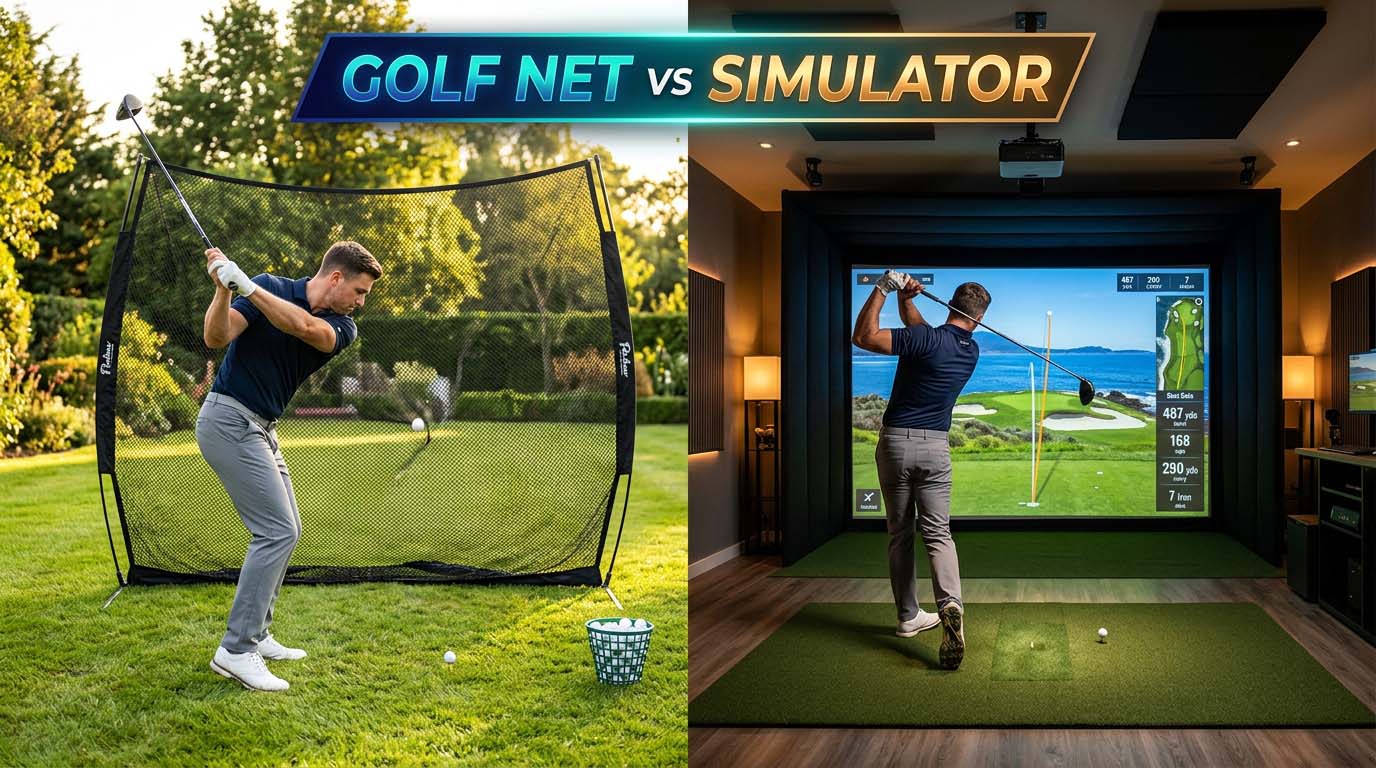
A golf net vs simulator decision is really two different purchases, not two versions of the same one. A net with a mat gives you a safe place to hit real balls and, paired with a launch monitor, real swing data, for a fraction of the space and cost. A simulator adds a screen, a projector and software so you can see ball flight and play a course, which asks for more room, a longer setup and an ongoing subscription in most cases. Pick based on whether you want to practice or to play.
Both routes stop a golf ball indoors. What they give you back is where they split, and the gap is bigger than most buying guides admit.
Golf Net vs Simulator: What a Net Actually Buys You
A golf net, a hitting mat, and a way to collect your ball is the entire system. Set it up in a garage bay, a basement corner or a spare room, hit into it, and you are practicing. Add a launch monitor like a camera or radar unit next to the mat, and you get carry distance, ball speed, spin and launch angle on every swing, the same numbers a fitting session measures. What a net does not do is show you anything. There is no image of a fairway, no flag to aim at, just a net catching a ball and a screen (if you have a launch monitor) reporting numbers.
That trade-off is the honest pitch for a net: less setup, less to go wrong, and a system you can break down or leave in a garage without heating or cooling the space around it. It also travels. A net folds down small enough to move between a garage and a backyard, which a simulator screen and enclosure generally do not.
What a Simulator Actually Buys You
A simulator, in the way most golfers mean it, is an impact screen or enclosure with a projector throwing a course image onto it, tied to a launch monitor that feeds swing data into simulation software. You are not just hitting into fabric, you are watching the ball fly down a rendered hole and playing something closer to a round.
That immersion is the whole reason to choose a simulator over a net. It also adds real decisions a net never asks: screen width and height to cover your shot dispersion, a projector positioned so your body and the club do not block the image mid-swing, side and top netting so a mishit does not leave the bay, flooring that can take repeated impact, and often a recurring software subscription for course libraries and updates. None of that is optional once you want the "playing a course" experience rather than a bare hitting station.
Space Is the Real Decision, Not Price
Ceiling height is the constraint that cannot be fixed after the fact, and it is where most simulator plans go wrong. According to Rapsodo's own guidance on ceiling height (read September 12, 2026), 8 feet is workable only for short-game practice, while a full swing with a driver needs meaningfully more headroom, with 10 feet described as the comfortable standard for most adult golfers and taller or steeper-swinging players needing more. A garage with an 8-foot ceiling and a low-hanging light fixture or garage door track is not a simulator room until that gets solved, whatever the screen and projector cost.
Room depth matters just as much once a launch monitor is involved. Trackman's own room guidance (read September 12, 2026) notes that radar-based launch monitors need meaningfully more depth behind and in front of the golfer than camera-based units placed closer to the ball, because a radar unit tracks the ball over a longer flight path before it reaches the screen. A net-only setup sidesteps most of this: you still need enough depth to swing a driver without clipping a wall, but there is no ball-flight tracking distance to protect and no screen distance to hold.
If you already store clubs in a garage, the same space usually decides both questions at once. A bay too cold or damp for storing golf clubs safely over winter is also a bay where a projector, a launch monitor and simulator software will not thank you either. Sort the space first, then decide what goes in it.
The Cost Nobody Puts in the Headline Number
Golf retailers tend to advertise a net, a screen or a launch monitor as a standalone line item, which flatters the price and hides the total. A net-based setup, at the simple end, is a net, a mat, and optionally a launch monitor: an entry-level tier for the net and mat, then a separate mid-to-premium tier for the launch monitor if you want real numbers rather than just a place to hit. A simulator setup stacks a screen or enclosure, a projector, a launch monitor, a hitting mat, flooring, and in most cases a recurring software fee on top of all of it. None of those figures are fixed enough to state as a dollar amount here without a source and a date attached, and prices move by retailer and by season, so think in tiers (entry, mid-range, premium package) rather than a single number when you compare quotes.
The software subscription is the one line buyers forget to budget for after the hardware purchase, because it recurs every year the net-only route never charges. If data and practice are the goal, a net plus a launch monitor gets you there without that ongoing cost.
Weather and Where You Will Actually Use It
A net works outdoors as readily as indoors, which matters if your only indoor space is too short, too cold, or shared with a car. A simulator enclosure is built to live in one place: the projector needs a fixed throw distance, the screen needs to stay flat and untensioned by weather, and a launch monitor generally wants a stable, dust-free room rather than an open garage bay with the door up. None of this means a garage simulator is impossible. Plenty of golfers run one successfully. It means the garage has to behave like a room, with the same attention to temperature and moisture that goes into preparing golf equipment for the off months, not like a place a car happens to park.
The Hybrid Middle Ground
Plenty of golfers land between the two options rather than at either end. A hitting mat and net with a launch monitor gets you swing data at the entry-tier end of the spending range. Adding a screen later, once the space and budget both say yes, turns the same bay into a simulator without buying twice: the mat, monitor and much of the flooring carry over. Buying the full enclosure first and hoping to "grow into" the space, on the other hand, is the direction that tends to disappoint, because a room too short or too shallow for a driver swing does not get taller after the enclosure is installed.
How to Decide
Work through these in order, because later ones only matter if the earlier ones clear:
- Measure the room, not the wish. Ceiling height with your driver at the top of a full backswing, and depth in front of and behind where you would stand.
- Decide if you want data or an experience. A launch monitor on a mat and net gives you the numbers a fitting also uses. A screen and projector give you the picture of a course. Some golfers want both eventually, few need both on day one.
- Price the software, not just the hardware. A simulator with an ongoing course-library subscription costs more in year two than the box on the invoice suggests.
- Check the room's other job. A garage that parks a car, floods, or drops below freezing needs that problem solved before it earns a screen and a projector.
- Start with the cheaper mistake. A net and mat that turns out too small to enjoy is a smaller loss than an enclosure built in a room that was never going to fit a full swing.
If the swing data itself is what you are chasing, it is worth remembering that a home launch monitor and a proper club fitting measure different things: the monitor tracks what you did on a given swing, a fitting session is built around finding equipment that changes what you do next. Neither replaces the other, and for some golfers the honest answer to "is a fitting even worth it" changes once they have a season of home data to bring into that appointment.
FAQ
Do I need a launch monitor for either setup?
No. A net alone stops the ball and lets you practice contact and tempo with no data at all. A launch monitor is what adds distance, ball speed and spin numbers, and it works the same way whether it sits in front of a bare net or a full simulator screen.
What ceiling height do I actually need?
Short-game-only practice can work at 8 feet, but a full swing with a driver wants meaningfully more headroom, with 10 feet commonly described as the comfortable minimum for most adult golfers and more for taller players or steep swing planes, per Rapsodo's own guidance (read September 12, 2026).
Can I start with a net and add a screen later?
Yes, and it is usually the cheaper path. A mat, net and launch monitor set up for data collection can often keep its mat, monitor and flooring when a screen and projector are added later, once the room and the budget both allow it.
Does a simulator work in an unheated garage?
It can, but the room needs to behave like a stable indoor space: dust, temperature swings and moisture affect a projector, a screen and a launch monitor more than they affect a plain net, so a garage that is not already suitable for storing golf gear over winter usually is not ready for a simulator either.
Is a simulator worth it if I only want to practice, not play courses?
Usually not on its own. If practice and data are the goal, a net, mat and launch monitor deliver that without the added cost and space of a screen, projector and course software, which mainly pay off when you want to see and play a rendered course.