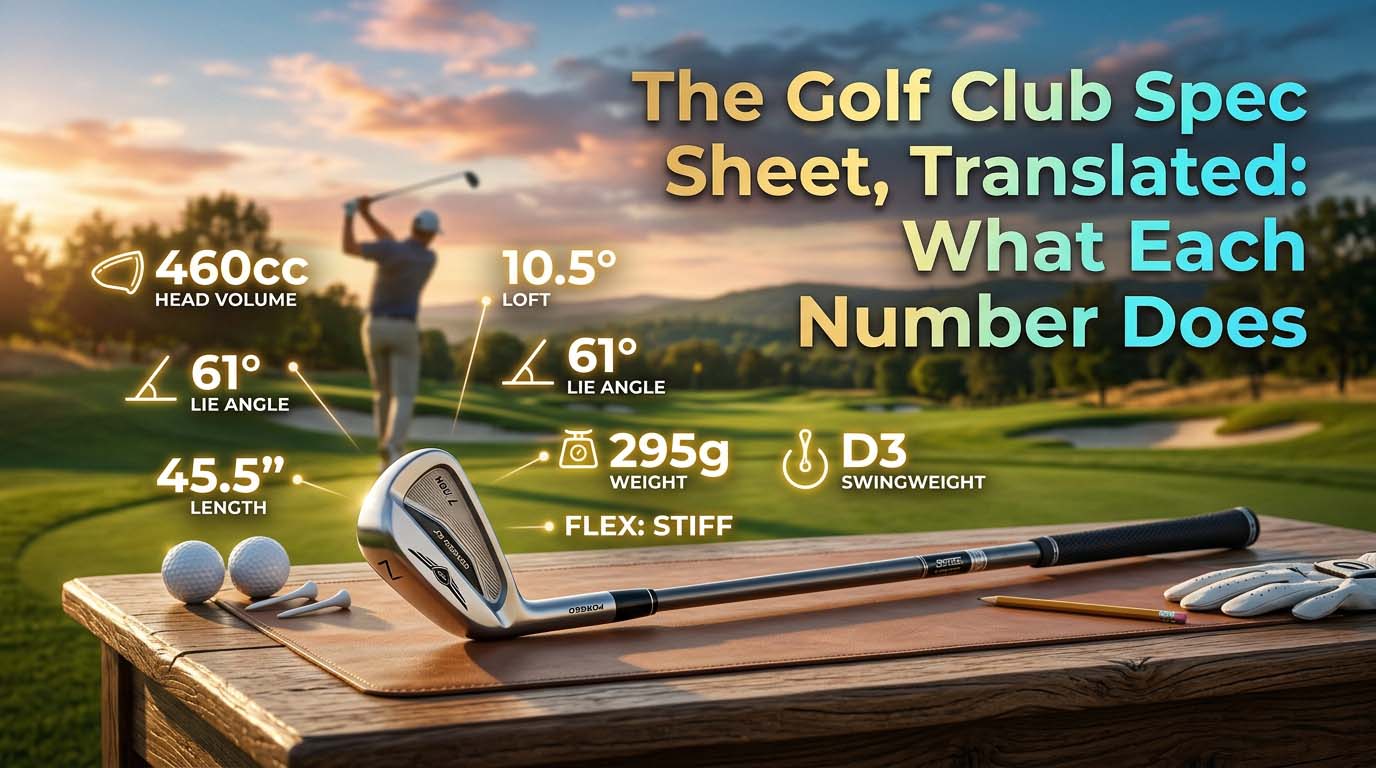
A golf club spec sheet tells you three things: what shape the club is, what is in the box, and where it sits against the rules. It does not tell you how far you will hit it, whether it is more forgiving than the model it replaced, or what changed since last year. Those are the three questions almost everybody brings to a spec sheet, and the maker's own page answers none of them.
Once you know which numbers are fitting decisions, which are rule ceilings that every competitor shares, and which are absent, a spec sheet becomes genuinely useful. Most of it is about matching a club to your body and your swing, not about ranking one club above another.
Every specification quoted below was read on the manufacturer's own page on August 26, 2026. Specs change with each model year. Check the current page before you buy.
A Real Spec Sheet, Read Line by Line
To make this concrete rather than abstract, here is a genuine published grid, taken from one maker's own product page and used purely as a worked example. This is not a recommendation and no comparison to any other club is made or implied.
PING's own page for the G440 MAX driver publishes the following, read 2026-08-26:
| Spec | Published value | What it actually decides |
|---|---|---|
| Lofts | 9.0°, 10.5°, 12.0° | How high the ball starts and how much it spins |
| Loft adjustability | ±1.5° | How far you can move that after purchase |
| Lie angle | 58.5° (average) | Where the sole sits at impact, which affects start direction |
| Head weight | 203.0g | Part of how the club feels through the swing |
| Clubhead volume | 460cc | Nothing about this model. See below |
| Standard length | 46" | Swing arc, control, and consistency of contact |
| Swing weight | D3 | Perceived head heaviness, not actual weight |
| Stock shafts | Seven models, in flexes from Soft Regular to X-Stiff and weights from 38.0g to 67.0g | The single biggest fitting variable on the club |
Eight rows. Six of them are fitting decisions. One is a rule ceiling. One, swing weight, is the most misunderstood number in golf. There is no performance claim anywhere in it.
The Numbers That Are Fitting Decisions
Loft. The angle of the face, and the first number anyone looks at. Higher loft launches higher and spins more; lower loft launches lower and spins less. Which of those helps you depends on your swing speed and how you deliver the club, which is why the same driver head ships in 9.0, 10.5 and 12.0 degrees rather than one "best" loft. A slower swing generally needs more loft to get the ball up, not less.
Loft adjustability. The ±1.5° in the example above means the hosel can be set to change the stated loft by up to a degree and a half in either direction. This is genuinely useful and widely misread. It does not turn a 9.0 into a 12.0, and on most adjustable hosels changing loft also nudges the lie angle and face angle, because they are all set by the same sleeve. Treat it as fine tuning around a loft you already chose correctly.
Lie angle. The angle between the shaft and the ground when the sole sits flat. Wrong lie angle points the face somewhere other than where you aimed at impact, and the effect grows with the loft of the club, so it shows up most in irons and wedges. A driver spec sheet gives an average because the adjustable hosel moves it.
Head weight and swing weight. These are two different things and the difference matters. Head weight is a measurement in grams of the head itself. Swing weight, expressed as a letter and a number such as D3, is a scale that describes how heavy the head feels when you swing the assembled club. It is a balance measurement rather than a weight, which is why a lighter club can carry a higher swing weight than a heavier one. A club can be too light to feel where the head is, and too heavy to deliver it on time.
Length. In the example, 46 inches as standard. Length changes your swing arc, and a longer club is harder to strike out of the middle. This is the spec most often changed at a fitting and least often thought about by a buyer.
Shaft. Look back at that spec table and notice that the shaft options take up more room than every other spec combined: seven models, several flexes each, weights spanning roughly 30 grams. That proportion is the truest thing on the page. The head gets the marketing and the shaft is doing more of the work of making the club fit you.
Two cautions on shafts, both of which get their own articles in this cluster. Flex letters are not standardized between manufacturers, so one maker's Stiff is not another maker's Stiff. And shaft weight is a separate variable from flex that most golfers have never consciously chosen.
The Number That Is Not a Choice
Clubhead volume, 460cc in the example, is the spec most often quoted as though it were a feature.
It is a rules ceiling, and essentially every mainstream driver sits at it. Per Section 2.4b(i) of The R&A's Equipment Rules, a driver's clubhead volume must not exceed 460 cubic centimetres, plus a manufacturing tolerance of 10 cubic centimetres. Overall club length has a separate ceiling: per Section 2.1c, no club other than a putter may exceed 48 inches.
So "460cc" on a spec sheet is not telling you the head is big. It is telling you the head is at the legal maximum, which is where every competitor's head also is. It is a constraint the whole category shares, not a differentiator, and reading it as one is a small mistake that leads to a larger one: assuming any number on a spec sheet is a performance number.
Where a driver actually falls outside those limits, it is a different situation entirely, and the consequences are covered in what makes a driver non-conforming. Face flex has its own separate test and its own separate numbers, explained in how the driver CT test works.
Notice also what the length row implies. The example driver's standard length of 46 inches sits inside the 48 inch equipment rule with room to spare, and length limits used in competition can be tighter than the equipment rule, which is a competition condition rather than a spec-sheet question. If you are checking whether a specific club is legal for where you play, the list is the place to look, and how to use the conforming club list covers what that check does and does not prove.
The Four Things a Spec Sheet Never Tells You
This is where a spec sheet stops being useful, and knowing exactly where that line falls saves a lot of wasted reading.
1. How far it goes. No distance figure appears on the grid above, and that is normal. Distance depends on your swing, the ball, the turf and the air. Where a maker does publish a gain, it is a marketing claim rather than a specification, and this site does not repeat those.
2. How forgiving it is. "Forgiveness" is a word, not a published number. Moment of inertia and center of gravity location, the properties the word is gesturing at, are usually absent from the consumer spec grid entirely. They were absent from the example above.
3. What changed from the previous model. This is the important one, and it is verifiable rather than a complaint. The PING G440 MAX product page carries a full specification grid and does not compare the model to any previous generation, anywhere on the page (read 2026-08-26). That is not unusual and it is not a criticism of one maker. Manufacturers publish what is new about the new club. They do not publish what is different from the old one, because the old one is often still for sale.
4. Whether the older model is still current. Which brings us to the most useful five minutes you can spend on a maker's website. PING's own United States driver listing showed fifteen driver models on one page on 2026-08-26, spanning both the G440 and the G430 generations at the same time, with one G430 model marked "Limited Availability." A previous-generation club that the maker still lists is not clearance stock, it is a lower rung on a current ladder, and a lower price is the ordinary price of that rung rather than a discount. The lineup page is the check, it is free, and no review site can do it for you because it changes.
How to Actually Use a Spec Sheet
Work through it in this order and it stops being intimidating.
- Find the fitting numbers. Loft, lie, length, shaft flex, shaft weight. These are the ones that decide whether the club suits you, and they are the ones a fitting exists to set.
- Ignore the ceilings. Volume at 460cc, and anything else that is identical across every model in the category, tells you the club is legal and nothing else.
- Check the shaft grid for your spec. This is the check that catches an expensive mistake. If the loft and shaft combination you need is not in the stock list, the club either has to be custom ordered or is not really available to you at the shelf price.
- Read swing weight as feel, not as weight. And know that it changes when anything else on the club changes, including the grip.
- Go to the maker's lineup page before you go anywhere else. What is still listed, and what has quietly disappeared, tells you more about a used or discounted club than any spec on the sheet.
What a Used Listing Leaves Out
A private listing or a marketplace ad typically gives you a model name, a loft and possibly a flex letter. That is three of the eight rows above.
The ones that go missing are the ones that cost money to fix: shaft model and weight, actual length if the club has been cut or extended, lie angle if it has been bent, and grip size. A club advertised as "10.5, stiff" can be almost any length with almost any shaft in it. Ask for the shaft's full name as printed on the shaft, and ask for a measured length, before you decide a price is good.
Do Any of These Numbers Matter for a Casual Golfer?
Some of them, and not the ones that get the attention.
Loft, length and shaft flex change what a club does in ordinary hands, and getting those roughly right is worth more than any head technology. Volume, CT and the rest of the rules apparatus matter when you are checking whether a club is legal for a competition, and much less when you are playing socially. Where the rules actually bite for an ordinary player is covered in the equipment rules that matter for amateurs.
The honest summary: a spec sheet is a fitting document and a legality document. It was never a performance document, and reading it as one is how people end up buying a club that is legal, current, well made, and wrong for them.
Frequently Asked Questions
What do golf club specs actually mean?
They describe the club's geometry and contents: the angles (loft, lie), the physical measurements (head weight, volume, length), a balance figure (swing weight), and what shaft and grip come fitted. They do not describe performance, and no distance or forgiveness number appears on a normal consumer spec grid.
Why is every driver 460cc?
Because that is the ceiling. The R&A's Equipment Rules, Section 2.4b(i), cap clubhead volume at 460 cubic centimetres plus a 10cc tolerance, so mainstream drivers are built to the limit. It is a shared constraint, not a feature of any one model.
What is the difference between head weight and swing weight?
Head weight is the mass of the head in grams. Swing weight, written as a letter and a number such as D3, is a balance scale describing how head-heavy the assembled club feels. Changing the grip, the shaft or the length changes swing weight without changing head weight.
Does the spec sheet tell me if this year's model is better than last year's?
No. Manufacturers publish what is new about the new model, not what is different from the old one. The PING G440 MAX page, read 2026-08-26, carries a full spec grid and no comparison to any previous generation. To find out whether the older model is still a current product, look at the maker's own lineup page.
How much loft should I have on my driver?
There is no spec-sheet answer to this, which is why the same head ships in several lofts. As a general direction, slower swing speeds usually benefit from more loft rather than less, and this is exactly the question a fitting is for.
Which spec should I care about most if I only care about one?
The shaft. It carries more fitting variables than every other line on the sheet combined, and it is the part most buyers never consciously choose.
Sources
- PING, G440 MAX driver product page, read 2026-08-26, for the published lofts, ±1.5° adjustability, 203.0g head weight, 58.5° average lie, 460cc volume, 46 inch standard length, D3 swing weight and the stock shaft grid, and for the absence of any previous-generation comparison on the page.
- PING, United States driver listing page, read 2026-08-26, for fifteen driver models shown across two generations simultaneously, with one G430 model marked "Limited Availability."
- The R&A, Equipment Rules, Section 2.4b(i) for the 460cc clubhead volume limit plus a 10cc tolerance, and Section 2.1c for the 48 inch overall length limit on clubs other than a putter. Cited to this site's own record of a 2026-08-15 read; The R&A's equipment rules URL redirected to a 404 for our fetcher on 2026-08-26 and was not re-read.
Nothing on this site has been tested by this site. Every figure above is a manufacturer's or a governing body's own published number. No distance, ball speed, forgiveness or performance claim appears anywhere in this article, and no product is recommended.