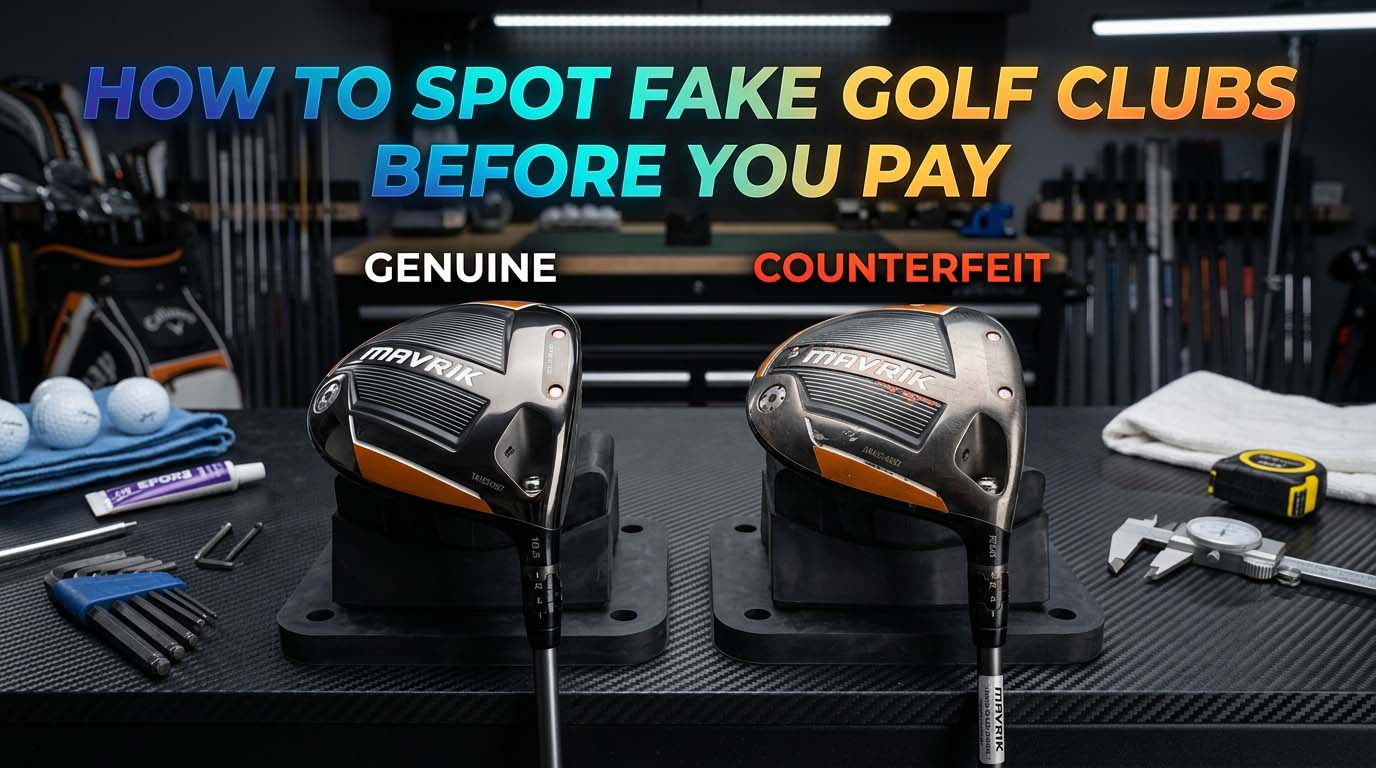
The clearest signs of a counterfeit golf club are physical and comparative, not a single tell: rough or uneven ferrule and hosel finish, imprecise paint fill inside grooves and lettering, low-quality print on the shaft label, inconsistent weight or grind across a matched set, and cheap print quality on the headcover or box. None of these require special tools, only a side-by-side comparison against the manufacturer's own official product photos and, where possible, the item in hand. A price well below every authorized retailer's price for the same model and condition is the fastest early filter, but it is a warning sign, not a physical proof, so the checks below are what actually settle it.
This is a real and documented problem in golf. Counterfeit clubs, particularly drivers and high-demand irons, circulate through general marketplaces and some overseas listings, and manufacturers including Callaway have published their own counterfeit-awareness guidance for exactly this reason. None of what follows is about any specific seller or marketplace; it is a pattern that shows up across many sellers and channels, and the response to it is the same regardless of where a listing is found: check the club itself.
The price test comes first, but it is not the proof
Before any physical inspection, compare the asking price to what an authorized retailer or a manufacturer's certified pre-owned program charges for the same model, year, and condition. A price meaningfully below that range, especially on a new-in-plastic driver, is the single strongest early signal something is off. It is not conclusive on its own, since genuine clearance and closeout pricing exists too, which is exactly why it should trigger the physical checks below rather than an automatic pass or fail.
Ferrule and hosel finish
The ferrule is the small collar where the shaft meets the clubhead, and it is one of the hardest details for a counterfeiter to match. On a genuine club, the ferrule sits flush against the hosel with a clean, even edge and consistent color. Look for a visible gap, an uneven glue line, a ferrule that is a slightly different color or sheen than the manufacturer's actual product photos, or a hosel with rough machining marks rather than a smooth, finished surface.
Paint fill and lettering precision
Manufacturers apply paint fill inside engraved grooves, logos, and model lettering with tight, consistent tolerances. On a counterfeit, paint fill often bleeds slightly outside the engraved line, looks uneven in thickness, or is missing entirely from fine details that a genuine club fills cleanly. Compare the exact font, spacing, and alignment of the model name and logo against a current photo from the manufacturer's own site, not a competitor's listing photo, since resellers sometimes reuse old or incorrect images.
Shaft label print quality
The printed label on the shaft, showing the shaft model, flex, and weight, is another detail that is expensive to replicate precisely. Look for blurry text, colors that look slightly off compared to the manufacturer's own shaft imagery, a label that is crooked or poorly aligned to the shaft's axis, or printing that rubs off with light scratching, which a genuine factory-applied label should not do.
Weight and grind consistency across a set
If you are buying more than one club, compare them to each other, not only to a reference photo. A genuine matched set has consistent sole grinding, consistent finish, and a swing weight that falls within a tight, expected range across the set. Noticeable differences in finish quality, grind lines, or apparent weight between clubs that are supposed to match each other is a sign the set may not be genuine, or may not actually be a matched set at all.
Headcover and packaging print quality
For new or new-in-box clubs, the headcover, box, and any included manual or hangtag are worth the same scrutiny as the club itself. Genuine packaging uses consistent, sharp printing, correct model names and logos, and materials that match what the manufacturer's own site shows. Blurry text, an incorrect logo version, or packaging that looks like a generic template rather than a brand-specific design are all signs worth treating seriously.
Serial numbers: useful, but not a single proof
A genuine-looking serial number is worth checking, but it is not, by itself, proof that the physical club you are holding is the club that number was issued to. Counterfeiters can and do copy real serial formats onto fake clubs, and how much a manufacturer can actually confirm from a serial number varies significantly by brand, with some offering no consumer-facing check at all. Golf Club Serial Numbers: What They Prove and What They Don't covers what each major manufacturer actually offers, phrased against their own stated policies rather than assumed.
Where to buy to lower the risk, without accusing anyone
The most reliable way to avoid a counterfeit is to buy from a channel the manufacturer itself vouches for. Every major manufacturer maintains its own list of authorized dealers on its website, and buying through one of them, or through a manufacturer's own certified pre-owned program where it exists, shifts the authenticity risk away from you. If you are buying through a general marketplace instead, that platform's own buyer protection and return process, used correctly, is your practical safety net; read what it actually covers before you buy, not after a problem shows up.
If you think you already bought a fake
Stop using the club, photograph it in detail including the ferrule, hosel, shaft label, and any serial number, and contact the manufacturer's customer service directly, since several manufacturers, including Callaway, provide a dedicated channel for reporting suspected counterfeits. If you bought through a marketplace with buyer protection, open a claim through that platform's own process rather than negotiating directly with the seller.
For the used-clubs decisions that sit alongside this one, see Buying Used Golf Clubs: What Wears Out and What Never Does, and for the full buying framework, see Buying Golf Clubs: The Decisions That Actually Cost You Money. This site researches equipment from manufacturer documentation and public sources rather than running hands-on product tests; more on that scope is on the About page.
FAQ
Is it easy to spot a fake golf club just by looking at it quickly?
Not usually. Good counterfeits pass a quick glance. The differences show up in close details, ferrule finish, paint fill precision, shaft label print quality, and set-to-set consistency, that require a deliberate comparison against the manufacturer's own product photos.
Does a genuine-looking serial number mean the club is real?
Not on its own. Serial formats can be copied, and how much a manufacturer can confirm from a serial number varies by brand. Treat a serial check as one part of the process, alongside physical inspection, not as a standalone proof.
Are counterfeit clubs mostly a used-market problem?
No. Counterfeits appear both in private-party used listings and as new-in-box items sold at a discount, particularly through general online marketplaces and some overseas sellers. The price test and the physical checks apply to both situations.
What is the single most reliable physical check?
There is not one. Ferrule finish, paint fill, and shaft label print quality each catch different counterfeits, which is why comparing several details against the manufacturer's own current photos works better than relying on any single check.
What should I do if a seller won't provide close-up photos of the ferrule and shaft label?
Treat that reluctance as a reason to slow down or walk away. A legitimate seller of a genuine club generally has no reason to avoid providing detailed photos before a sale.