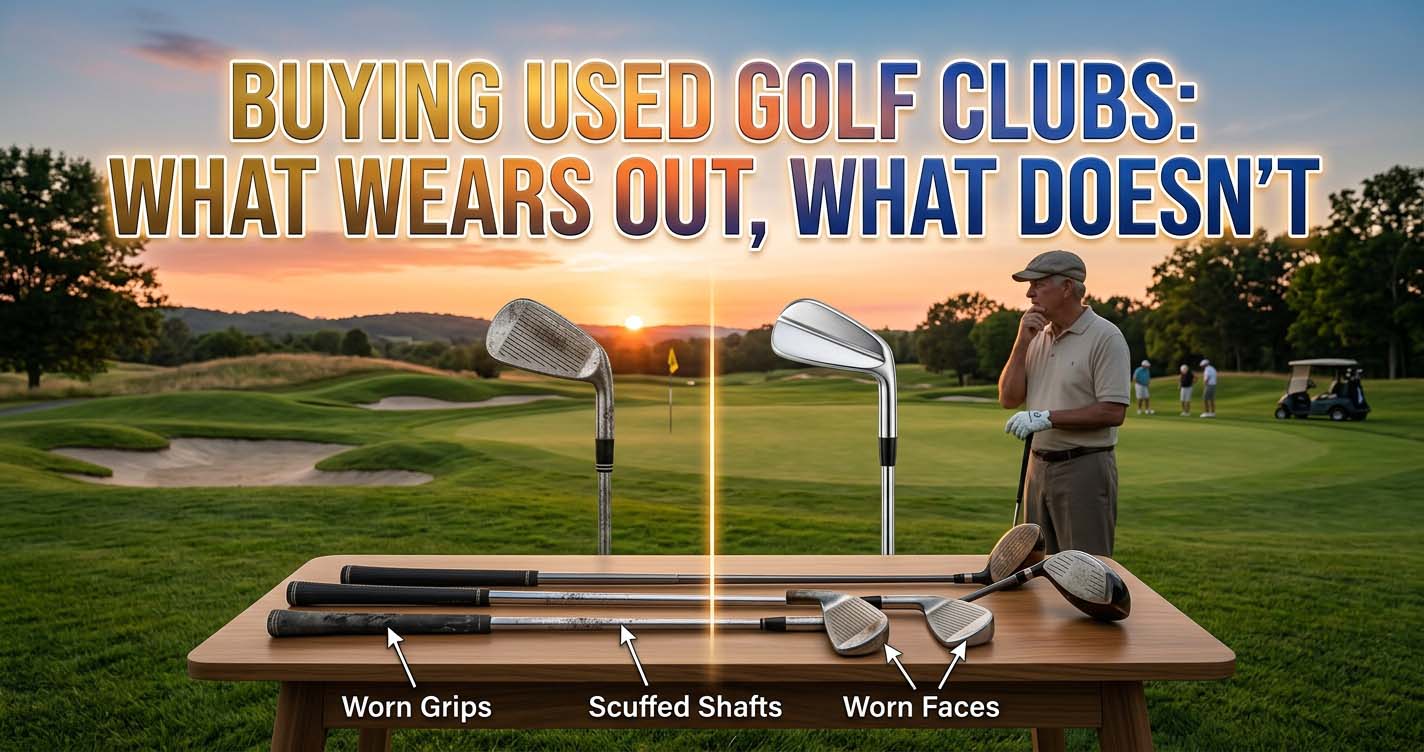
Used golf clubs wear out in three places that matter: the grooves on the clubface, the shaft, and the grip. Almost everything else on a club, including the loft, the lie angle, and the head's internal weighting, does not change with normal use and stays exactly as it left the factory unless the club was damaged. That difference is why a used club at a fraction of retail price is often a genuine bargain, and it is also why "used" is not automatically a synonym for "worn out." The part buyers get wrong is not usually the wear itself, it is assuming a clean-looking head means a clean club overall, when the shaft and grooves tell a different, and more reliable, story.
What actually wears out
Grooves and the clubface. Every strike gradually smooths the grooves on irons and wedges, and worn grooves reduce spin and control on shorter shots before they affect distance. This shows up first on the sole-facing edge of the grooves near the center of the face, since that is where clean contact happens most often. A flashlight held at a low angle across the face makes worn or shallow grooves visible in a way that overhead lighting hides.
The shaft. Steel shafts can develop rust pitting, usually starting near the ferrule where moisture collects, and can pick up bends from a hard impact or a fall. Graphite shafts do not rust but can develop small splinters or cracks near the tip, most often on drivers and hybrids that have taken a mishit or been dropped. A shaft that looks visually straight can still be bent; sighting down its length under good light, or rolling it on a flat surface, catches what a glance misses.
The grip. Grips harden and lose tack with age and UV exposure, and a slick or cracked grip is the most common cosmetic sign of an older set. It is also the cheapest and easiest thing to fix: regripping a full set is a routine, inexpensive service, so a worn grip on an otherwise sound club is a negotiating point, not a reason to walk away.
What basically never wears out
Loft and lie angle. Under normal play, a club's loft and lie do not drift. They can change from a hard impact bending the hosel or from an intentional bending adjustment, but ordinary rounds of golf do not move these specs.
The head's core design and weighting. Internal weight ports, face technology, and the head's basic geometry are fixed at manufacture. A three-year-old driver head performs almost identically to the day it was made, assuming no structural damage, which is exactly why used drivers from the last two or three model years are often the best value in the used market: you are paying mostly for cosmetic wear and a shorter warranty window, not for lost performance.
Set matching. A set built and sold together as a matched set keeps its swing weight and shaft consistency across the clubs. This is one reason a mismatched, assembled-later set (individual clubs bought separately over time from different sources) is worth a closer look than a set that was clearly sold and has stayed together.
Where to buy used, and why the channel changes the risk
Private-party listings, whether local or on a general marketplace, offer the lowest prices and the least protection. A manufacturer's own certified pre-owned program, where one exists, or a specialty golf reseller with a stated inspection and return process, costs more but shifts the authenticity and condition verification onto the seller instead of you. Neither channel is automatically the wrong choice; the price difference between them is roughly what you are paying for that verification, and it is worth knowing that trade-off explicitly rather than discovering it after the sale.
The risk that is not about wear at all
Wear is a spectrum you can inspect and negotiate around. A counterfeit club is a different problem entirely: it is not a worn version of the real thing, it is not the real thing. This risk is highest on private-party used listings and on new-in-box listings priced well under retail, and it is worth checking for separately from wear, using a physical comparison against the manufacturer's own product photos rather than trusting the listing alone. How to Spot Fake Golf Clubs Before You Pay walks through that check in detail, and Golf Club Serial Numbers: What They Prove and What They Don't explains what a serial number can and cannot confirm, since it differs by manufacturer and is not the single proof many listings imply it is.
For the full framework across all the decisions that go into a club purchase, not just the used-versus-new question, see Buying Golf Clubs: The Decisions That Actually Cost You Money.
A short pre-purchase checklist
- Run a flashlight across the face at a low angle to check groove depth and wear.
- Sight down the shaft, or roll it on a flat surface, to check for a bend.
- Check a steel shaft near the ferrule for rust pitting; check a graphite shaft near the tip for splintering.
- Ask for close-up photos of the sole, the hosel, and any brand stamping if they were not included, and treat a seller's reluctance to provide them as a reason to slow down.
- Compare the asking price against current retail and against a manufacturer pre-owned program's price for the same model and condition, if one exists.
FAQ
Do golf clubs wear out over time even if they are not hit often?
Grips and rust on steel shafts can develop from age and moisture exposure even with light use. The head, loft, and lie generally do not change unless the club was damaged, regardless of how often it was played.
Is a used driver from two or three years ago still worth buying?
Usually yes. The performance difference in that window is typically small, and you are mainly paying less for cosmetic wear and a shorter remaining warranty, not for meaningfully worse performance.
How can I tell if a used club's shaft is bent?
Sight down the shaft's length under good light, or roll it slowly on a flat, hard surface. A bend will show as a visible wobble or a gap that changes as it rolls, which is more reliable than a visual check alone.
Is it worth paying more to buy from a certified pre-owned program instead of a private seller?
It depends on how much you value the inspection and return protection versus the lower private-party price. Neither is automatically wrong; the price gap is roughly what that added verification is worth.
What is the biggest mistake people make buying used golf clubs?
Judging condition from the clubhead's cosmetic finish alone and skipping the shaft, grooves, and grip, which wear differently and tell a more complete story about the club's actual condition.