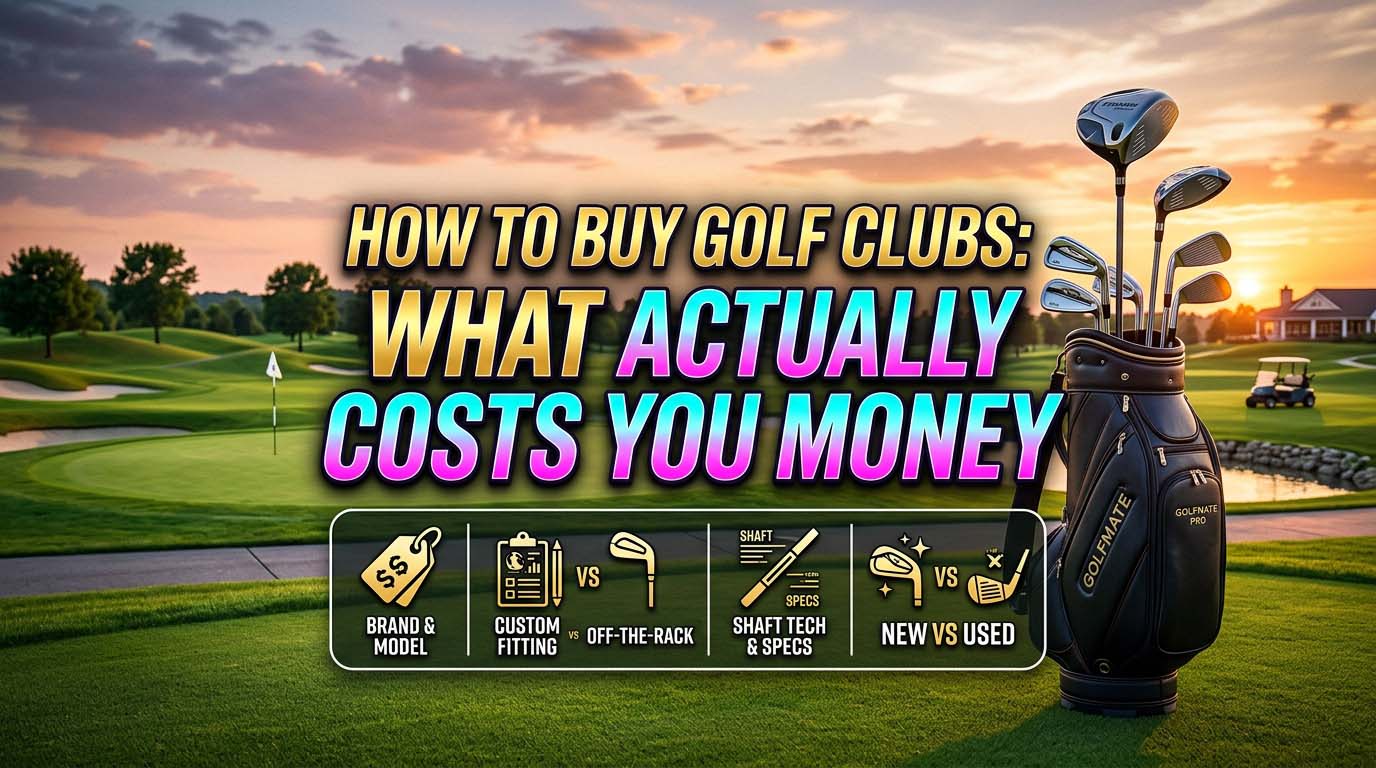
Buying golf clubs comes down to five decisions, not one: new versus used, fitted versus off-the-rack, a complete set versus building a bag piece by piece, brand premium versus measurable performance, and how much authenticity risk you are willing to accept for a lower price. Each decision moves money in a different direction, and most of the money wasted on golf clubs is lost on the wrong one of these, not on picking the wrong brand. The single biggest avoidable loss is buying a club that is not what it was described as, whether that means it is more worn than stated or it is not a genuine club at all.
This guide walks through those five decisions in the order they actually matter, and points to a deeper answer for the two that carry the most risk: buying used, and verifying that a club is real.
New versus used: the first decision, and the biggest swing in price
New clubs come with a full warranty, a known condition, and a known specification. Used clubs cost meaningfully less and, on irons and wedges from the last two or three model years, the performance gap is small enough that the savings usually win. The trade-off is that "used" hides a range of conditions from lightly hit to genuinely worn out, and it introduces a second risk that new retail purchases mostly avoid: you cannot always be certain the club is what the listing says it is. That second risk deserves its own decision, covered below and in full in Buying Used Golf Clubs: What Wears Out and What Never Does.
Fitted versus off-the-rack
A fitting matches shaft flex, lie angle, and length to your swing rather than a generic average. It costs money and time up front, and it matters most for a driver and for irons you will hit often, less for a wedge or a putter you might only carry as a spare. If you are buying off-the-rack because a fitting is not in the budget yet, the safest move is to buy a stock configuration close to a common fitting result (a middle-of-the-road shaft weight and flex for your swing speed) rather than an outlier spec that only works if it happens to match you.
Complete set versus building a bag piece by piece
A complete boxed set is the simpler purchase and usually the better value per club for a first bag. Building a bag one club at a time costs more per piece but lets you skip clubs you would not use and put the saved money toward a better driver or putter. Neither is wrong; the mistake is buying a full 14-club set and then never touching four of them.
Brand premium versus measurable performance
Two clubs from different brands with similar loft, similar shaft weight, and similar head design will usually perform closer to each other than the price difference suggests. Some of what you pay for a premium brand is genuinely better manufacturing tolerance and materials; some of it is marketing. Because manufacturers do not consistently publish independently verified distance or spin numbers in a way a buyer can check before purchase, the only claim worth treating as fact here is the one you can verify yourself or that traces to a named, checkable source, not a number printed on a hangtag.
Authenticity risk: the decision most guides skip
This is the decision that costs people the most when it goes wrong, because a counterfeit club is not a worn club, it is not the club at all. The risk shows up in exactly two places: buying used from an individual seller, and buying new-in-box at a price that is meaningfully below what every authorized retailer charges. Both situations are common and both are manageable, but they require actually looking at the club rather than trusting the listing photo.
How to Spot Fake Golf Clubs Before You Pay covers the physical checks that catch a counterfeit reliably: ferrule and hosel finish, paint fill precision, shaft label print quality, weight and grind consistency, and headcover print quality, all compared against a manufacturer's own official product photos. A lot of buying advice tells you to "check the serial number" and stops there. Serial numbers are worth checking, but they are not a universal proof of anything, and how much they prove differs by manufacturer. Golf Club Serial Numbers: What They Prove and What They Don't explains what each major brand actually offers a consumer, and where no self-serve check exists at all.
What buying decisions do not include
Whether a club conforms to the Rules of Golf is a separate question from whether it is genuine. A perfectly authentic driver can still be non-conforming for competition play, and that has nothing to do with counterfeiting. If you play in any kind of sanctioned or club competition, The Equipment Rules That Actually Affect Amateur Golfers covers the handful of rules that actually come up, separate from the buying decisions here.
A short framework before you buy anything
Before paying for a club, new or used, ask four questions in this order:
- Does the price make sense for the condition and the channel it is sold through? A price meaningfully under what an authorized retailer or a reputable pre-owned program charges for the same model and condition is the single strongest early warning sign, more reliable than any single photo.
- Does the physical club match the manufacturer's own product photos in finish, paint fill, and labeling, not just in silhouette?
- If it is used, what is the actual wear on the grooves, the shaft, and the grip, not just the cosmetic condition of the head?
- Can you get a second opinion or return the club if something does not check out once it arrives?
None of these require special equipment or expert knowledge. They require slowing down before paying, which is the one step almost every bad golf club purchase skips.
FAQ
Should a beginner buy new or used golf clubs?
Used is usually the better value for a first set, especially irons and wedges from the last two or three years, as long as you check for wear and confirm the clubs are genuine. New clubs make more sense when the warranty and a certain condition matter more than the savings.
How much does a golf club fitting cost?
Fitting cost varies widely by retailer and how many clubs are being fitted, so treat any specific number you see as a starting estimate for that retailer rather than a fixed price, and confirm current pricing directly before booking.
Is it worth buying a full set instead of individual clubs?
For a first bag, a complete set is usually the simpler and better-value choice. Building a bag club by club makes more sense once you know which clubs you actually use and want to upgrade selectively.
What is the single biggest red flag when buying a golf club?
A price that is well below what every authorized retailer and reputable pre-owned program charges for the same model and condition. That gap is either an unusually good deal or a sign of a counterfeit or misrepresented club, and it is worth treating as the second, not the first.
Do all golf brands offer the same protections when buying used?
No. Manufacturer pre-owned programs, warranty transfer policies, and counterfeit reporting all vary by brand. Checking the specific manufacturer's own page for the model you are buying is more reliable than assuming one brand's policy applies to another.